Stop wasting time on basic search. Discover the 12 best academic search engines for peer-reviewed journals and AI-powered research in 2026. Find data faster.
Stop Using Basic Search for Your Research
Still relying on a standard Google search for your thesis or white paper? You’re likely missing most of what actually matters. General search engines are great for finding a pizza place. They’re a poor fit for peer-reviewed, high-impact scholarly work, since specialized databases index parts of the web general search barely touches: journals, patents, and institutional repositories.

If you want verified data, specialized databases are where it lives. By the end of this guide, you’ll know which tools to use to find better sources in less time. For a broader view of how these fit into the wider search landscape, see our Top Search Engines List: 12 Best Platforms for Traffic (2026).
1. Google Scholar: The Most Comprehensive Search Engine for Peer-Reviewed Journals
Google Scholar remains the default starting point. It’s massive, it’s free, and it indexes nearly every format of scholarly literature globally, from court opinions to technical reports. What it lacks is the surgical precision of newer AI-native tools, so you get real signal mixed with real noise.
The “Cited by” feature is still the standout: it lets you track how an idea has spread and grown over time. Google also rolled out Scholar Labs, an AI research assistant that breaks a complex question into its component parts, runs multiple searches against Scholar, and summarizes how each result addresses your question, worth trying for a broad first pass, though it’s still worth reading the source rather than trusting the summary outright. Use Google Scholar to cast a wide net before switching to more specialized tools.
2. Semantic Scholar: AI-Powered Search for Academic Research
If Google Scholar is the library, Semantic Scholar is closer to a research assistant. It uses AI to understand the context of a paper rather than just matching keywords, which helps when you know roughly what you’re looking for but not the exact terminology for it. It also surfaces “highly influential citations,” so you can see which papers actually moved the field rather than just accumulated citations.
The “TL;DR” feature is genuinely useful: a one-sentence summary of every paper lets you scan a hundred results in a few minutes. For more on this category of tool, see our guide to 7 Top AI Powered Search Engines for Research (2026 Guide). Semantic Scholar earns its place by filtering for impact rather than popularity.
3. Consensus: The Best AI Search Engine for Evidence-Based Scientific Answers
Consensus takes a different approach entirely. Instead of searching “impact of vitamin D on sleep,” you ask “does vitamin D improve sleep?” and the engine analyzes the literature and returns a Consensus Meter showing roughly what share of relevant studies land on yes versus no.
It’s a useful first check for debunking a claim or finding solid ground before you commit to one, and it pulls from peer-reviewed sources rather than blogs or opinion pieces. Treat the meter as a starting signal rather than a final verdict, since it reflects how the underlying studies are worded and framed as much as what they found. For niche cases it doesn’t cover well, see 10 Best Academic Search Engines Beyond Google Scholar (2026).
4. CORE: The Open Access Powerhouse
CORE (Connecting REpositories) is a nonprofit aggregator of open-access research, pulling from thousands of repositories worldwide. If a paper is legally available for free, CORE is one of the most reliable places to find it, which makes it especially valuable for independent researchers without a university library login.
CORE isn’t just a search bar. It also provides an API that other research tools are built on top of, and it’s a strong source for pre-prints and older studies that can get buried elsewhere. You always know exactly where the data came from, which matters more than it sounds like it should when you’re citing something.
5. PubMed: The Gold Standard for Medicine and Life Sciences
If your research is in medicine or the life sciences, PubMed is home base. Maintained by the National Library of Medicine, it indexes tens of millions of citations and remains the most authoritative source for clinical trials and biological research. The interface is built for people who already know the field, which means it rewards learning MeSH (Medical Subject Headings) rather than free-text keywords.
PubMed’s own recent updates have focused on the practical side: better reference-list rendering, date stamps on saved searches, and cleaner sharing tools, not flashy AI features. What it does offer is genuinely useful filtering: narrow results by study type, “Randomized Controlled Trial” or “Systematic Review” among them, which is a big part of why it stays at the top of this list despite the plainer interface. For a deeper list of specialized tools in this space, see our guide to Medical Search Engines for Healthcare Professionals (2026).
6. ResearchGate: The Social Network for Scientists
ResearchGate is part search engine, part social network. Researchers upload their own papers here, sometimes including full-text versions you can’t find anywhere else, and you can follow or message authors directly to ask about their data. It makes research feel considerably more human than a database.
The catch: not everything on ResearchGate is peer-reviewed, since authors upload their own content. Always check the journal name and date before treating something as settled. ResearchGate’s verified badge, worth knowing about since it’s often misunderstood, confirms an author’s institutional affiliation through their university email, not the quality or replication status of their research, so a verified badge tells you who someone is, not whether their findings held up. It’s still a strong place to find the very latest work before it hits the major journals.
7. OpenAlex: The Successor to Microsoft Academic
Microsoft Academic was shut down years ago, but the underlying idea lives on through OpenAlex, a fully open, free catalog of the global research system built on that legacy. It tracks authors, institutions, and journals in a genuinely connected way, which enables complex queries most search engines can’t handle, something like “all papers on AI ethics published this year by researchers in Germany.”
If you’re building your own research tools or doing bibliometric analysis, OpenAlex is the place to start. It’s the engine quietly powering a lot of the “fancy” AI research tools you interact with elsewhere.
Specialized Databases for Niche Research
Beyond the tools above, a handful of specialized databases matter a lot if your work sits in a specific discipline:
- JSTOR: A deep digitized backlog of academic journals in the social sciences and humanities, much of it behind paywalls that general search and AI tools struggle to index.
- arXiv.org: The essential hub for physics, mathematics, and computer science pre-prints, often the first place breakthrough research surfaces, well before formal peer review.
- ScienceDirect: Elsevier’s large database of peer-reviewed scientific and medical publications.
- ERIC (Education Resources Information Center): Purpose-built for education research, indexing everything from journal articles to policy papers.
- BASE (Bielefeld Academic Search Engine): One of the largest search engines dedicated specifically to academic web resources, with access to hundreds of millions of documents.
Using these alongside the tools above ensures you’re finding what’s scientifically rigorous for your field, not just what’s broadly popular.
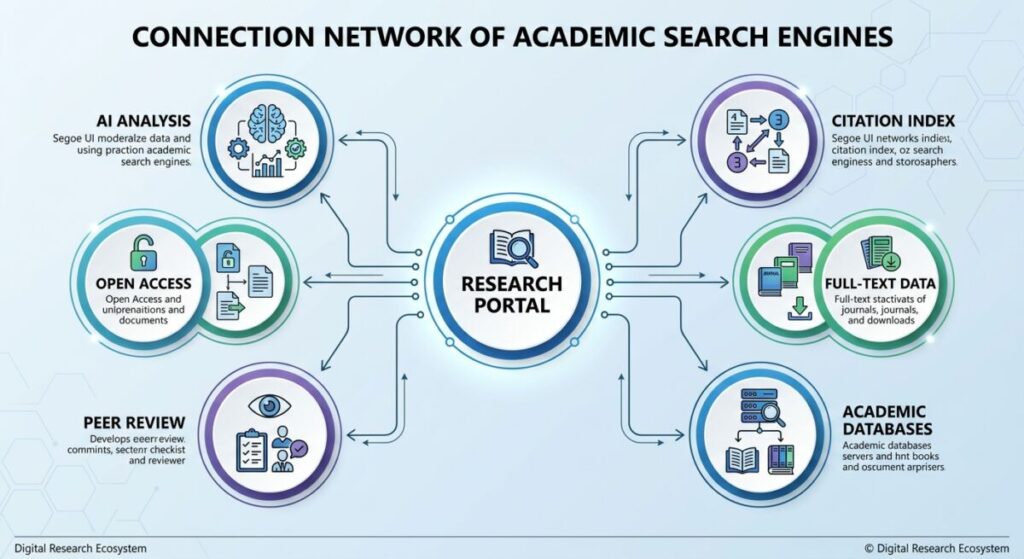
2026 Comparison: Which Scholarly Search Engine Is Right for You?
Choosing the right tool depends on the task in front of you. Here’s how the top contenders stack up:
| Feature | Google Scholar | Semantic Scholar | Consensus | CORE |
|---|---|---|---|---|
| Primary Strength | Database Size | Contextual AI | Evidence Synthesis | Open Access |
| AI Summaries | Yes (Scholar Labs) | Yes (TL;DR) | Yes (Consensus Meter) | Partial |
| Citation Tracking | Excellent | Highly Influential Only | Moderate | Basic |
| Best For | General Research | Literature Reviews | Fact-Checking | Free Full Texts |
As a general rule, start broad with Google Scholar, then move to Semantic Scholar for a deeper contextual pass. If your research is medical, our list of Medical Search Engines for Healthcare Professionals (2026) goes further into that specific territory.
How to Choose the Right Engine
It depends on the goal. Doing a broad sweep of a new topic: start with Google Scholar. Need a quick, evidence-backed answer to a specific question: go to Consensus. Looking for a free full text: CORE is the best bet. Most experienced researchers use at least three of these together, since relying on one alone means inheriting that one tool’s blind spots and ranking biases.
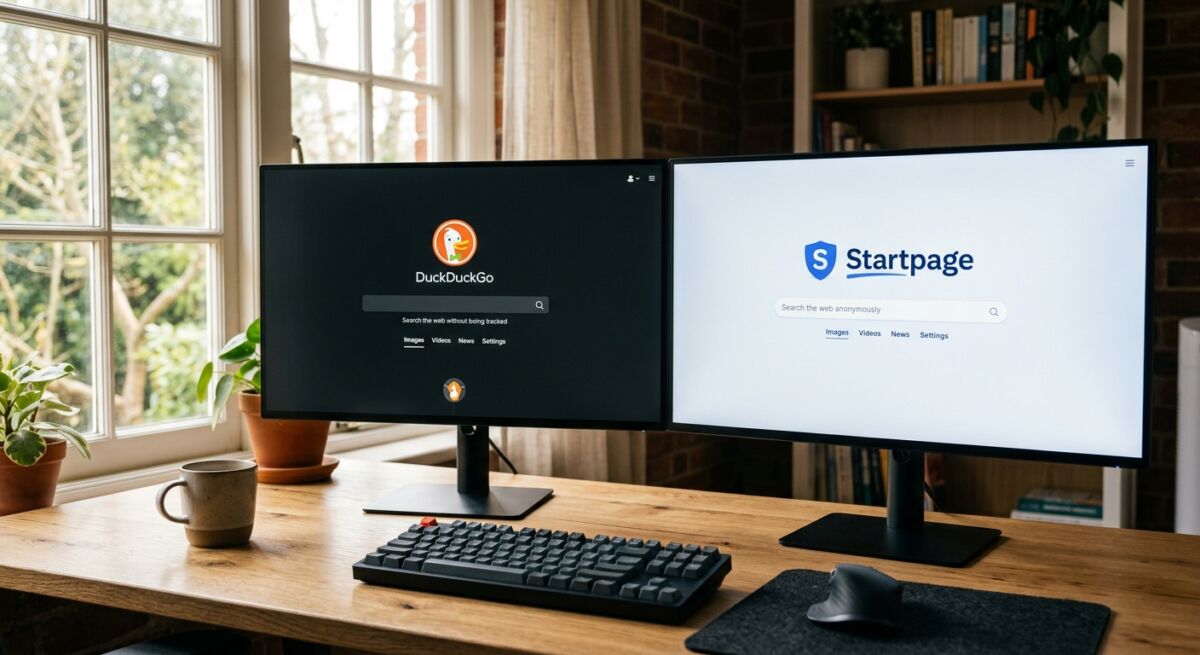
Privacy matters here too, especially for sensitive or commercially relevant topics. If you’re researching something you’d rather not leave a clear trail on, our comparison of DuckDuckGo vs Startpage for Privacy in 2026 covers how to keep that search history off the open web.
Common Research Mistakes to Avoid
The most common mistake is searching with a single keyword and stopping there. Research is iterative: find a paper, note its actual keywords and terminology, then search again with better language. A second common mistake is ignoring publication date. In fast-moving fields like AI or medicine, a paper from a few years ago can already be outdated, so filtering for the last one to two years is usually worth doing when currency matters.
Finally, don’t trust the abstract alone. Abstracts function like movie trailers: they show the best parts and can genuinely mislead. Always check the methodology section. Was the sample size large enough? Was there a control group? Those questions separate a good researcher from a mediocre one, far more reliably than a catchy headline does.
Optimizing Your Research Workflow: From Search to Citation
Finding the paper is only half the job. Most active researchers now pair a tool like Semantic Scholar or Consensus with a reference manager, Zotero or Mendeley are the two most common, using the export citation button to move sources directly into a bibliography rather than retyping anything.
There’s also a newer consideration worth knowing about: how AI tools decide which sources to cite when answering a question, sometimes called Generative Engine Optimization (GEO). If you want your own work to be findable this way, keeping your papers properly indexed on ORCID and your Google Scholar profile matters more than it used to, since that’s part of what AI systems use to establish who you are and what you’ve published. For more on this, see our guide to 7 Proven GEO Strategies for AI Brand Citations in 2026.

FAQ
What is the best search engine for academic research for free?
Google Scholar and CORE are the strongest free options for most people, giving access to millions of papers with no subscription required.
Is Google Scholar still relevant?
Yes, it remains the largest single index of scholarly work. Most researchers now pair it with a more precise AI-powered tool like Semantic Scholar rather than relying on it alone.
How can I find scholarly articles for free?
Use CORE, or the open-access filter on engines like BASE. ResearchGate is also worth checking for author-uploaded versions of otherwise paywalled papers.
What’s the difference between a search engine and a database?
A search engine like Google Scholar indexes broadly across the web. A database like PubMed is a curated collection of a specific type of literature, and usually offers more precise filtering as a result.
Which AI search engine is best for students?
Consensus tends to work well for students specifically because it gives a direct, evidence-weighted answer to a question rather than a list of results to interpret.
Are results on ResearchGate peer-reviewed?
Not always. Plenty of peer-reviewed work is hosted there, but anyone can upload their own papers, so verifying the source yourself is still necessary.
How do I cite a paper I found online?
Most academic search engines include a “Cite” button. Always double-check the generated citation against whatever style guide you’re required to use, APA or MLA most commonly.
What’s the most accurate academic search engine?
PubMed and Web of Science are generally considered among the most accurate, largely because of how strict their indexing standards are for which journals get included at all.
The Future of Research Is Here
Finding the right search engines for academic research is only the start. The real skill in 2026 is using several of these tools together, fast enough to stay efficient and careful enough to stay accurate. Don’t let a weak search strategy hold a strong piece of research back.
At Infineural Technologies, we help businesses and researchers navigate the complex world of search and data, whether that means an SEO strategy or custom research tooling. Contact Infineural Technologies today, and let’s build something worth citing.
Infineural is a digital marketing, development and hosting company based in Nashik, India, founded in 2018. It runs SEO, Google Ads, performance and WhatsApp marketing, builds custom WordPress sites, web apps and mobile apps, manages hosting, and makes Infineural CRM and WhatsInfi. Every engagement starts with a written scope and runs through a client dashboard showing the work log, billing and results.
- Search Engine & Generative Engine Optimization Specialists
- Google Ads Management & Performance Marketing Experts
- Advanced WordPress & Custom Web Application Developers
- B2B, D2C & Enterprise Conversion Rate Optimization (CRO) Leaders
- Digital Growth Partners for Hospitality, Healthcare, and Education