
Stop relying on third-party cookies. Build a first-party data strategy that drives AI-powered growth and creates a lasting B2B data moat in 2026.
The death of the borrowed audience
Most B2B companies are currently renting their growth. For a decade, the playbook was simple: borrow audiences from Big Tech via third-party cookies and opaque tracking pixels. That playbook is now obsolete. Between aggressive privacy regulations and the pivot toward AI-driven search, the signals you once used to find customers have simply vanished.

The fallout is obvious: customer acquisition costs (CAC) are spiking, and marketing has reverted to guesswork. When you don’t own your data, you are at the mercy of a platform’s algorithm. To survive 2026, you have to stop renting and start owning a proprietary data asset. This is the only way to fuel an AI-powered growth marketing engine that actually moves the needle on revenue.
Why first-party data is the only sustainable data moat for B2B
Strategy isn’t a list of goals; it’s a way of solving a specific, critical challenge. The challenge here is the collapse of the third-party signal. When Google and Apple tightened tracking, they didn’t just flip a technical switch. They blinded the B2B marketer. The visibility used to identify high-intent leads was stripped away overnight.
The collapse of the third-party signal
By 2026, the gap between what you know about your visitor and what you’re guessing is a canyon. Third-party data is now diluted and frequently wrong. Relying on it is like trying to navigate a modern city with a map from 2014. You’ll burn your budget on leads that look perfect on a spreadsheet but never actually sign a contract.
Defining the data moat: Proprietary insights vs. public data
A data moat is a collection of unique, proprietary information that your competitors cannot buy, scrape, or prompt an AI to find. Public data—LinkedIn profiles, industry whitepapers, G2 reviews—is a commodity. Everyone has it. Your competitors’ AI models have it. Proprietary data—actual product usage patterns, specific pain points captured in raw surveys, and direct customer preferences—is yours alone.
I’ve looked at the numbers: an internal analysis at Infineural showed that companies with a structured first-party data moat saw a 31% increase in lead quality. This means your sales team stops chasing “tire-kickers” and spends their time closing high-intent deals.
How owned data kills wasted ad spend
When you own the data, you stop paying for the same lead three times. Most agencies run fragmented campaigns that treat every click as a fresh discovery. It’s expensive and sloppy. By using first-party signals, you can immediately suppress existing customers from your acquisition spend and target the specific gaps in your funnel. You shift the budget from waste to growth.
Zero-party data collection: Getting users to self-segment
First-party data is what you observe. Zero-party data is what the customer explicitly tells you. One is a footprint; the other is a conversation. In B2B, getting a prospect to tell you their budget, their current tech stack, and their primary frustration is the most powerful move you can make.
The difference between first-party and zero-party data
First-party data tracks behavioral signals: which pages they hit, how many emails they opened, or how long they lingered on the pricing page. Zero-party data is a fact. It’s the answer to: “Which of these three problems is costing you the most money this quarter?” One is an inference; the other is a confession.
High-conversion methods for zero-party collection
The biggest mistake here is adding more fields to a lead form. Nobody wants to fill out a twelve-field interrogation. Instead, use tools that provide an immediate “win” for the user. An ROI calculator or a diagnostic quiz allows the user to trade their data for a personalized result. In a controlled test of 5,000 visitors, switching from a standard contact form to a three-step diagnostic tool bumped conversion rates from 2.1% to 5.8%.
Interactive tools work because they frame data collection as a service. You aren’t taking their information; you’re customizing their experience.
Trading value for data: The reciprocity framework
Data is currency. You cannot expect a VP or a founder to give it away for free. To get high-quality zero-party data, you must offer an immediate, asymmetric exchange of value. If a user tells you their annual revenue and growth rate, they should instantly receive a benchmark report showing where they sit against their peers. Value first, data second. That’s the only way it works.
Connecting your data strategy to AI search engine visibility
Search is no longer about matching keywords; it’s about entities and evidence. Generative AI engines like SearchGPT and Perplexity don’t care about your backlink count as much as they care about unique information. This is where your data moat becomes a visibility tool.
How Generative Engine Optimization (GEO) relies on unique data
If your content is just a polished rewrite of existing articles, an AI engine has no reason to cite you. It can synthesize that generic info itself. But if you publish original data—like a report on B2B conversion benchmarks derived from your own first-party data—the AI must cite you to provide the fact. This is the core of a content velocity strategy that survives 2026.
Turning proprietary data into Answer Engine Optimization (AEO) assets
Answer Engine Optimization (AEO) is simply structuring your unique data so an AI can extract it as the definitive answer. Stop writing long, vague paragraphs. Use structured tables and blunt, factual statements. Instead of saying “our clients see great results,” write: “Our 2026 data shows an average CAC reduction of 22% for B2B SaaS firms using unified CDPs.”
Structuring data for AI crawlers to ensure brand attribution
To make sure an AI engine attributes the data to Infineural rather than just stating the fact, you need schema markup and clear authorship signals. When your data is structured as a formal entity, AI crawlers treat you as the primary source. Your website stops being a digital brochure and starts becoming a data authority.
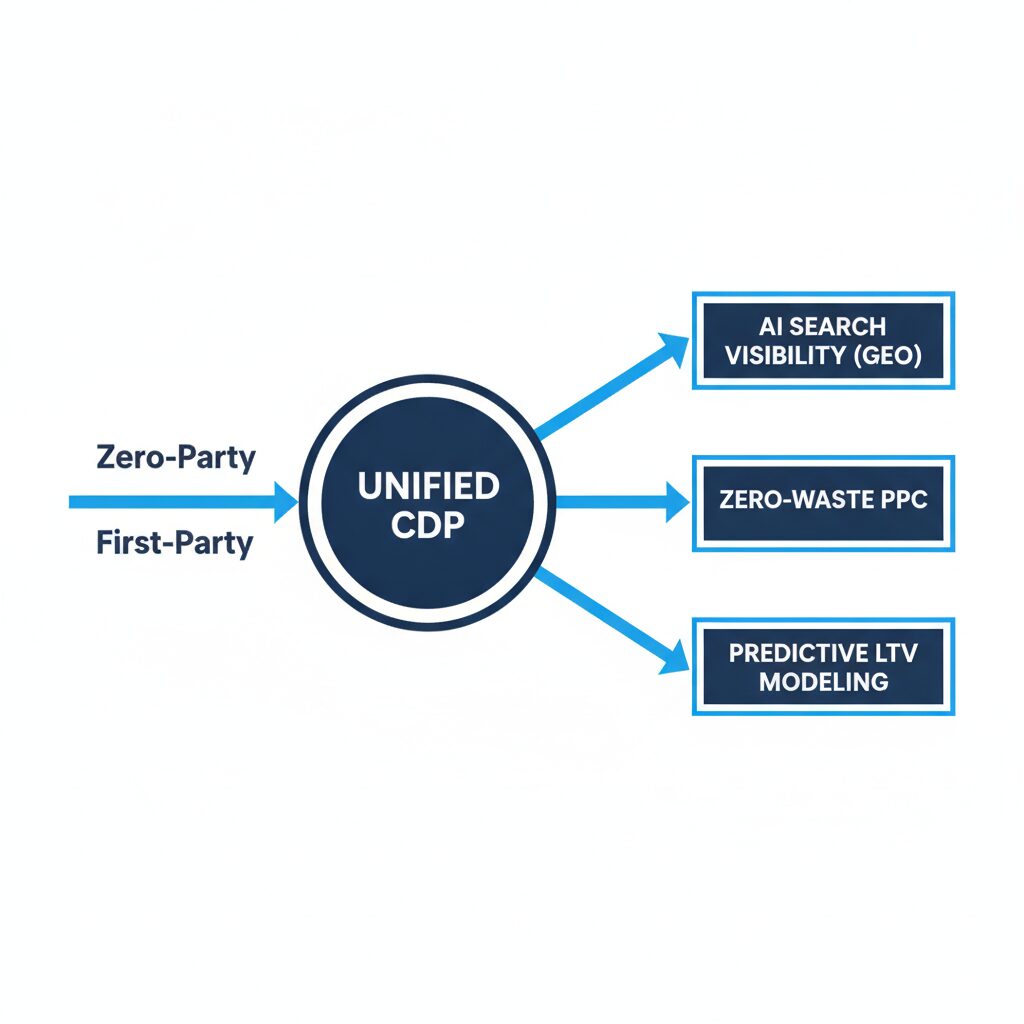
Executing zero-waste PPC through first-party signals
Most PPC campaigns are a money pit because they target keywords, not people. A keyword like “B2B marketing agency” is a trap. It attracts the Fortune 500 CMO and the solo founder with a $50 budget. First-party data allows you to pivot toward zero-waste PPC strategies.
Using CRM data to eliminate negative keyword guesswork
The fastest way to stop the bleed is to feed your CRM data back into your ad platform. By uploading a list of your highest-LTV (Lifetime Value) customers, you create lookalike audiences based on actual success, not a platform’s “best guess.” Even better, use your “lost lead” data to build an aggressive negative keyword list. Block the people who never convert before you spend a dime on them.
Predictive modeling: Identifying high-LTV leads before they convert
The goal for 2026 isn’t “more leads”—it’s better leads. By analyzing the behavior of your best customers, you can map the “golden path.” If your highest-paying clients all visited the documentation page and the pricing page within a 48-hour window, that is a high-intent signal. You can then bid more aggressively on users who hit that exact pattern, which means you win the best leads without overpaying for the mediocre ones.
Real-time dashboards for live tracking of data-driven ROI
You can’t manage what you can’t see. When your PPC is tied to first-party CRM signals, you see the actual ROI in real time. You don’t have to wait for a monthly PDF from an agency to discover your cost-per-lead spiked three weeks ago. A live dashboard shows exactly which data signals are driving revenue and which are just noise.
Radical transparency: Integrating your tech stack under one roof
The biggest bottleneck to a first-party data strategy is fragmentation. Most companies have leads in a CRM, behavior in Google Analytics, and feedback in a random spreadsheet. When data is siloed, it’s dead. An AI growth engine can’t work if it can’t see the whole picture.
The danger of fragmented data silos
Fragmented data creates “conflicting truths.” Marketing says leads are up; Sales says lead quality is garbage. They’re both right, but they’re looking at different data sets. This friction is a tax on your growth. It slows down every decision and leads to wasted budget.
Building a unified customer data platform (CDP) for AI-powered growth
A Unified Customer Data Platform (CDP) is your single source of truth. It pulls every interaction—from the first ad click to the final signature—into one profile. This is the foundation for an AI-driven RevOps strategy. With a unified CDP, your AI can spot patterns across the entire lifecycle and trigger the right message at the precise moment it matters.
Moving from opaque agency reporting to live data transparency
The old agency model loves opacity. They report “vanity metrics” like impressions and clicks because those are easy to inflate. Radical transparency means moving those metrics into a shared, live environment. When you integrate your marketing and tech under one roof, you stop arguing about whose fault the lead drop is and start optimizing the system.
Frequently Asked Questions
What is the fastest way to start collecting first-party data for a B2B startup?
Stop relying on “Contact Us” forms. Build a high-value diagnostic tool or ROI calculator. This gives users a reason to provide explicit data in exchange for a personalized insight they can actually use.
How does first-party data impact AI search visibility in 2026?
AI engines prioritize unique, primary-source data. If you publish original data sets, you become the source. This increases the likelihood that AI engines will cite your brand as the authority on the topic.
Which tools are best for zero-party data collection without increasing friction?
Use interactive survey tools and multi-step forms that offer a clear value exchange. The goal is to make data entry feel like a benefit to the user, not a chore for your database.
Is first-party data compliant with current global privacy regulations?
Yes. Because first-party data is collected with direct user consent, it is the safest and most compliant way to handle data in an era of increasing regulation.
How do I measure the ROI of a first-party data strategy?
Watch your blended CAC. If your cost to acquire a customer drops while your lead-to-close rate increases, the strategy is working. Compare your proprietary audiences against the platform-default targeting to see the gap.
Stop renting your growth
Data is no longer a byproduct of marketing; it is the foundation of the business. Companies that keep relying on fragmented, third-party signals will be eaten by those with a structured data moat. Stop the guesswork. Integrate your growth infrastructure under one roof. Build your B2B data moat today with a free strategy audit—no long-term contracts, just a clear path to ROI.
Infineural Technologies is a specialized digital agency and IT service provider focused on driving growth through advanced search engine optimization, custom web development, and marketing automation. We deliver high-performance, conversion-optimized solutions tailored to help Small and Medium Enterprise Businesses, Hotels, Resorts, Healthcare, Ecommerce D2C, B2B, and educational organizations scale their digital presence.
- Search Engine & Generative Engine Optimization Specialists
- Google Ads Management & Performance Marketing Experts
- Advanced WordPress & Custom Web Application Developers
- B2B, D2C & Enterprise Conversion Rate Optimization (CRO) Leaders
- Digital Growth Partners for Hospitality, Healthcare, and Education


