Discover the top 50 search engines for 2026. From AI-native platforms to privacy-first engines, learn where your audience is searching beyond Google.
The State of Search in 2026
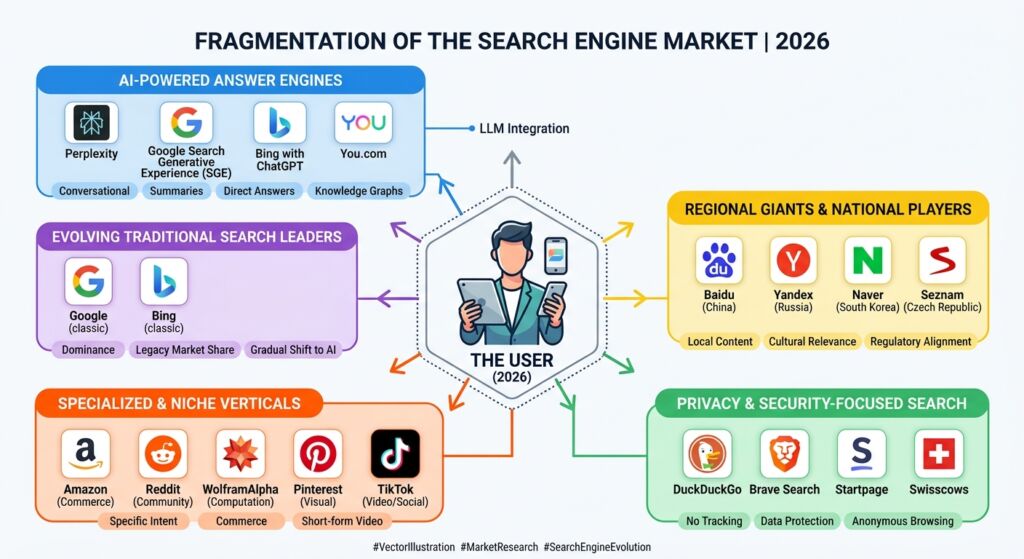
Google remains the giant, but the search market has fragmented. In 2026, users no longer rely on a single box for every query. They use AI engines for research, privacy engines for sensitive tasks, and vertical engines like Amazon or TikTok for shopping and entertainment. If you only optimize for one platform, you are leaving 40% of your potential reach on the table.

In our work at Infineural Technologies, we have seen brands double their organic visibility by targeting the specific platforms where their audience actually hangs out. This list identifies the 50 most relevant search engines today, categorized by how people use them to find information.
The Big Three: General Purpose Engines
Google continues to hold the largest market share, currently sitting at 89.2% as of April 2026. However, the experience has shifted toward AI-generated answers. To stay visible here, you need a solid strategy for AI Overview Optimization to ensure your brand appears in the generated summaries.
Microsoft Bing has gained ground by integrating deep GPT-5 functionality directly into the OS. It is the default for corporate environments and older demographics. If your audience is B2B, Bing is often more cost-effective for ads than Google.
Yahoo still exists, primarily powered by Bing. It remains a top choice for news and finance-heavy users. It serves as a secondary traffic source that requires almost no extra effort if you already rank on Bing.
AI-Native Search Engines
Perplexity AI has become the gold standard for conversational research. It cites sources directly, making it a high-intent traffic driver for authoritative blogs. You.com offers a customizable search experience where users choose which sources to prioritize. Andi focuses on a distraction-free, ad-free interface that provides direct answers. Genspark uses specialized AI agents to build custom research pages for complex queries. SearchGPT by OpenAI provides a real-time bridge between the LLM and the live web, often acting as the primary search tool for ChatGPT Plus users.
Privacy-First Search Platforms
Privacy is no longer a niche concern. In 2026, roughly 12% of US users prefer engines that do not track their data. DuckDuckGo leads this category, recently surpassing 100 million daily queries. Startpage provides Google results without the tracking, which is a great middle ground for those who want quality without the surveillance. You can see a detailed breakdown of DuckDuckGo vs Startpage to see which fits your browsing habits.
Brave Search uses its own independent index and is built into the Brave browser. Swisscows is a family-friendly option based in Switzerland with strict data laws. Qwant is the European alternative that emphasizes local privacy regulations. Mojeek is one of the few engines with its own crawler that does not rely on Big Tech indexes.
Specialized and Vertical Search
People often skip general engines entirely when they know exactly what they want. Amazon is the primary search engine for products. YouTube remains the second largest search engine globally for video content. Reddit is where people go for authentic human opinions; if you want to find specific discussions, there are several Reddit search engines designed just for this.
Pinterest acts as a visual discovery engine for DIY and fashion. TikTok has become the primary search tool for Gen Z looking for quick tutorials or reviews. LinkedIn is the search engine for professional networking and B2B lead generation. Giphy and Unsplash are the go-to tools for finding specific visual assets.
Academic and Scholarly Research Engines: Beyond Google Scholar
In 2026, the demand for verified, peer-reviewed data has skyrocketed as AI-generated misinformation becomes more prevalent. While Google Scholar remains a staple, specialized academic search engines offer deeper indexing of repositories that general crawlers often miss. For researchers and high-authority content creators, these platforms are essential for finding primary sources.

Developer-Centric and Technical Search Engines
The developer community in 2026 has moved away from general-purpose search for debugging and code discovery. Technical search engines now prioritize syntax highlighting, documentation indexing, and repository search. If you are marketing a SaaS product or a technical tool, appearing in these indexes is more valuable than a high-volume Google rank.

Where Developers Search in 2026
- GitHub Search: The primary engine for discovering open-source logic and library implementations.
- Stack Overflow: Still the leading community-driven search for troubleshooting, though now heavily integrated with AI-summarized solutions.
- Grepper: A specialized tool that provides ‘cheat sheet’ style answers directly in the search results for developers.
- Symbolhound: One of the few engines that allows searching for special characters, which is crucial when looking for specific code symbols or operators that Google ignores.
- Phind: An AI search engine specifically optimized for developers, providing detailed explanations alongside code snippets.
Optimizing for these platforms requires a different technical approach. You can find more specialized tools in our guide on the best search engines for developers to find code snippets. By diversifying into these niches, technical brands can bypass the high competition of general search results.
The Top Research Platforms for 2026
- Microsoft Academic: Re-emerged with enhanced semantic search capabilities, mapping relationships between authors, papers, and field of study with high precision.
- BASE (Bielefeld Academic Search Engine): One of the world’s most voluminous search engines for academic web resources, providing access to over 300 million documents from more than 10,000 sources.
- CORE: Aggregates millions of open-access research papers, making it a goldmine for those who need full-text access without paywalls.
- Semantic Scholar: Uses AI to highlight the most influential papers and identify connections between disparate research topics.
- WolframAlpha: Not a search engine in the traditional sense, but a ‘computational intelligence’ engine that provides direct answers for mathematics, science, and socio-economic data.
For a deeper dive into these tools, explore our comprehensive list of the best search engines for academic research beyond Google Scholar to streamline your data collection process. Leveraging these platforms allows brands to build ‘Information Gain’ into their content, a critical ranking factor in the 2026 SEO landscape.
International and Regional Giants
If you are looking for global expansion, you cannot ignore regional leaders. Baidu dominates China with over 75% market share. For a full strategy, check out the 7 popular search engines in China. Yandex is the leader in Russia and several CIS countries. Naver is essential for the South Korean market, operating more like a social portal than a traditional search box. Petal Search is Huawei’s answer to Google, serving millions of users on devices without Google Play Services.
Meta-Search Engines and The Future of Decentralized Search
Meta-search engines act as aggregators, pulling results from multiple indexes to provide a broader overview of the web. In 2026, these are favored by power users who want to avoid the ‘filter bubble’ created by personalized algorithms. Simultaneously, Web3 search engines are emerging as a way to index decentralized content on the blockchain.
Key Meta and Web3 Players
- Dogpile: Fetches results from Google, Yahoo, and Bing, curating the best of the ‘Big Three’ in one interface.
- SearXNG: A privacy-respecting, hackable metasearch engine which allows users to host their own instances, ensuring 100% anonymity.
- Ecosia: While a meta-searcher (powered by Bing), its primary draw is its environmental impact. To understand the mechanics, read our guide on how eco-friendly search engines plant trees.
- Presearch: A decentralized search engine that rewards users with cryptocurrency, gaining massive traction in the Web3 space.
Understanding how meta search engines differ from traditional engines is vital for any multi-channel traffic strategy. For those looking ahead, mastering Web3 search will be the next frontier in digital marketing autonomy.
Academic and Professional Search
For high-level research, general tools often fail. Google Scholar is the most well-known, but Semantic Scholar uses AI to identify connections between papers. WolframAlpha is a computational engine that answers math and data questions directly. PubMed is the essential tool for healthcare professionals; you can find more in our list of medical search engines. Phind and Stack Overflow are the primary search tools for developers seeking code solutions.
Eco-Friendly and Social Impact Engines
Some engines use their ad revenue for good. Ecosia plants trees with the profits from your searches. According to Ecosia’s 2026 report, they have planted over 250 million trees to date. OceanHero uses revenue to recover plastic from the ocean. GiveWater funds clean water projects in developing nations. These platforms allow users to contribute to global causes through their daily digital habits.
The Full List of 50 Search Engines for 2026
1. Google
2. Microsoft Bing
3. Yahoo
4. Perplexity AI
5. You.com
6. DuckDuckGo
7. Baidu
8. Yandex
9. Naver
10. Ecosia
11. Amazon
12. YouTube
13. TikTok
14. Pinterest
15. Reddit
16. Brave Search
17. Startpage
18. SearchGPT
19. Andi Search
20. Genspark
21. Swisscows
22. Qwant
23. Moje her
24. Petal Search
25. Sogou
26. Shenma
27. WolframAlpha
28. Google Scholar
29. Semantic Scholar
30. PubMed
31. Phind
32. Stack Overflow
33. Archive.org (Wayback Machine)
34. Giphy
35. Unsplash
36. Boardreader
37. Million Short
38. Gigablast
39. Lycos
40. Ask.com
41. AOL Search
42. Dogpile
43. MetaGer
44. Excite
45. OceanHero
46. GiveWater
47. SearchScene
48. CC Search (Openverse)
49. Slideshare
50. Scribd
For a deeper look at the most effective platforms for marketing, see our Top Search Engines List: 12 Best Platforms for Traffic (2026). Understanding this variety is the first step in moving away from Google-dependency.
Frequently Asked Questions
Which search engine is the most private in 2026?
DuckDuckGo and Startpage remain the leaders, but Brave Search is quickly becoming a favorite for its independent index. All three avoid tracking user data or creating search profiles.
How does AI search differ from traditional search?
Traditional search provides a list of links for you to click. AI search engines like Perplexity or SearchGPT synthesize information from multiple sources to give you a direct answer.
Is Google still the best search engine?
Google has the largest index and best local data, but it is often cluttered with ads. For specialized tasks like academic research or privacy, other engines are superior.
What is the best search engine for shopping?
Amazon is the primary choice for product searches, but TikTok and Pinterest are better for product discovery and trend-based shopping. Google Shopping remains a strong aggregator for price comparisons.
Why should I use Ecosia?
Ecosia uses its ad profits to fund reforestation projects globally. It offers a way to offset your carbon footprint simply by performing your daily web searches.
What is a meta search engine?
A meta search engine like Dogpile or MetaGer pulls results from multiple other engines simultaneously. This gives you a broader perspective than using a single source.
Which search engine is best for programmers?
Phind and Stack Overflow are designed specifically for technical queries. They provide code snippets and technical documentation more efficiently than general engines.
How do I rank on AI search engines?
Focus on authoritative, long-form content that answers specific questions directly. Citing reliable data and maintaining a high E-E-A-T score is vital for AI citation.
What is the best alternative search engine to Google in 2026?
In 2026, the best alternative depends on your needs: DuckDuckGo is the leader for privacy, Perplexity AI is best for conversational research, and Bing offers the strongest AI integration for B2B users.
Which search engines are best for privacy?
The top privacy-focused search engines in 2026 are DuckDuckGo, Startpage, and Brave Search. These platforms do not track your IP address or search history, ensuring a surveillance-free browsing experience.
How do I get my website listed on alternative search engines?
Most alternative search engines like DuckDuckGo and Yahoo pull from Bing’s index, so submitting your site to Bing Webmaster Tools is the first step. For others like Yandex or Baidu, you must use their specific webmaster portals to ensure your content is indexed.
Infineural is a digital marketing, development and hosting company based in Nashik, India, founded in 2018. It runs SEO, Google Ads, performance and WhatsApp marketing, builds custom WordPress sites, web apps and mobile apps, manages hosting, and makes Infineural CRM and WhatsInfi. Every engagement starts with a written scope and runs through a client dashboard showing the work log, billing and results.
- Search Engine & Generative Engine Optimization Specialists
- Google Ads Management & Performance Marketing Experts
- Advanced WordPress & Custom Web Application Developers
- B2B, D2C & Enterprise Conversion Rate Optimization (CRO) Leaders
- Digital Growth Partners for Hospitality, Healthcare, and Education