
Agencies that send a PDF of “impressions” every 30 days aren’t measuring what matters. In manufacturing, growth isn’t about being seen by random visitors. It’s about being found by the right procurement officer at the exact moment they have a sourcing problem to solve. A website that functions as a digital brochure loses contracts to competitors who treat their web presence with the same precision they’d expect from a machine tool.
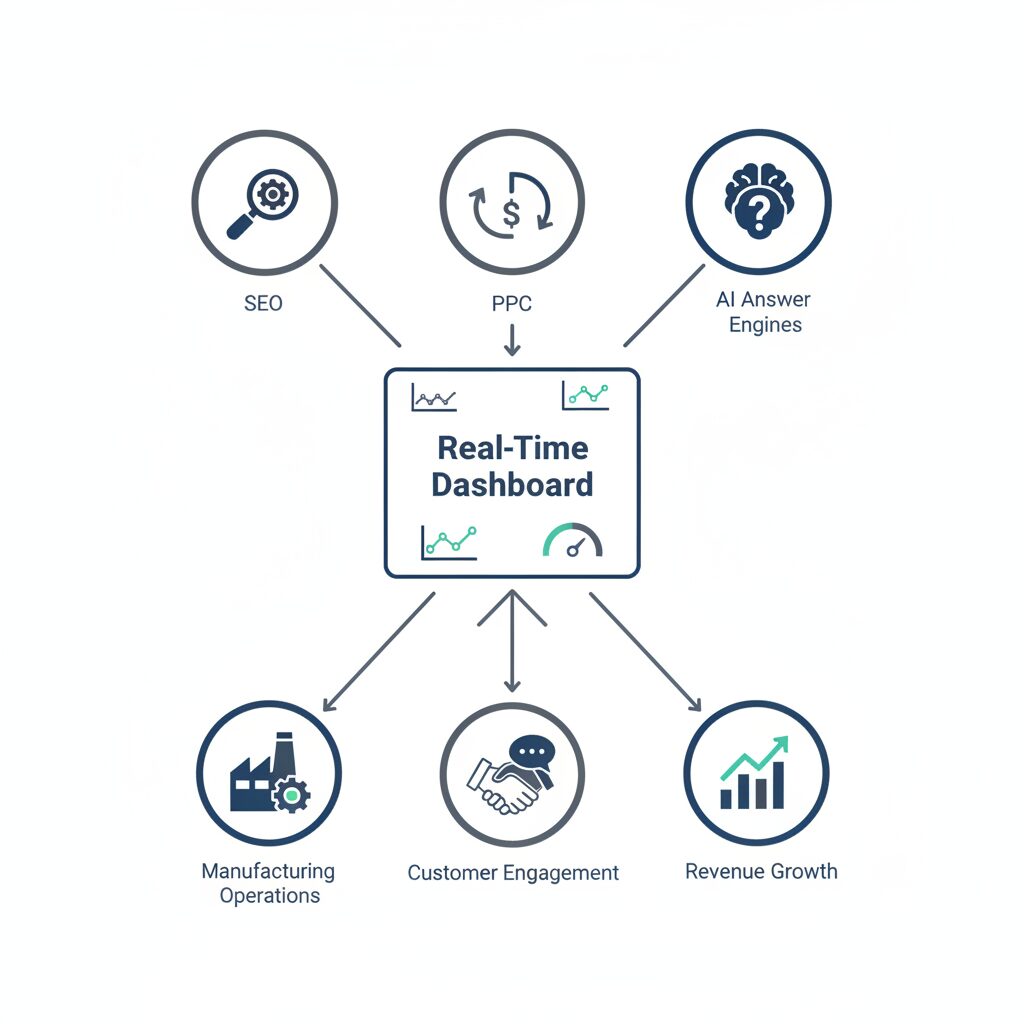
At Infineural Technologies, we see manufacturers make the same mistake repeatedly: optimizing for high-volume keywords like “industrial parts,” which mostly attracts students and job seekers rather than buyers. Real traction requires a focus on technical search triggers and an integrated approach that puts your actual specifications in front of buyers using AI-powered research tools. This guide covers how to build that.
Forrester’s 2026 Buyers’ Journey Survey, based on responses from roughly 18,000 global business buyers, found that 94 percent used AI during their most recent purchase process, and a majority now compare vendors and research products inside AI tools before ever contacting a supplier directly. If your technical data isn’t structured for those tools to find and cite, you’re effectively invisible during the part of the buying process that now happens first. That means your technical data has to be crawlable, your local presence has to be solid, and your paid campaigns have to be precise. Miss any one of the three and the other two carry less weight than they should.
Technical specifications as the new search triggers
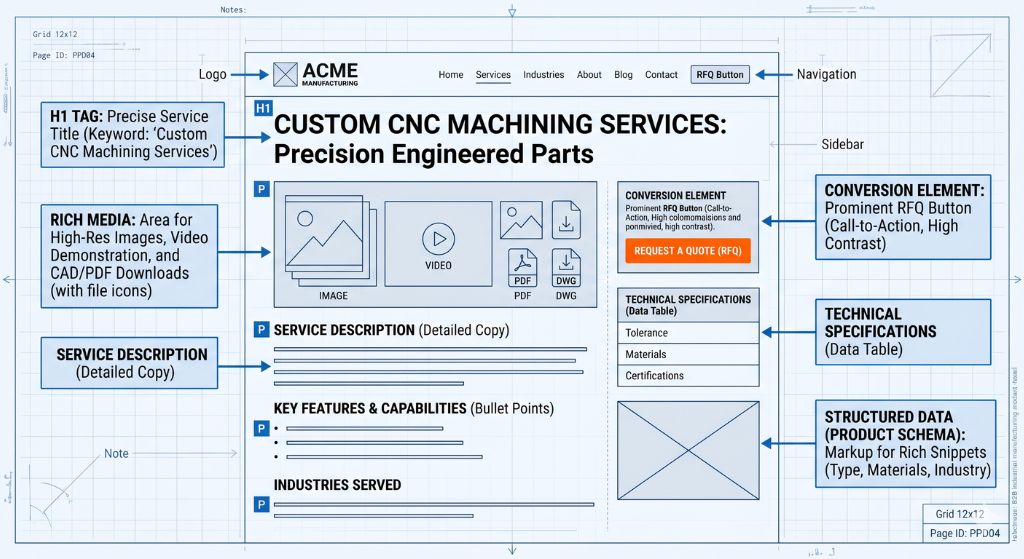
Search has changed. Google and specialized industrial AI tools now weight technical depth well above marketing language. Manufacturers that win treat their website as a technical resource rather than a brochure. When a procurement manager searches for a specific tolerance level or material grade, the site needs to answer immediately, which builds credibility before the first sales call happens and means your team spends more time closing and less time re-explaining basics.
Buyers increasingly search with precise technical language rather than generic category terms: “ISO 9001 certified CNC machining for 316L stainless steel” rather than “best gear manufacturer.” Content needs to reflect that level of specificity. If your specs live only inside a downloadable PDF, search engines and AI tools generally can’t read them well. Moving that data onto proper landing pages, real HTML rather than a locked file, is what actually makes it indexable.
Structured data helps here too. Schema.org markup that labels SKUs, lead times, and material specifications gives search engines and AI answer tools a clean, reliable way to pull your capabilities directly into a comparison, rather than relying on a summary that may not represent you accurately.
The shift from catalog browsing to answer-engine queries
Fewer buyers click through five pages of a digital catalog today. Procurement teams increasingly use natural language queries, asking an AI something like “which supplier in Maharashtra can handle a 50,000-unit run of automotive fuel injectors with a 4-week lead time.” If a site doesn’t state capacity, lead times, and location clearly enough for AI to parse, that contract goes to whoever does. AI overview optimization is about capturing exactly this kind of high-intent query before a competitor does.
The most common failure we see is a lack of specificity: “world-class quality” instead of “0.005mm precision tolerance.” AI engines generally weight the concrete number over the adjective. Every product page works better as a data sheet a machine can parse quickly than as marketing copy meant to persuade a human reader.
Winning the Nashik and Maharashtra industrial hub
Nashik has grown into a real hub for automotive and engineering exports. For firms in the Ambad or Satpur industrial zones, an SEO strategy needs to be hyper-local and still competitive at a broader scale. We’ve seen Nashik-based firms lose local contracts to Pune-based competitors simply because their local search presence was weaker, a frustrating way to lose work to a competitor down the road. Working with a local SEO partner who understands these nuances tends to close that gap faster than a generic national agency would.
Local SEO for manufacturers goes beyond a Google Business Profile. It’s about appearing in “near me” searches from procurement officers actually visiting the region, and showing up when a large enterprise buyer is sourcing a local vendor for specialized tooling. That requires hyper-local digital marketing tailored to the Indian industrial context. Naming specific industrial estates and local logistics capability helps search engines verify proximity and relevance, which tends to translate into lower shipping costs and higher buyer confidence.
If a buyer can’t find your factory on a map or your certifications in the search results, you’re effectively not in the running. Proximity functions as a trust signal here. Localized landing pages for every region served, a plant in Ambad and a sales office in Mumbai, for instance, aren’t duplicate content when they map an actual physical footprint to real, distinct local search intent.
Zero-waste PPC for industrial lead generation
SEO takes time, but PPC can produce results immediately when it’s targeted well. Most agencies bid on broad terms and burn budget on clicks from people looking for a job, not a supplier. A tighter approach uses AI to trigger ads more selectively, based on signals like industrial IP ranges and search intent that closely matches actual capabilities, so ad spend on manufacturing campaigns goes toward high-intent leads rather than accidental clicks.
A live dashboard showing which search term led to which inquiry is what actually lets you stop paying for ads that aren’t working, rather than discovering it a month later in a report. If an ad isn’t producing leads that look like real businesses, it gets killed quickly. Aggressive use of negative keywords to filter out students and hobbyists matters more in manufacturing than in most categories, since the budget only needs to fund conversations with actual decision-makers.
Timing matters too. Running ads around high-attention moments, major cricket tournaments among them, can put a capability in front of business owners who are on their phones during a match break rather than at their desk. It sounds unconventional, but B2B decision-makers are people first, and reaching them when they’re already engaged tends to help recall later, even for a purchase decision made in a Monday morning meeting rather than in the moment.

Converting technical authority into contracts
Authority matters in industrial buying. If your engineers are genuinely excellent, your website should be able to prove it with data rather than adjectives, “we think” and “maybe” don’t do the work that a specific number does.
Manufacturers often have valuable expertise locked inside PDFs that never get indexed. Turning that expert knowledge into proper web pages, rather than downloadable documents, lets it actually reach the decision-makers researching the next several years of their supply chain. Our guide to search optimization for Indian languages covers how to extend this to regional-language searchers specifically.
Real social proof in manufacturing looks less like a star rating and more like a detailed account of solving a specific production bottleneck, framed around lead time, cost, or cycle-time improvements. A headline like “how we cut CNC cycle time for a Nashik automotive vendor” does more to build trust than a generic testimonial, because it’s the kind of specific claim a buyer can actually evaluate, once backed by a real number.
Real-time visibility into ROI
Waiting until month-end to see how a campaign performed means finding out too late to act on it. Knowing which keywords are driving calls right now, not four weeks from now, is what makes automation and live tracking genuinely useful rather than a nice-to-have. Where a lot of agencies use automated reporting to soften bad news, the more useful version of this is straightforward: a live dashboard that shows exactly what’s happening, visible whenever you want to check it, not packaged into a monthly narrative.
That means seeing every lead, its source, and its current status in real time, which is what actually enables course correction instead of quarterly regret. Pairing this with an industrial CRM to track a lead from first search through to invoice keeps spend tied to real revenue rather than a proxy metric. If search interest spikes for a specific material, a shortage driving buyers to look for alternatives, for example, budget and SEO focus can shift within hours instead of waiting for the next planning cycle.
Answer Engine Optimization for industrial buyers
Buyers now research through Perplexity, Claude, and specialized industrial AI assistants alongside Google. These tools weight your data’s structure and how your brand is mentioned across authoritative sources more heavily than traditional ranking factors, which makes getting technical data cited by trade journals and industry directories a real part of the strategy, not a nice-to-have. Checking forum and community discussions for how procurement officers actually talk about vendor reliability can also surface useful positioning insight.
AEO rewards direct, specific answers. If a procurement officer asks “what is the lead time for custom aluminum extrusions in Maharashtra,” a page with a clear sentence like “lead time for custom aluminum extrusions at [company]’s Nashik plant runs 14 to 21 days” gives an AI tool exactly what it needs to cite confidently. That specificity is what wins a zero-click search: being the cited source of truth while a slower-loading competitor page is still waiting to be indexed.
Non-traditional search surfaces matter too. For engineering-adjacent buyers, being present in developer-facing search tools or CAD repositories matters if your components have downloadable 3D models or API documentation. That content deserves its own SEO treatment rather than an afterthought, since it reaches a technically sophisticated buyer earlier in their process.
Frequently Asked Questions
What is the average ROI for industrial SEO?
It varies by starting point and sector, but a well-run program should be trackable against direct lead value in a live dashboard, so you can see what your spend is actually producing rather than estimating it after the fact.
How do manufacturing companies rank for technical part numbers?
Schema.org markup, paired with dedicated landing pages that lay out detailed technical specifications in a form AI engines can parse easily. The goal is pages that work for both traditional search and AI answer engines at once.
Why does local SEO matter for Nashik-based industrial manufacturers?
It puts you at the top of regional supply-chain searches, building geographic authority and trust with nearby procurement teams who value proximity and reliable logistics, both of which tend to support more stable, longer-term contracts.
How long does it take to see lead generation results from B2B SEO?
Technical SEO typically starts showing meaningful lead flow within 4 to 6 months. Well-targeted PPC can generate inquiries within the first week, while the SEO groundwork compounds in value in the background.
Can AI-powered growth replace traditional sales teams in manufacturing?
No. It makes them more efficient by delivering higher-intent, pre-qualified leads, so sales engineers spend time closing rather than chasing inquiries that were never going to convert.
Do I need separate agencies for SEO and PPC?
Not ideally. Keeping both under one roof keeps data integrated and strategy coherent, which tends to prevent budget waste and keeps brand voice consistent across channels.
What does “radical transparency” mean in practice here?
Ongoing access to your own data: spend, lead sources, and conversion rates, visible whenever you want to check, rather than packaged into a monthly report that arrives after the fact.
How is 2026 SEO different from a few years ago?
It’s considerably more technical. Answer Engine Optimization and structured data for AI systems now matter alongside traditional ranking factors, which raises the bar on depth, load speed, and factual accuracy across the board.
Industrial search rewards an integrated approach, technical depth, genuine local relevance, and transparent, trackable execution, over fragmented efforts and reports that arrive too late to act on. If you’re ready to see where your current setup is losing ground to competitors, contact Infineural for a no-obligation technical review of where the gaps actually are.