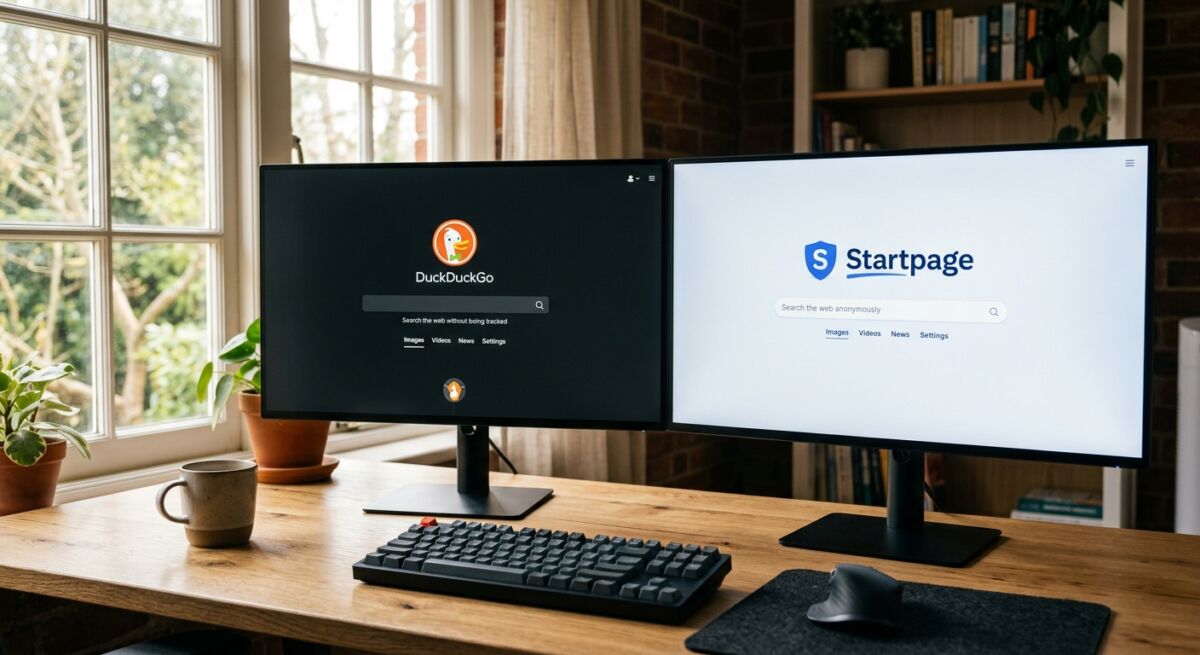
DuckDuckGo vs Startpage for online privacy in 2026. We compare AI, GDPR vs Five Eyes, and search accuracy to crown the winner. See which is best for you.
Choosing the Right Private Search Engine in 2026
You want to stop being followed online. I get it. Every time you search for a pair of shoes or a new software tool, ads for those exact items haunt you for weeks. It is annoying. It is invasive. And in 2026, it is completely unnecessary. The two biggest names in the game are still DuckDuckGo and Startpage. But which one actually protects your data better today?

Here is the bottom line. DuckDuckGo is better if you want a complete privacy ecosystem with a dedicated browser and tracker blocking. Startpage is better if you want Google-quality search results without Google-level spying. In our work at Infineural Technologies, we have seen that most users stick with DuckDuckGo for the features, but power researchers flock to Startpage for the accuracy. It really comes down to what you value more: the tools or the results.
DuckDuckGo vs Startpage for Online Privacy: 2026 Comparison Table
For those who need a fast answer, here is how the two privacy giants stack up in 2026.
| Feature | DuckDuckGo | Startpage |
|---|---|---|
| Search Index | Bing + DDG Crawler | Google (via Proxy) |
| Jurisdiction | USA (Five Eyes) | Netherlands (GDPR) |
| AI Integration | Native Privacy-First AI | Google-powered AI (Anonymized) |
| Ecosystem | Browser, App, Email | Search-focused |
| Unique Tool | Tracker Blocking Suite | Anonymous View (Proxy) |
| Best For | Daily Privacy Ecosystem | High-Accuracy Research |
As you can see, the choice depends on whether you want a full set of privacy tools (DuckDuckGo) or the gold standard of search accuracy without the tracking (Startpage).

DuckDuckGo vs Startpage for Online Privacy: Search Results & Accuracy
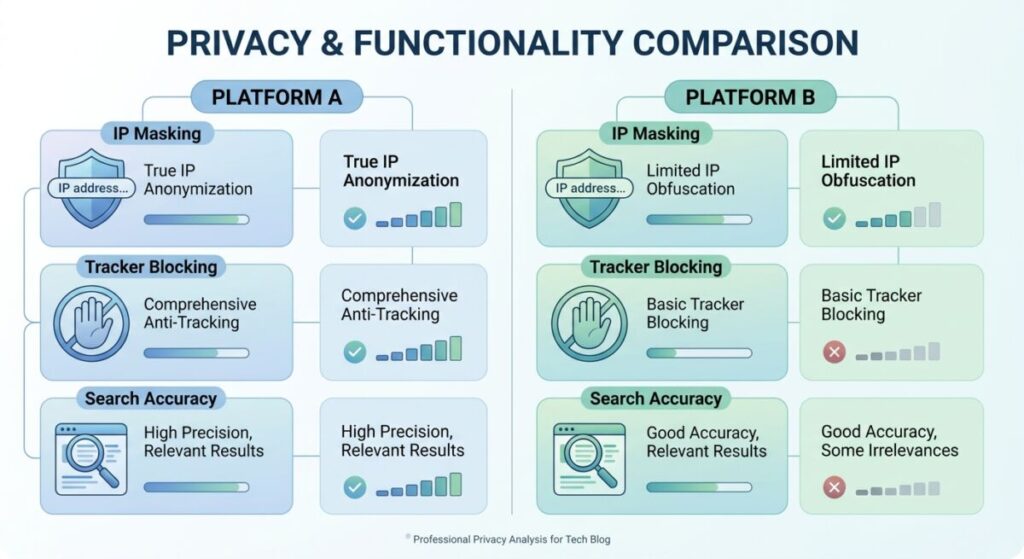
Why does this matter? Because a search engine is only as good as what it finds. DuckDuckGo uses its own crawler, DuckDuckBot, but it also pulls heavily from Bing. It is a solid mix. But let us be honest. Bing is not Google. Sometimes the results feel just a little bit off when you are looking for obscure technical data.
Startpage takes a different path. They pay Google for their search results. Think of it like a middleman. You send your request to Startpage. They strip away your IP address and tracking cookies. Then, they ask Google the question for you. Google sees a request from Startpage, not from you. You get the world's best search index with a total privacy shield. That is a massive win for accuracy in 2026.
Are you looking for more options? Check out our Top Search Engines List: 12 Best Platforms for Traffic (2026) to see how these two compare to the rest of the market. It is not just about these two anymore.
Jurisdiction Matters: Five Eyes vs. GDPR Protection
In 2026, where your data is physically processed is as important as how it is encrypted. DuckDuckGo is headquartered in the United States, a core member of the Five Eyes intelligence alliance. While DDG has a stellar track record of resisting data requests, they are ultimately subject to U.S. laws like the Patriot Act. If privacy is your absolute priority, this is a point of contention for many hardcore advocates.
Startpage, on the other hand, is based in the Netherlands. This means they operate under the European Union’s GDPR, which offers some of the most robust data protection rights in the world. Even better, Dutch laws are historically more protective against arbitrary government data surveillance. For users seeking a ‘safe haven’ outside of U.S. jurisdiction, Startpage holds a significant advantage in the duckduckgo vs start page for online privacy debate.
- DuckDuckGo: Subject to US jurisdiction (Five Eyes).
- Startpage: Subject to Dutch/EU jurisdiction (GDPR).
The Privacy Paradox: How DuckDuckGo and Startpage Make Money
One of the most common questions in the duckduckgo vs start page for online privacy debate is: ‘If they aren’t selling my data, how do they stay in business?’ Understanding the revenue model is key to verifying their privacy claims.
DuckDuckGo’s Revenue Model: DuckDuckGo generates revenue primarily through contextual advertising. Unlike Google, which shows ads based on your personal profile and search history, DDG shows ads based on the keyword you just typed. If you search for ‘best hiking boots,’ you see ads for boots. Once you leave that search, the connection is gone. They also earn affiliate commissions from certain partners, but this is done without tracking individual user identities.
Startpage’s Revenue Model: Startpage operates on a similar principle but with a twist. Because they use Google’s search results, they also utilize Google’s advertising system. However, Startpage acts as a proxy. They strip the identifying information from the request before it reaches Google, and they handle the ad delivery in a way that ensures Google never knows who the actual user is. This allows them to monetize using the world’s most efficient ad engine without compromising the user’s anonymity.
- Transparency: Both companies are transparent about their models, but Startpage’s reliance on Google’s infrastructure is a point of contention for some purists.
- Sustainability: Both models are proven and sustainable in 2026, meaning neither is likely to suddenly pivot to a data-selling model to survive.

Comparing Privacy Features: Ecosystem vs. Anonymous Proxy
In 2026, privacy is about more than just hiding your search history. It is about stopping the "fingerprinting" that websites use to identify you. DuckDuckGo has leaned hard into this. They offer a full privacy suite. Their browser extension blocks hidden trackers on almost every site you visit. They even have an Email Protection service that strips trackers from your inbox. It is a one-stop shop for staying invisible.
Startpage is more focused. They do not try to be your browser. They want to be your private window to the web. Their standout feature is "Anonymous View." When you see a search result, you can click a small mask icon next to it. This opens the website through a proxy. The website thinks Startpage is visiting, not you. This is a level of protection that DuckDuckGo does not offer in the same way. It is perfect for clicking on suspicious links without worry.
User Experience: Minimalist Portal vs. Privacy Ecosystem
While privacy is the goal, the daily interface is where you’ll spend your time. In 2026, the gap between these two has widened significantly in terms of ‘feel.’
The DuckDuckGo Experience: Using DuckDuckGo feels like using a modern tech suite. Between the dedicated browser, the mobile app, and the integrated AI (DuckAI), it is designed for the user who wants a ‘set it and forget it’ experience. The interface is clean, colorful, and feels like a direct competitor to Chrome or Safari. It’s an ecosystem that manages your privacy across the entire web, not just the search bar.
The Startpage Experience: Startpage is the ‘minimalist’s choice.’ It doesn’t try to be your browser or your email provider; it focuses on being the world’s best privacy proxy. The interface is intentionally sparse, mirroring the simplicity of early Google. The standout feature in 2026 remains the ‘Anonymous View’—a one-click proxy that lets you visit a website without that website seeing your IP or browser fingerprint.
Which should you choose based on UX?
- Choose DuckDuckGo if you want a cohesive set of tools that protect you across multiple apps and devices.
- Choose Startpage if you want a lightweight, distraction-free portal that simply gives you the best possible results with maximum anonymity.

Who Owns Your Privacy? Transparency in 2026
Understanding the business model is key to trusting a private search engine. DuckDuckGo is a venture-backed private company. They make money through non-tracking ads (based on the search term, not the user) and affiliate commissions. They have faced scrutiny in the past regarding their search syndication agreement with Microsoft, though they have since tightened these privacy controls to block Microsoft trackers.
Startpage’s history is more complex. In 2019, they received a significant investment from System1, an ad-tech company. This caused a temporary stir in the privacy community. However, Startpage maintains that their privacy policy is legally insulated from their investors. In 2026, they continue to use a ‘Privacy One Group’ structure to ensure that no user data is ever shared with the parent company. Both engines have proven that privacy can be a profitable business model without harvesting user data.
AI Search in 2026: Privacy-Preserving LLMs
In 2026, the debate isn’t just about links; it’s about AI-generated answers. Both platforms have adapted to the era of Generative Engine Optimization (GEO), but their approaches differ wildly.
DuckDuckGo AI has integrated a native, privacy-centric AI chat that allows you to interact with various LLMs anonymously. They act as a shield, ensuring your prompts are not used to train future models. This makes DDG the better choice for those who want to experiment with AI without creating a permanent digital footprint of their curiosities.
Startpage leverages Google’s advanced AI overviews but strips the personal identifiers before the request hits Google’s servers. You get the most sophisticated AI synthesis available globally, but you are still relying on Google’s underlying logic. If you are optimizing your own content for these platforms, understanding AI overview optimization is key to appearing in these private AI summaries.
- DDG AI: Better for prompt privacy and model variety.
- Startpage AI: Better for factual synthesis and complex query resolution.

AI Search Comparison: DuckAssist vs. Startpage Anonymous AI
Search has changed. We do not just look for links anymore. We want answers. Both engines have integrated AI to keep up with the times. DuckDuckGo uses DuckAssist. It scans Wikipedia and other sources to give you a quick summary at the top of the page. It is fast. It is clean. And most importantly, it does not use your data to train its models.
Startpage introduced their Anonymous AI recently. Because they pull from Google, their AI summaries are often more comprehensive for complex queries. But they still keep that "middleman" approach. Your AI prompts are anonymized before they ever hit a server. Want to see how this stacks up against other tech? You might find our guide on 7 Top AI Powered Search Engines for Research (2026 Guide) useful for a deeper look at AI tools.
Speed and User Experience
Look, if a search engine is slow, you will not use it. It does not matter how private it is. In our testing this year, DuckDuckGo feels slightly snappier. Their interface is modern and very customizable. You can change themes, toggle map settings, and use "!bangs" to search other sites directly. Type "!a" to search Amazon or "!w" for Wikipedia. It saves time.
Startpage feels a bit more traditional. It is clean, but it lacks the "cool factor" of DuckDuckGo. However, speed has improved significantly in 2026. The lag that used to come from the proxying process is almost gone. If you are used to the Google layout, you will feel right at home here. It is familiar. It is simple. And it works.
Which One Should You Choose?
Still on the fence? Let us make it easy. Choose DuckDuckGo if you want a complete solution. If you want to install one app or one extension and have your privacy "just work" across the web, they are the winners. They are building a fortress around your digital life. It is convenient and very effective for the average user.
Choose Startpage if you are a "search purist." If you find yourself constantly going back to Google because alternative results are not good enough, Startpage is your answer. You get the gold standard of search results without the data harvesting. For many of our clients at Infineural Technologies, this is the deciding factor. You can also explore Best Private Search Engines That Don't Track Data (2026) for even more niche alternatives.
Frequently Asked Questions
Does DuckDuckGo sell your data to advertisers? No, DuckDuckGo does not store or share your personal information or search history. They make money through non-targeted ads based on the keyword you just typed, not your identity.
Is Startpage owned by an advertising company? Startpage is partially owned by System1, but they maintain a strict privacy policy and are based in the Netherlands. This means they are protected by strong EU privacy laws that prevent data exploitation.
Can Google see what I search for on Startpage? No, Google only sees a request coming from Startpage's servers. Your IP address, browser fingerprint, and personal details are never passed along to Google's systems.
Does DuckDuckGo have a VPN? Yes, as of 2026, DuckDuckGo offers a VPN as part of their "Privacy Pro" subscription service. This adds another layer of security for your entire device, not just your browser.
Which engine is better for international searches? Startpage usually wins here because it uses Google's superior localized indexing. If you are searching in languages other than English, Startpage provides more relevant local results.
Are these engines really better than "Incognito Mode"? Yes, Incognito Mode only hides your history from people using your computer. It does not stop Google or websites from tracking you, while DDG and Startpage actually block the tracking.
Do these search engines work with Tor? Both engines have versions that work well within the Tor browser. DuckDuckGo actually operates its own ".onion" service for maximum anonymity for users on the dark web.
Can I use both at the same time? Many users keep DuckDuckGo as their default for quick daily tasks. They then switch to Startpage when they need to perform deep research that requires Google's specific indexing power.
Secure Your Digital Future Today
Privacy is no longer a luxury. It is a necessity in a world where data is the most valuable currency. Whether you choose the all-in-one protection of DuckDuckGo or the precision of Startpage, you are taking a step in the right direction. Stop letting tech giants dictate what your data is worth. Take control of your searches. If you need help optimizing your own search presence or staying ahead of these trends, contact Infineural Technologies today. Let us help you navigate the future of the private web.
Infineural is a digital marketing, development and hosting company based in Nashik, India, founded in 2018. It runs SEO, Google Ads, performance and WhatsApp marketing, builds custom WordPress sites, web apps and mobile apps, manages hosting, and makes Infineural CRM and WhatsInfi. Every engagement starts with a written scope and runs through a client dashboard showing the work log, billing and results.
- Search Engine & Generative Engine Optimization Specialists
- Google Ads Management & Performance Marketing Experts
- Advanced WordPress & Custom Web Application Developers
- B2B, D2C & Enterprise Conversion Rate Optimization (CRO) Leaders
- Digital Growth Partners for Hospitality, Healthcare, and Education