
Stop relying on obsolete reports. Use AI competitive intelligence to automate tracking, find market gaps, and drive radical growth. Get your free audit.
The logic of real-time intelligence
Most founders rely on quarterly reports that are obsolete the moment the ink dries. This reliance on stale data is exactly how market leaders slide into irrelevance. When you operate on a three-month lag, you aren’t actually strategizing. You are simply reacting to a ghost of your competitor’s past moves.

To hold a lead, you have to stop manual tracking. You need autonomous systems that spot competitor pivots the second they happen. It is the difference between guessing and knowing. By building a zero-waste intelligence stack, you identify market gaps and turn them into immediate revenue, which means your growth is based on evidence rather than a “gut feeling.”
How automated tracking kills the guesswork
Manual competitor research is a failure of scale. I have seen teams spend twenty hours a week scraping websites and reading press releases. That is a waste of expensive human capital on a task an AI agent can finish in seconds. The real killer here is latency. If a competitor drops their price or launches a new feature on Tuesday, but your team doesn’t spot it until Friday, you’ve surrendered four days of market response. In a high-velocity sector, four days is an eternity.
From stagnant spreadsheets to live streams
Spreadsheets are where data goes to die. In my experience, the most successful growth teams replace static cells with live API feeds. We do this at Infineural by building systems that scrape competitor landing pages every hour. The system does not just record the change. It analyzes the intent.
For example, if a competitor changes their H1 from “Focus on Efficiency” to “Focus on Cost Reduction,” the AI flags a shift in their value proposition. This allows you to tweak your zero-waste PPC campaigns in real-time. This means your ads counter their new narrative before it ever gains momentum with your shared audience.
Spotting pricing shifts and offer pivots
Pricing is the loudest signal of a competitor’s desperation or confidence. Data from MarketInsights (2026) suggests that B2B firms using automated pricing monitors react 14 times faster to market shifts than those stuck with manual audits. When a competitor launches a flash discount, an autonomous stream hits your sales team’s Slack channel instantly.
This stops the gut-wrenching moment where a sales rep loses a deal because they didn’t know the other guy just dropped their entry price by 20%. By automating this, you maintain a clear view of your own positioning, which means you can stay competitive without accidentally starting a race to the bottom that kills your margins.
Analyzing ad creative without the manual slog
Sifting through the Meta Ad Library by hand is a tedious chore that usually results in fragmented, useless notes. AI-powered tools now let you monitor creative rotations at scale. You can see exactly which hooks a competitor is testing and which ads have been running for months.
Ads that stay live are ads that make money. When an AI agent identifies a winning creative pattern in your niche, you can bake those insights into your own AI-powered growth framework. You aren’t copying. You are using market-validated data to slash your own testing risk and shorten your path to a winning campaign.
The high-precision market gap analysis
A market gap isn’t just a missing feature. It is a disconnect between what the customer is begging for and what the market is actually delivering. Most companies try to find this through surveys. Surveys are flawed because people lie or forget. The more clinical method is using Large Language Models (LLMs) to synthesize raw, unstructured customer pain.
Turning competitor complaints into product roadmaps
The real goldmine for growth is the one-star review. By feeding thousands of competitor reviews into an LLM, you move from anecdotes to statistical certainty. In one project, we analyzed 4,000 reviews for a SaaS competitor and found that 22% of churn was caused by one specific onboarding friction point.
That is a glaring market gap. By building a product that solves that specific pain, you create a natural migration path for their unhappy customers. This is the core of a guiding policy: find the specific crack in the competitor’s armor and concentrate all your force there.
Finding underserved segments in sentiment clusters
Not all customers are created equal. Sentiment analysis lets you cluster users by their specific frustrations. You might find a group of enterprise users who love a competitor’s tool but hate their lack of SOC2 compliance. That cluster is an underserved segment waiting for a better option.
When you hit this segment with a campaign focused specifically on security, your conversion rates climb. This happens because you are solving a verified pain point, which means you replace the guesswork of “buyer personas” with actual data-driven precision.
Mapping feature deficits against real demand
Demand usually screams in forums and community hubs long before it hits a product roadmap. AI agents can monitor Reddit, G2, and niche forums to map requested features against what competitors actually offer.
When you map these deficits, you build a roadmap based on evidence. If 30% of users in a specific niche are asking for an integration that no one provides, that is your entry point. This is how you scale without fragmentation. You build exactly what the market is already demanding.
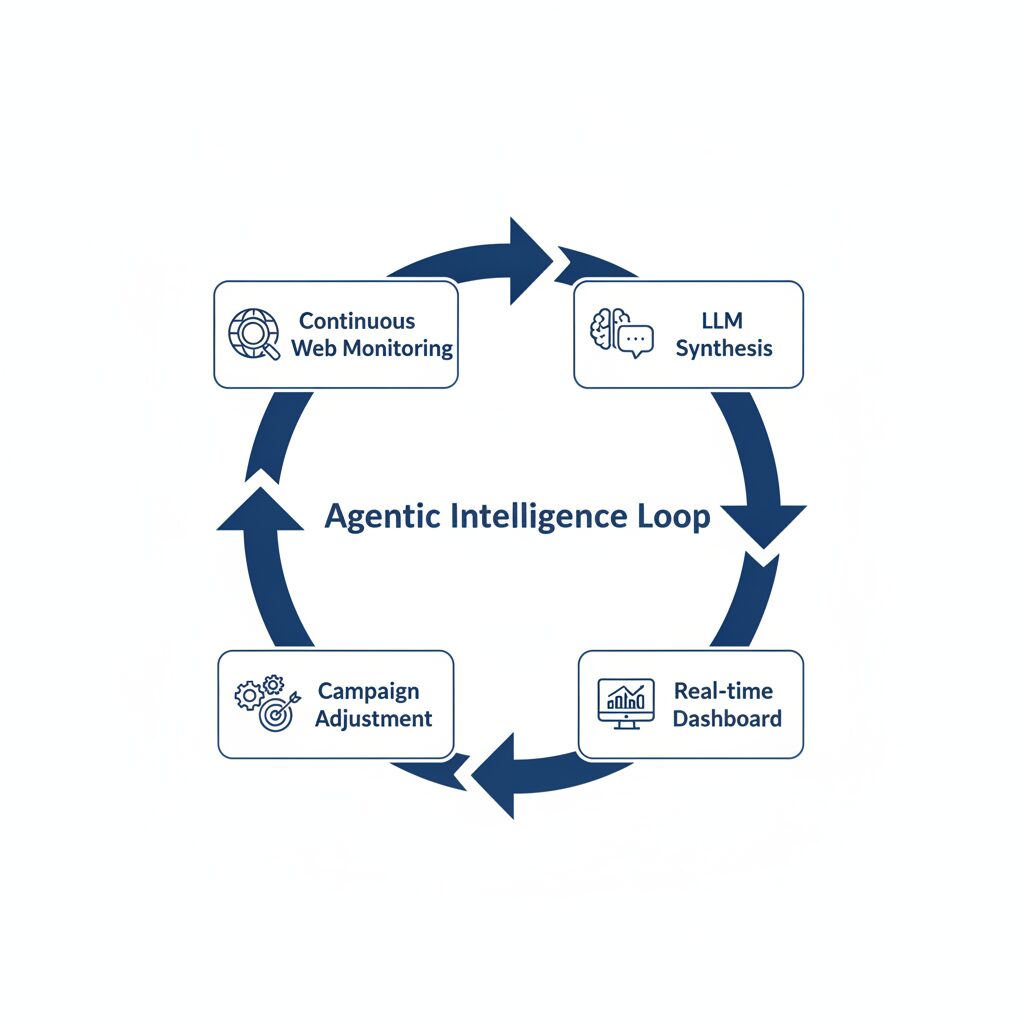
Agentic discovery: Moving from snapshots to movies
Static research is a snapshot. Agentic discovery is a movie. The shift is moving from a researcher who asks a question to an agent that monitors a variable 24/7.
Building agents for web-scale monitoring
Modern AI agents do more than scrape. They reason. An agent can be programmed to watch a competitor’s career page. If they suddenly hire five engineers specializing in Rust, the agent infers a technical pivot or a new product build. This is a lead indicator of a future launch.
In practice, this gives you a head start of weeks or months. You can prepare your counter-messaging or accelerate your own development before the competitor even announces the feature. It is the only way to stay proactive in a crowded market.
Synthesizing noise into a real-time dashboard
Data is useless if it stays in a log file. The goal is to move from raw data to a real-time dashboard that an executive team can actually use to make decisions. This dashboard should not show every single change. It should only show the ones that move the needle on ROI.
The key metric here is the Signal-to-Noise Ratio (SNR). A high-quality system filters out the noise, like a minor color change on a landing page, and highlights the signals, such as a change in the target audience’s vocabulary. This allows for rapid decision-making without the mental fatigue of data overload.
The trap of static research
The biggest failure of static research is the “Confirmation Bias Trap.” A human researcher often looks for data that supports the strategy they’ve already decided on. An AI agent has no ego. It simply reports the delta.
Agentic discovery finds the things you aren’t looking for. It might spot a new competitor entering from an adjacent market that your team completely ignored. By the time a human researcher finds them, they have already captured 5% of your market share. That is a costly mistake.
Scaling with real-time monitoring
The final step is integrating this intelligence into your daily workflow. Intelligence that doesn’t lead to action is just an expensive hobby.
Trigger-based alerts for instant response
Your team should not be checking a dashboard every morning. Use trigger-based alerts instead. For example, if a competitor’s page load speed drops by 2 seconds, an alert triggers a temporary ad campaign highlighting your own site’s superior performance.
This creates a reactive loop that operates at machine speed. When the competitor fails, you catch their falling users within minutes. This level of agility is impossible with a traditional agency model.
Intelligence-driven multi-channel campaigns
Competitive intelligence should dictate your ad copy. If your AI agent detects that a competitor is leaning heavily into “Ease of Use,” your campaigns should shift to “Power and Control.” You occupy the opposite mental space in the customer’s mind.
This ensures your campaigns are not just loud, but strategically positioned. You stop competing on the same terms as everyone else and start redefining the terms of the competition.
The speed gap: Agencies vs. AI-powered growth
Traditional agencies operate on a monthly reporting cycle. They tell you what happened thirty days ago. In today’s market, a month is an eternity. By the time you read the PDF report, the opportunity has vanished.
The only alternative is bringing marketing and tech under one roof. When the person managing the AI agents is the same person managing the ad spend, the distance between insight and action drops to zero. This is the only way to achieve actual AI-powered growth in 2026.
Frequently Asked Questions
How does AI competitive intelligence differ from traditional market research?
Traditional research is a retrospective snapshot. AI competitive intelligence is an autonomous, real-time stream that focuses on continuous change rather than historical data.
What are the best AI tools for automated competitor tracking?
The most effective stacks combine custom n8n agents for scraping with LLMs for synthesis. Specialized tools for ad intelligence and pricing monitors fill the gaps.
Is AI-driven market gap analysis accurate for small niches?
Yes. In fact, it is often more accurate because it analyzes raw customer sentiment and specific complaints rather than broad, diluted market trends.
How often should competitive monitoring data be refreshed for maximum ROI?
In high-velocity markets, data should be refreshed hourly. This lets you pivot your campaigns before the competitor’s move becomes common knowledge.
Can AI agents detect competitor pricing changes automatically?
Yes. Agents monitor pricing pages and trigger alerts the moment a value changes, allowing you to respond to pricing wars in minutes.
How do I avoid legal issues with AI scraping?
Stick to public-facing data and respect robots.txt files. Use reputable scraping services that comply with global data privacy laws to keep your business safe.
Can AI predict a competitor’s next move?
AI cannot see the future, but it is excellent at pattern recognition. By tracking hiring trends and technical shifts, it provides high-probability lead indicators.
Does this replace the need for a human strategist?
No. It replaces the grunt work of data collection. You still need a human strategist to decide how to weaponize those insights.
Stop guessing and start dominating
Competitive intelligence is not a monthly chore. It is a continuous engine. By integrating these tools, you move from reactive survival to proactive dominance. If you are tired of fragmented data and opaque agency reports, it is time to bring your marketing and tech under one roof. Contact Infineural today for a real-time dashboard audit to find your next growth lever for free.
Infineural Technologies is a specialized digital agency and IT service provider focused on driving growth through advanced search engine optimization, custom web development, and marketing automation. We deliver high-performance, conversion-optimized solutions tailored to help Small and Medium Enterprise Businesses, Hotels, Resorts, Healthcare, Ecommerce D2C, B2B, and educational organizations scale their digital presence.
- Search Engine & Generative Engine Optimization Specialists
- Google Ads Management & Performance Marketing Experts
- Advanced WordPress & Custom Web Application Developers
- B2B, D2C & Enterprise Conversion Rate Optimization (CRO) Leaders
- Digital Growth Partners for Hospitality, Healthcare, and Education