
Stop wasting budget on fragmented marketing. Compare the ROI of a fractional CMO vs a marketing agency to find the right growth engine for your business.
The core conflict: strategic ownership vs technical execution
Most founders eventually hit a wall where throwing more money at ad spend simply stops working. It feels like the channel is broken, but it rarely is. The actual problem is a lack of a coherent strategy. You are essentially choosing between two different animals: a strategic leader who owns the roadmap or a production house that executes tasks. This guide breaks down the financial and operational trade-offs of a fractional CMO vs marketing agency so you can stop guessing with your budget and start scaling based on a diagnosis.

Strategy is not a vision statement or a list of goals. I’ve seen too many founders mistake “increasing revenue by 20%” for a strategy. It isn’t. Strategy is a coherent set of actions designed to overcome a specific challenge. In growth, that challenge is the gap between your product’s current state and where your customers actually live. A fractional CMO diagnoses and manages this gap. An agency simply fills a piece of it.
What a fractional CMO actually does
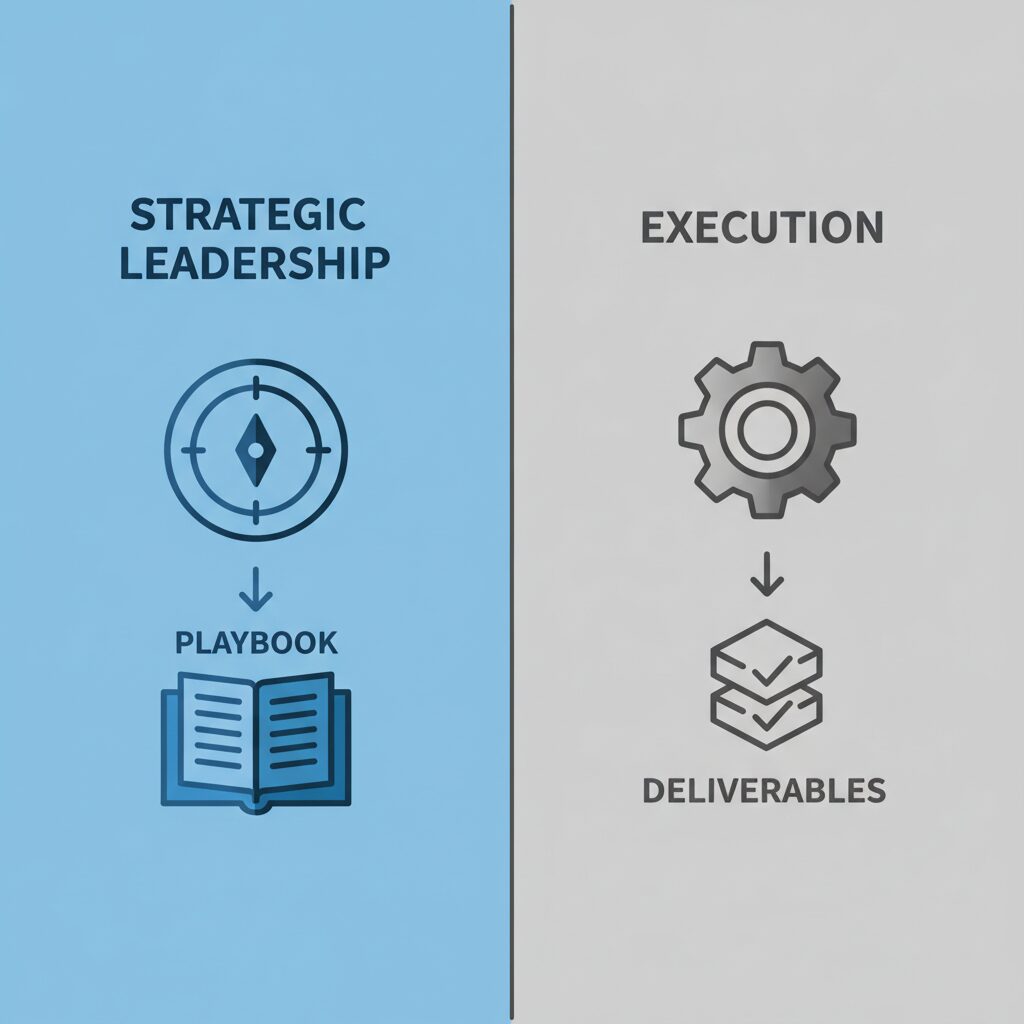
A fractional Chief Marketing Officer (CMO) provides executive leadership on a contract basis. They don’t just throw ideas at the wall; they own the ROI. Their primary job is to find the “crux”—the one bottleneck in your acquisition funnel that, if broken, unlocks everything else.
In a real-world scenario, they build the growth playbook and define the target persona, which means you stop wasting spend on “lookalike” audiences that don’t actually buy. They act as the architect. If you have a team of juniors or a few freelancers, the fractional CMO tells them exactly what to build and how to measure it. They implement AI-powered growth systems, which means the business stops relying on a few heroic manual efforts that break the moment you try to scale.
How a marketing agency operates as a vendor
A marketing agency is a production house. They provide the hands: the copywriters, the ad buyers, and the designers. Their business model is built on deliverables. They sell you a bundle of four blogs a month, a set of ad campaigns, or a social media calendar.
The danger here is that agencies often operate as vendors, not partners. A vendor does what they are told. If you tell an agency to run Google Ads, they will run them—even if those ads are driving low-intent traffic that your sales team hates. Whether those ads align with a long-term customer acquisition cost (CAC) goal is often secondary to the agency’s primary goal: keeping your monthly retainer active. This is how fragmented marketing happens.
The danger of the execution gap
The most common way startups fail is through the execution gap. This happens when a founder hires an agency to execute a strategy that doesn’t exist. You end up paying for high-end execution of a mediocre plan. It is the equivalent of paying a world-class driver to drive a car in the wrong direction. The result is expensive noise.
Industry benchmarks show that companies relying solely on agencies without internal strategic leadership often see significantly higher churn in their marketing spend. They burn cash on the wrong keywords because no one is looking at the entire machine. They have a fast vehicle, but no map.
Fractional CMO benefits for high-growth startups
For a startup, a full-time CMO is usually a financial impossibility. A seasoned executive can command $250,000 to $400,000. A fractional model gives you that same brainpower for a fraction of the cost, without the equity hit.
Building a scalable growth playbook
A fractional CMO doesn’t start by tweaking ad copy. They start by building a growth playbook. This is a documented system for how the company acquires, activates, and retains users, which means the founder can finally stop being the primary project manager for every campaign.
Once you have a playbook, the guesswork vanishes. You know that every $1,000 spent on a specific LinkedIn Matched Audience generates exactly three qualified leads. That predictability is the only thing that allows a company to scale safely. Without it, you aren’t growing; you’re gambling with your venture capital.
Vetting and managing your tech stack
Most SMBs run a “Frankenstein” tech stack. They pay for five different tools that do the same thing, and none of them talk to each other. A fractional CMO audits this mess and cuts the fat. They implement automation to ensure leads flow from the ad to the CRM instantly, which means your sales team stops losing leads to slow follow-up times.
At Infineural, we’ve seen companies slash software overhead by 20% simply by consolidating tools and using n8n AI agents to move data. The CMO ensures the tools serve the strategy, not the other way around. If you’re shopping for a CRM, prioritize open APIs to avoid being locked into a vendor’s ecosystem.
Reducing overhead while securing executive leadership
The fractional model is about lean efficiency. You get the oversight needed to manage a integrated B2B marketing strategy without the massive base salary of a full-time C-suite hire. It keeps your burn rate low while ensuring someone is actually accountable for the growth numbers.
When to choose an agency vs consultant for startups
There are times when an agency is the right call. The choice depends on whether you lack the map or the vehicle.
Immediate need for specialized production
If you already have a proven strategy and clear targets, you don’t need a CMO. You need a production line. If your goal is to pump out 20 high-quality videos a month or manage a complex PPC spend across ten different regions, an agency is the fastest path.
Agencies excel at technical execution. They have the manpower to produce content at scale. When the strategy is already a commodity, the agency is the solution.
The risk of black box reporting
The failure mode of the traditional agency is the “black box.” They send a monthly PDF filled with vanity metrics: impressions, clicks, and reach. These numbers don’t pay the bills. They are often used to mask a lack of actual growth with professional-looking charts.
This is why radical transparency is a requirement. You shouldn’t have to ask your agency for the data. You need a real-time dashboard that shows exactly where every dollar went and how much pipeline value it produced.
Comparing speed of deployment to long-term equity
An agency can start tomorrow. They have the team ready. A fractional CMO takes longer to integrate because they have to diagnose the business first. However, the CMO builds internal equity. They create systems that stay with the company. When an agency leaves, they take their processes with them. When a fractional CMO leaves, the playbook remains in your hands.
Calculating marketing leadership ROI
Most companies calculate marketing ROI too bluntly: total spend versus total revenue. That’s a lazy metric. You have to look at the efficiency of the spend.
The cost of a full-time CMO vs the fractional model
A full-time CMO costs roughly $30,000 to $40,000 per month when you factor in benefits and bonuses. A fractional CMO typically costs $5,000 to $15,000. The real ROI isn’t just the salary savings; it’s the prevented waste. A single strategic correction on a $20,000 monthly ad spend can save a company $100,000 in wasted budget over a year.
Measuring success: zero-waste PPC and live tracking
Success in 2026 is defined by zero-waste PPC. This means every ad group is tied to a hard conversion goal with a strict cap on CAC. The fractional CMO sets the guardrails; the agency executes the bids.
Take a B2B SaaS company we analyzed: they shifted from tracking “lead volume” to “pipeline value.” By killing the bottom 30% of low-intent keywords, they actually reduced their total lead count but increased closed-won revenue by 18% in four months. That is strategic leadership in action.
The hidden cost of fragmented agency contracts
Many enterprises juggle an SEO agency, a PPC agency, and a social media agency. This creates a fragmented marketing nightmare. Each agency optimizes for its own silo. The SEO agency wants more traffic (even if it’s junk). The PPC agency wants more clicks (even if they don’t convert).
This fragmentation is an operational tax. You pay three management fees and spend your weekends in meetings trying to get the agencies to talk to each other. It’s a recipe for stagnation.
The integrated model: moving everything under one roof
The most successful companies are ditching the binary choice of CMO vs Agency. They are moving toward an integrated model that blends leadership and execution.
Why radical transparency beats monthly PDF reports
The monthly report is a post-mortem. It tells you what went wrong after the money is already gone. Radical transparency means seeing the data in real-time. If a campaign fails on Tuesday, you kill it on Wednesday. You don’t wait until the 30th of the month to find out you burned $5,000 on a dead end.
Combining AI-powered growth with strategic leadership
AI has collapsed the cost of execution. Content that used to take a week now takes an hour. This makes the “production” value of agencies plummet. The real value has shifted to the strategy—knowing what to prompt, how to distribute it, and how to measure the impact.
By using agentic AI for marketing, an integrated team can do the work of a 20-person agency with a 3-person core team. This eliminates bloated retainers and puts the focus back on the bottom line.
Integrated marketing solutions for multi-location enterprises
For companies with multiple locations, fragmentation is a disaster. You need a multi-location marketing strategy that keeps the brand consistent while allowing for local tweaks. An integrated approach ensures the strategic roadmap is pushed to every local campaign without losing the core voice.
Decision matrix: fractional CMO or agency?
Use these scenarios to decide your next move.
Scenario A: You have a product but no repeatable acquisition channel
You’re guessing which channels work. Your CAC is all over the place. You have product-market fit, but no engine. Hire a fractional CMO. You need a diagnosis and a playbook before you spend another dime on execution.
Scenario B: You have a proven channel but lack the hands to scale
You know LinkedIn Ads work. You have the creative and the offer. You just can’t keep up with the management and lead follow-up. Hire a marketing agency. You have the map; you just need more vehicles to drive it.
Scenario C: You are juggling three different vendors with zero cohesion
You have an SEO person, a Google Ads agency, and a freelance writer. Nothing is aligned. You spend your weekends acting as a glorified project manager. Move to an integrated model. You need a single point of accountability and a real-time dashboard to stop the bleed.
Frequently Asked Questions
Can a fractional CMO also manage my existing marketing agency?
Yes. In fact, this is often the best setup. The fractional CMO acts as the bridge, giving the agency the strategy and holding them accountable to hard ROI metrics.
How much does a fractional CMO cost compared to a full-service agency?
Fractional CMOs usually charge a monthly retainer for strategy. Agencies charge for deliverables. Often, a CMO costs the same as or less than a full-service agency retainer but provides significantly higher-level leadership.
Do I need a fractional CMO if I already have a marketing manager?
A marketing manager executes the plan. A CMO creates the plan. If your manager is struggling with direction or missing targets, you don’t need more “management”—you need a CMO.
What is the typical engagement length for a fractional CMO?
Most engagements last six to twelve months. That is usually enough time to build the playbook, stabilize the channels, and train your internal team to take over.
How do I measure the ROI of a strategic consultant versus a lead-gen agency?
Measure an agency by cost per lead. Measure a fractional CMO by the increase in lifetime value (LTV) and the decrease in overall CAC through strategic efficiency.
Stop the guesswork and scale your growth
Choosing between a fractional CMO and an agency comes down to whether you lack a map or the vehicle. For founders tired of opaque fees and fragmented results, the answer is an integrated approach. Stop the guesswork and get a real-time dashboard of your growth. Book a strategy audit to see how we bring your entire growth engine under one roof. No long-term contracts, just radical transparency and actual results.
Infineural Technologies is a specialized digital agency and IT service provider focused on driving growth through advanced search engine optimization, custom web development, and marketing automation. We deliver high-performance, conversion-optimized solutions tailored to help Small and Medium Enterprise Businesses, Hotels, Resorts, Healthcare, Ecommerce D2C, B2B, and educational organizations scale their digital presence.
- Search Engine & Generative Engine Optimization Specialists
- Google Ads Management & Performance Marketing Experts
- Advanced WordPress & Custom Web Application Developers
- B2B, D2C & Enterprise Conversion Rate Optimization (CRO) Leaders
- Digital Growth Partners for Hospitality, Healthcare, and Education
This article was drafted with AI assistance and thoroughly reviewed, edited, and fact-checked by our editorial team before publishing.