
Stop wasting budget on fragmented agencies. Build a zero-waste SaaS GTM strategy that integrates AI-powered acquisition and product-led growth.
The Strategic Failure of Fragmented SaaS Growth
It is common to see SaaS founders burn through nearly half of their initial marketing budget on fragmented campaigns. The pattern is predictable: one agency handles SEO, another manages PPC, and a separate dev shop handles the site. This isn’t just inefficient; it is a structural failure. When your ad copy promises a feature the product hasn’t actually shipped, you aren’t just losing a lead. You are paying to acquire users who will churn within the first 14 days, which means your acquisition spend becomes a subsidy for user frustration.
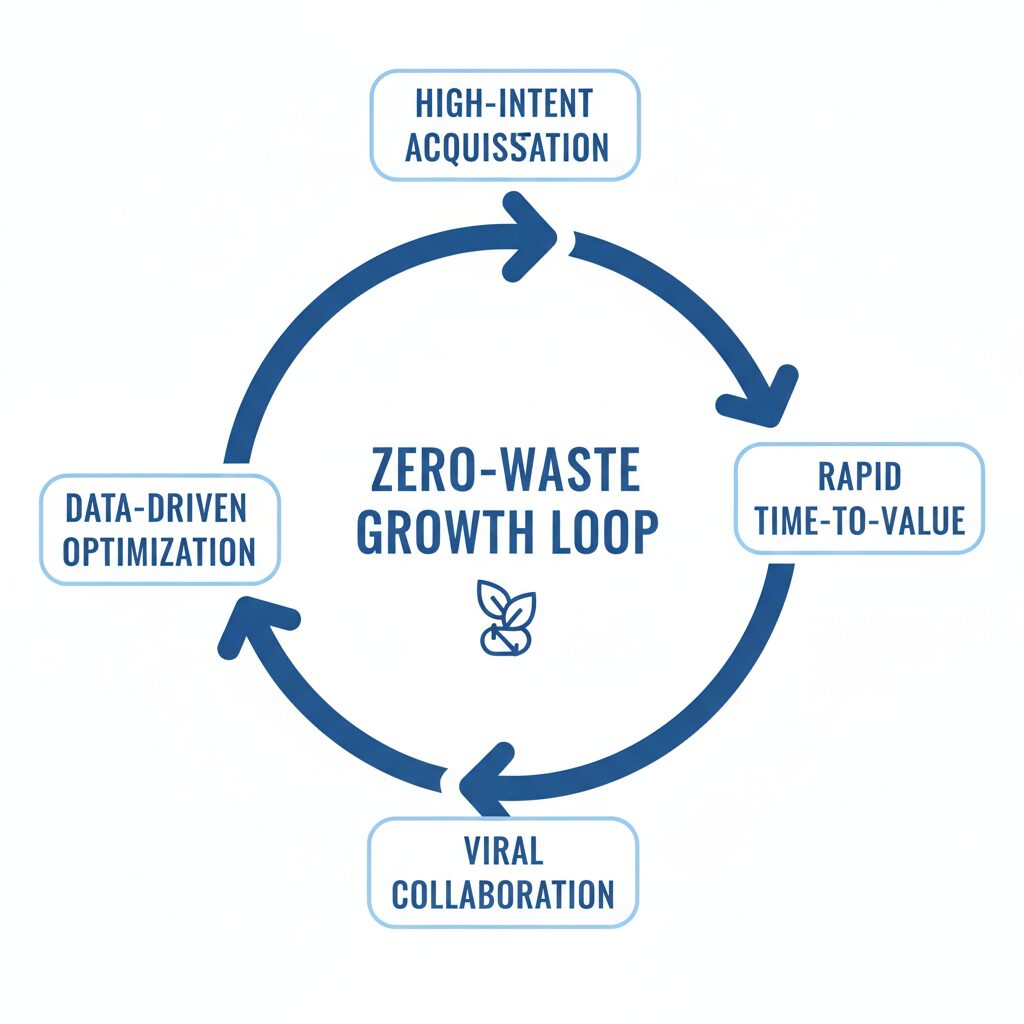
Strategy is not a wish list or a set of ambitious goals. It is a diagnosis of a specific challenge followed by a coherent set of actions to overcome it. In 2026, the bottleneck is rarely a lack of traffic. The real problem is the inefficiency of the growth stack. To fix this, you need a radically transparent framework that forces tech and marketing to operate as a single unit.
Defining the Zero-Waste Marketing Framework for SaaS
The hidden tax of fragmented growth stacks
Fragmented stacks create data silos that act as a tax on every dollar you spend. When your PPC agency cannot see real-time churn data, they continue bidding on keywords that attract “window shoppers” rather than buyers. This is the leakage effect. In practice, this manifests as a Customer Acquisition Cost (CAC) that feels like an industry standard but is actually a byproduct of poor internal integration. You end up paying a premium for low-quality traffic because the left hand doesn’t know what the right hand is doing.
Replacing guesswork with real-time visibility
Guesswork is a luxury that early-stage startups cannot afford. I’ve seen too many founders rely on monthly reports—essentially an autopsy of what went wrong 30 days ago. By the time you see the dip, the budget is gone. You need a real-time dashboard that tracks the funnel from the first click to the “aha moment” (the first value event).
When you map LTV (Lifetime Value) against spend in real-time, you can kill a failing channel in three hours instead of three months. For one B2B fintech client, we shifted budget from broad LinkedIn awareness to intent-based search. This move cut wasted spend by 18% within a single quarter. The logic was simple: stop paying for attention and start paying for intent.
Integrating AI as a core growth engine
AI is not a shortcut for writing mediocre blog posts. That is a waste of the technology. True AI-powered growth is about removing the bottleneck of personalization. Instead of a human guessing which of two landing pages works better, AI can deploy 50 variations based on the visitor’s industry and company size in milliseconds. This eliminates the friction between what the user needs and what your page says, which means higher conversion rates without increasing your ad spend.
The Go-To-Market Blueprint: Four Pillars of Execution
ICP precision: Targeting triggers, not demographics
Your Ideal Customer Profile (ICP) is not a list of job titles or company sizes. Those are demographics, and demographics are lazy. A real ICP is a set of specific pain points and triggers. A founder at a ten-person startup has entirely different triggers than a VP of Ops at a 500-person enterprise.
In 2026, precision means identifying the “forcing function”—the exact event that makes your software a necessity. Is it a new funding round? A regulatory shift? A catastrophic failure in a competitor’s tool? When you target the trigger, you stop chasing leads and start capturing demand.
Value proposition mapping vs. feature listing
Most SaaS websites are just glorified feature lists. They brag about “cloud-based sync” or “AI-driven insights.” This is noise. Customers do not buy features; they buy a better version of their professional self.
Map every feature to a concrete outcome. If your tool saves five hours of manual data entry per week, stop talking about the “automation engine.” Talk about the five hours the founder gets back to focus on high-level strategy. This shift from feature-centric to outcome-centric messaging is often the only difference between a bounce and a sign-up.
Pricing models as growth levers
Pricing is a strategic tool, not just a way to collect revenue. Friction occurs when the price creates a barrier to the first value event. If a user has to pay $500 before they see the product work, you have a friction problem.
Consider usage-based pricing or a “reverse trial”—where users start with the full feature set and are downgraded if they don’t convert. This allows the product to sell itself. An OpenView study from 2025 found that usage-based models grew 2.5x faster than flat-fee subscriptions in B2B because they align the cost directly with the value delivered.
Distribution channels for high-LTV acquisition
Traffic is not a monolithic metric. High-LTV users generally migrate from high-intent channels. While social media is useful for brand awareness, it often fills your pipeline with low-intent leads that waste your sales team’s time. Focus your capital on channels where the user is actively searching for a solution to the problem you solve.
SaaS Customer Acquisition: Shifting to High-Intent Channels
Zero-waste PPC: AI-driven intent filtering
Traditional PPC is a game of “whack-a-mole” with negative keyword lists. It is slow and reactive. Zero-waste PPC uses AI to analyze search intent as it happens.
If a user searches for a “free SaaS tool” but you sell an enterprise solution, the AI blocks the bid instantly. This stops the budget bleed. In one implementation, this approach reduced wasted spend by 31% over six weeks compared to manual management. It turns your ad spend into a precision instrument.
Answer Engine Optimization (AEO) for organic discovery
The way people find software is changing. Users are skipping the search results page and asking AI agents for the best tool for a specific job. This makes Answer Engine Optimization (AEO) a strategic priority.
To win here, your content cannot be fluffy. It must be structured as direct, factual answers. Instead of a generic 2,000-word guide on “What is GTM?”, provide a cited, concise definition followed by a specific framework. AI agents prefer content that is easy to parse. If you provide the clearest answer, the AI cites your brand, driving high-intent traffic directly to your site.
Multi-channel coherence across the user journey
A user rarely converts on the first touch. They might see a LinkedIn ad, read a comparison guide, and then search for your brand on Google.
If these touchpoints feel like they were written by three different people, you lose trust. A coherent strategy ensures the messaging is identical across every channel. Use retargeting not to “stay top of mind”—which is a vague goal—but to answer the specific objection the user had at the previous stage of the journey.
Scaling Through Product-Led Growth (PLG)
Collapsing the Time-to-Value (TTV)
Time-to-Value (TTV) is the only metric that matters in PLG. It is the gap between the sign-up click and the moment the user thinks, “This actually works.”
If your onboarding requires ten steps and a scheduled demo call, your TTV is too high. You are creating a hurdle where there should be a slide. For a project management tool, the first value event is creating the first task. Everything else—the profile picture, the team settings, the tutorial videos—is a distraction. Get the user to that first task in under 120 seconds.
Viral loops: Building intrinsic value
True scale happens when your users become your primary acquisition channel. This isn’t about “refer a friend for a $10 credit.” That is a bribe, not a loop. It is about building a product that becomes more valuable as more people join.
Collaborative features are the strongest loops. When a user invites a teammate to edit a document, they aren’t “referring” the product—they are using it. This creates a low-cost acquisition engine that runs 24/7 without a single cent of additional ad spend.
The Hybrid Motion: PLG for users, SLG for buyers
Product-led growth (PLG) wins the user. Sales-led growth (SLG) wins the buyer. In an enterprise, these are rarely the same person.
The smart move is to use PLG to get a foothold. Once you have 20 users in a single department, you have the leverage. When you finally approach the CTO, you aren’t selling a promise or a slide deck; you are selling a solution that is already delivering value to their staff.
Measuring Success with Radical Transparency
Killing vanity metrics to find the truth
Followers, likes, and page views are distractions. They do not pay the bills. The only metrics that dictate survival are Customer Acquisition Cost (CAC), LTV, and Churn.
When these are tracked in a real-time dashboard, the ROI of every dollar becomes visible. If your LTV/CAC ratio drops below 3:1, your growth is unsustainable. Radical transparency means having the courage to admit when a channel is failing and cutting it immediately, regardless of how “promising” the agency’s pitch sounded.
Using live tracking to drive pivot decisions
Most companies pivot too late because they wait for quarterly reviews. Live tracking allows you to see a shift in user behavior the week it happens.
If your users are ignoring your “core” feature but spending hours in a secondary tool, the market is telling you what your product actually is. The fastest companies are those that pivot their messaging and spend based on live usage data, not a founder’s gut feeling.
Frequently Asked Questions
What is the difference between a GTM strategy and a marketing plan?
A GTM strategy is a focused diagnosis and plan to launch a specific product to a specific audience to solve a specific problem. A marketing plan is the broader, ongoing effort to maintain brand awareness. One is a tactical strike; the other is a maintenance program.
How do I determine if my SaaS should use PLG or SLG?
Use PLG if your product provides immediate, individual value without needing a manager’s sign-off. Use SLG if the product requires complex installation, high security clearances, or an enterprise-wide contract to function.
What are the most effective SaaS acquisition channels in 2026?
High-intent search, AEO (Answer Engine Optimization), and collaborative viral loops currently offer the highest ROI. These focus on capturing users who are already seeking a solution.
How long does it typically take to execute a SaaS GTM strategy?
The initial setup and launch usually take six to twelve weeks. However, the strategy is not a “project” with an end date; it is an iterative loop of testing and optimization.
How do I calculate zero-waste CAC for a new SaaS product?
Divide your total sales and marketing spend by the number of new customers acquired, then subtract the spend wasted on non-ICP leads. This reveals the actual cost of acquiring a high-value user.
Why is fragmentation a problem for SaaS growth?
Fragmentation creates data silos and inconsistent messaging. When development and marketing don’t speak the same language, you spend money acquiring users for features that are either broken or don’t exist.
What is the role of AEO in modern SaaS growth?
AEO ensures your product is the recommended answer when users ask AI agents for tool suggestions. It shifts the goal from winning a click on a page to winning the recommendation of the AI.
How do I reduce Time-to-Value (TTV) in my onboarding?
Identify the single most important action a user takes to realize value. Then, remove every single step, form field, and tutorial that does not lead directly to that action.
A successful SaaS GTM strategy requires the total elimination of silos between development and marketing. By adopting a zero-waste approach and using integrated AI automation, you stop guessing and start growing. Ready to stop juggling agencies and actually scale your ROI? Book a strategy call with Infineural for a radically transparent growth audit and stop wasting your budget today.

Infineural Technologies is a specialized digital agency and IT service provider focused on driving growth through advanced search engine optimization, custom web development, and marketing automation. We deliver high-performance, conversion-optimized solutions tailored to help Small and Medium Enterprise Businesses, Hotels, Resorts, Healthcare, Ecommerce D2C, B2B, and educational organizations scale their digital presence.
- Search Engine & Generative Engine Optimization Specialists
- Google Ads Management & Performance Marketing Experts
- Advanced WordPress & Custom Web Application Developers
- B2B, D2C & Enterprise Conversion Rate Optimization (CRO) Leaders
- Digital Growth Partners for Hospitality, Healthcare, and Education
This article was drafted with AI assistance and thoroughly reviewed, edited, and fact-checked by our editorial team before publishing.