
Stop guessing which channels drive ROI. Use an AI-powered omnichannel attribution strategy to track non-linear paths and eliminate wasted ad spend.
The failure of the straight-line conversion
Most SMBs throw away 30% of their ad spend because they trust last-click attribution. They believe a customer sees an ad, clicks it, and buys. In July 2026, that straight line is a fantasy. The reality is a fragmented mess of touchpoints, often managed by AI assistants that your brand never even sees.

This is a problem of systemic blindness. When you use last-click models, you give all the credit to the final touchpoint. You ignore the three AI-driven research phases that actually built the intent. This creates a dangerous incentive. You over-invest in bottom-of-funnel channels while starving the discovery phase that fuels the whole engine. You end up optimizing for the finish line while forgetting how to start the race.
A real omnichannel attribution strategy demands radical transparency. You need a system that maps non-linear paths and tracks zero-click interactions, which means you stop guessing which ads work and start seeing exactly where your money is being wasted. Moving to a real-time dashboard is the only way to secure zero-waste PPC and a predictable ROI.
Mapping non-linear conversion paths in a cookieless world
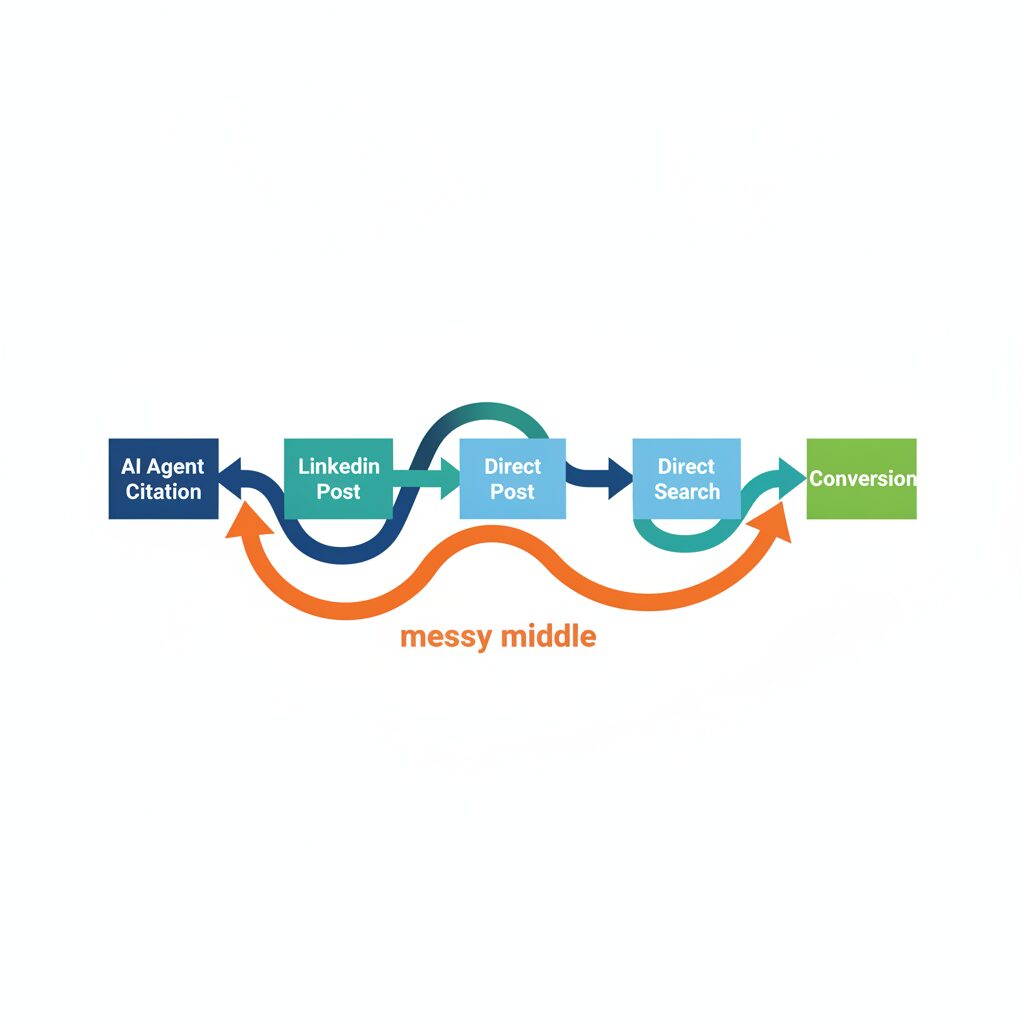
Old tracking relied on third-party cookies to stitch together a user journey. Those cookies are dead. We are now in the “messy middle.” This is a space where users loop between exploration and evaluation across four different devices without a single persistent identifier to tie them together.
Why the ‘messy middle’ breaks traditional tracking
I’ve watched this play out with B2B buyers. A lead in 2026 might find your service through a generative AI citation, read a LinkedIn post on their phone during a commute, and finally convert via a direct search on a desktop two days later. Standard tools see three different people. This fragmentation creates the “vampire effect.” One high-converting channel looks like a hero, while the supporting channels that actually did the heavy lifting look like waste.
The result is a budget disaster. I’ve seen founders cut their top-of-funnel content because it showed zero direct conversions. Three weeks later, their lead volume collapses. The channel didn’t fail. The measurement model did.
First-party data as the foundation for zero-waste PPC
The only way out is the aggressive collection of first-party data. You must incentivize users to identify themselves early. Use gated high-value tools or direct lead magnets to build your own map of the journey. A 2026 industry analysis by Marketing Metrics Lab found that firms using first-party data for attribution saw a 22% increase in marginal ROI compared to those trusting platform-reported data.
Owning the data removes the guesswork. You can prove that a specific zero-waste PPC campaign sparked the initial awareness, even if the sale happened via a direct URL. This turns your marketing from a series of expensive bets into a precise operation.
Integrating offline and online touchpoints under one roof
For multi-location businesses, the gap between digital intent and a physical visit is where the most data leaks. A user might chat with an AI agent on WhatsApp and then walk into your office. If those systems don’t talk, the ROI of your digital spend is invisible.
You need a unified identity graph. By linking CRM data with digital touchpoints, you can track a lead from the first AI interaction to the final signed contract. This integration lets you scale without the fragmented, “best-guess” reporting you usually get from traditional agencies.
The rise of AI agent tracking and zero-click attribution
The biggest pivot in 2026 is the shift from user-driven clicks to agent-driven actions. Customers aren’t always visiting your site to convert. They are hiring AI agents to do the shopping for them.
Tracking conversions when AI agents book for the user
Agentic AI now handles the logistics. A user tells their personal AI, “Find the best growth marketing agency in Nashik and book a consultation.” The agent scans the web, evaluates your credentials, and hits your API to schedule the call.
The user never clicked a link. Your old model records this as “Direct/None.” To fix this, you must deploy agentic AI for marketing tracking. This means monitoring API calls and agent-specific referral strings to credit the source the AI used to find you.
Measuring value in zero-click search environments
Search is no longer about traffic. It is about citations. In a zero-click environment, the AI provides the answer on the search page. Your click-through rate (CTR) will drop. But the people who actually do click are far more qualified.
You have to track “Brand Lift” and “Citation Volume.” 2026 data from SearchIntelligence shows that brands optimizing for zero-click SEO strategy saw a 40% increase in direct-to-site traffic, despite a 20% drop in organic clicks. The value is the authority the AI grants you. The click is just a formality.
Predictive attribution: Using AI-powered growth to forecast LTV
Static attribution looks at the past. Predictive attribution looks at the future. By applying machine learning to historical paths, you can find the specific sequence of touchpoints that leads to the highest Lifetime Value (LTV) customers.
You might discover that users who read a whitepaper and then see a specific LinkedIn ad have a 3x higher LTV than those from a Google Ad. Once you see that pattern, you move your budget to replicate it. That is the core of AI-powered growth.
Building your AI-powered growth attribution framework
A strategy is only as good as its execution. To stop the opaque reporting, you need a framework that chooses accuracy over simplicity.
Data-driven attribution (DDA) vs. rule-based models
Rule-based models, like linear or time-decay, are just guesses dressed up as math. They assign value based on a rigid rule, not actual human behavior. Data-driven attribution (DDA) uses algorithms to analyze every touchpoint in a path and assigns credit based on how much that point actually moved the needle.
In a 2026 test by the Growth Engineering Group, DDA cut wasted ad spend by 18% in a single quarter. It did this by killing channels that looked successful in last-click models but contributed zero incremental growth.
Setting up a real-time dashboard for radical transparency
Reports that arrive 30 days late are autopsies. They tell you why you died, not how to live. You need a real-time dashboard that merges ad spend, CRM data, and AI agent logs into one view. This allows for rapid pivots.
Avoid “metric bloat.” Don’t track everything. Focus on three numbers: Customer Acquisition Cost (CAC) by channel, Marginal ROI, and the Velocity of the conversion path. When these are live, “we think” and “maybe” disappear from your growth meetings.
Connecting multi-channel campaigns to actual revenue
The final link is the bank account. Many agencies report “leads.” Leads are a vanity metric. An omnichannel strategy must track actual revenue. By integrating your payment processor with your attribution tool, you see which campaign produced the most profitable clients, not just the most form submissions.
Eliminating waste: From fragmented data to zero excuses
The point of attribution is not just to know what works. It is to have the courage to cut what doesn’t. Most companies fail here because they are emotionally attached to a specific channel.
Identifying ‘vampire’ channels that steal credit without adding value
Vampire channels appear at the end of the path but don’t drive the decision. Branded search is the classic example. A user sees three of your ads and decides to buy. Then, they search your brand name to find the login page. Last-click attribution gives 100% of the credit to that final search.
Use a position-based or DDA model. You will see that branded search was just the final step of a journey that started elsewhere. When you spot these vampire channels, you can stop over-spending on them and move that money to the channels that actually generate demand.
Reallocating budget based on live tracking and marginal ROI
The most efficient way to scale is to focus on marginal ROI. Ask yourself: “If I spend one more dollar here, how much additional revenue comes back?”
As you spend more, ROI usually drops. A channel might have a 5x ROI at $1,000 a month, but only a 1.2x ROI at $10,000. Live tracking lets you find the ceiling for each channel. You can move the budget to the next efficient source before you hit diminishing returns. This is how you lower B2B customer acquisition cost without slowing down growth.
Frequently Asked Questions
What is the difference between multi-touch and omnichannel attribution?
Multi-touch tracks a few digital silos. Omnichannel integrates everything, including offline events and AI agent actions, into one single customer identity.
How do you track conversions from AI search engines like Perplexity or Gemini?
You track these through brand lift metrics, citation volume, and AI-specific referral headers. Since these are often zero-click, you monitor the spike in direct traffic following a surge in AI citations.
Can small businesses implement AI agent tracking without a massive budget?
Yes. Use lightweight API listeners and CRM integrations. The heavy lifting is in the data structure, not the price of the software.
How does zero-click attribution impact SEO strategy in 2026?
It changes the goal. You stop chasing clicks and start chasing accuracy and prominence in AI citations. You want to be the definitive answer the AI provides, which pulls in high-intent direct traffic.
Which attribution model is best for B2B startups with long sales cycles?
Data-driven attribution (DDA) is the clear winner for long cycles. It catches touchpoints from six months ago that rule-based models usually ignore.
How does first-party data solve the cookieless problem?
First-party data relies on direct consent. It creates a permanent link between the user and their journey that doesn’t break when a browser blocks a cookie.
What is a ‘vampire channel’ in marketing?
A vampire channel is a touchpoint that shows up late in the journey and steals credit for a conversion it didn’t actually influence.
Why is real-time reporting better than monthly reports?
Real-time reporting lets you move money the moment a channel dips. Monthly reports just tell you why you lost money four weeks ago.
Stop guessing and start scaling
Fragmented marketing is a liability. When your tech and your marketing live in separate silos, you create blind spots. Your competitors will find those spots and exploit them.
By implementing an omnichannel attribution strategy based on radical transparency and AI-powered growth, you stop gambling and start scaling. If you are tired of opaque reports and hidden fees from traditional agencies, it is time to bring your tech and marketing under one roof. Stop letting your budget leak into vampire channels. Book a growth audit to see your real-time ROI. No credit card required, no obligation.
Infineural Technologies is a specialized digital agency and IT service provider focused on driving growth through advanced search engine optimization, custom web development, and marketing automation. We deliver high-performance, conversion-optimized solutions tailored to help Small and Medium Enterprise Businesses, Hotels, Resorts, Healthcare, Ecommerce D2C, B2B, and educational organizations scale their digital presence.
- Search Engine & Generative Engine Optimization Specialists
- Google Ads Management & Performance Marketing Experts
- Advanced WordPress & Custom Web Application Developers
- B2B, D2C & Enterprise Conversion Rate Optimization (CRO) Leaders
- Digital Growth Partners for Hospitality, Healthcare, and Education
This article was drafted with AI assistance and thoroughly reviewed, edited, and fact-checked by our editorial team before publishing.