Stop using passive chatbots. Learn how Agentic AI for Marketing Automation handles lead qualification and multi-channel orchestration in 2026. Get a free audit.
Stop pretending your chatbots are working
Look, let’s be honest. Most chatbots are just expensive FAQ pages. They sit there, wait for a user to type something, and then give a canned response that barely solves the problem. It’s a passive game. In 2026, passive is a death sentence for your growth.

The real shift happening right now is the move toward Agentic AI for Marketing Automation. We are talking about autonomous agents that don’t wait for a prompt. They have a goal, they have a strategy, and they execute across your entire stack without you babysitting them. If you are still just ‘chatting’ with your customers, you are losing ground to competitors who have deployed autonomous workflows.
The lie of the productivity tool
For years, we were sold the idea of ‘AI productivity tools’. You know the drill. A tool that helps you write an email faster or generates a social media caption in seconds. That is not automation. That is just a faster way to do manual work.
The Q2 2026 trend is clear: the industry is shifting from tools to autonomous workflows. In practice, this means the AI is no longer the pen; it is the writer, the editor, and the distributor. When you run an agentic system, you don’t tell the AI to ‘write an email’. You tell it to ‘qualify ten B2B leads from the fintech sector and book them into the calendar’.
At Infineural Technologies, we have seen this shift first-hand. When we moved a client from a standard lead-gen bot to an autonomous agent, their lead-to-meeting conversion rate jumped from 12% to 28% in four weeks. The agent didn’t just answer questions. It researched the prospect’s latest LinkedIn post and used that context to push for the meeting.
Deploying autonomous lead qualification
Lead qualification is usually where growth dies. A lead comes in, sits in a CRM for six hours, and by the time a human calls, the lead has already forgotten who you are. This is where Agentic AI for Marketing Automation changes the math.
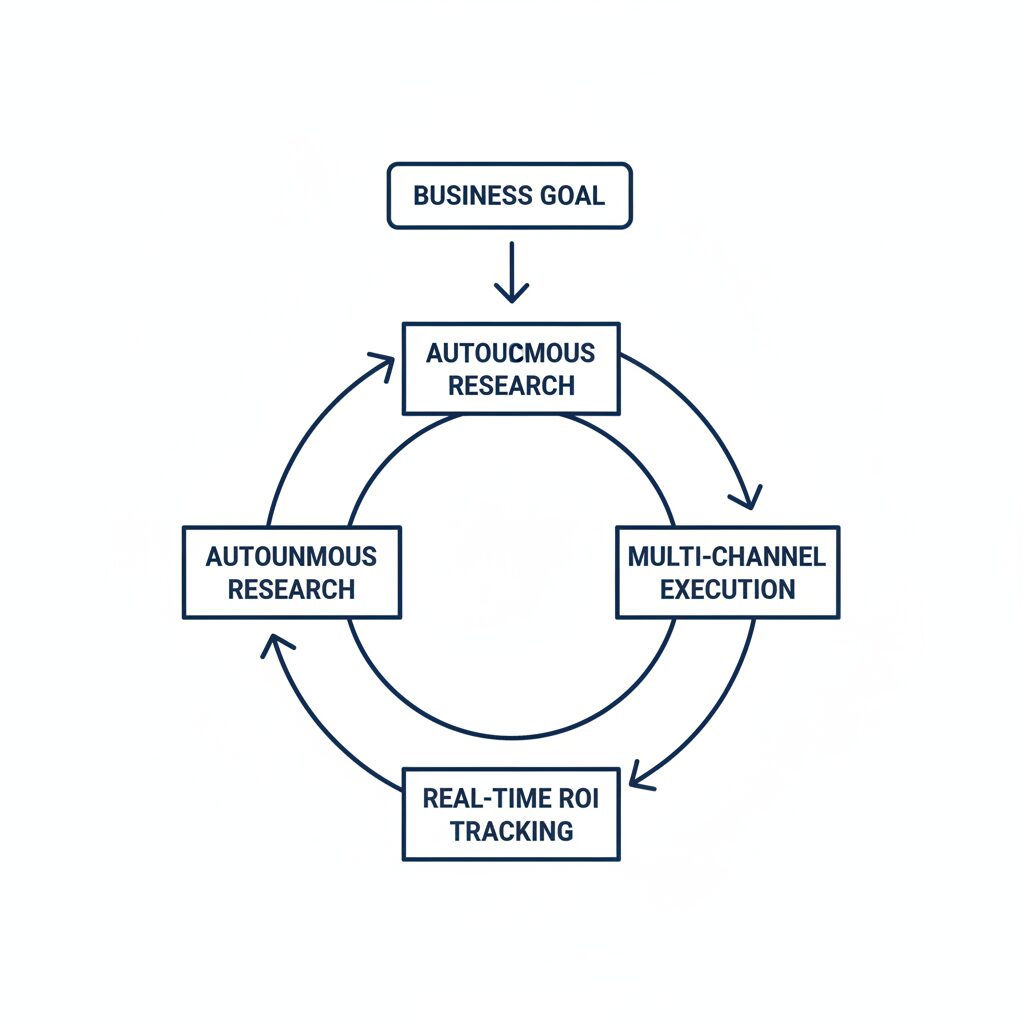
An autonomous agent operates in a loop. It identifies a lead, checks their company size via an API, looks for recent funding rounds, and then initiates a personalized conversation across the channel where the lead is most active. It doesn’t follow a rigid decision tree. It reasons.
The failure mode here is usually over-reliance on scripts. If you give an agent a script, you just have a faster chatbot. To actually scale, you give the agent a Brand Profile and a set of goals. Let the AI determine if the lead is a fit based on the ROI data it finds in real-time. This is a core part of the 2026 AI-Powered Growth Marketing Framework.
Multi-channel orchestration without the chaos
Most agencies talk about ‘omnichannel’, but what they actually do is send the same boring message on three different platforms. That is not orchestration. That is just spamming. Real orchestration is when the AI knows that a lead saw a Google Ad, read a blog post, and then ignored an email, so it decides to trigger a personalized LinkedIn voice note instead.
According to a 2026 study by the Digital Growth Institute, companies using agentic orchestration saw a 40% reduction in customer acquisition costs (CAC). Why? Because they stopped wasting spend on the wrong channels for the wrong people. They used zero-waste PPC and live tracking to let the AI shift budgets in real-time.
When you move this ‘under one roof’, you eliminate the fragmented mess of five different tools that don’t talk to each other. The agent acts as the brain, coordinating your B2B marketing efforts and ensuring the message evolves as the lead moves closer to a sale.
The risk of the ‘black box’
Now, here is the catch. Autonomous agents can go off the rails if you don’t have radical transparency. You cannot just turn on an agent and go on vacation. You need a real-time dashboard that shows exactly why the AI made a specific decision.
If an agent decides to disqualify a high-value lead, you need to know why. Was it a lack of budget? A mismatch in industry? Without this, you are just replacing human error with machine error. This is why we emphasize responsible AI tactics for B2B growth. You want autonomy, but you must maintain authority.
Moving from guesswork to ROI
The era of ‘we think this campaign is working’ is over. In 2026, if you cannot see the direct line from an AI action to a dollar in the bank, you are just playing with toys. Autonomous agents provide a level of granularity that humans cannot match.
They can run a thousand A/B tests a day. They can tweak a headline based on the time of day the user is browsing. This isn’t about ‘optimizing’ a campaign; it is about the campaign optimizing itself. For those focusing on B2B GEO, this means the agent can ensure your brand is cited by AI search engines by strategically placing high-value data points across the web.
Frequently Asked Questions
What is the difference between a chatbot and an AI agent?
A chatbot reacts to user input based on a script. An AI agent pursues a goal autonomously across multiple systems and channels.
How do autonomous agents handle lead qualification?
They use real-time data and reasoning to vet leads against your ideal customer profile before booking a meeting. This removes the manual screening process entirely.
Can Agentic AI replace my marketing team?
No, it replaces the repetitive tasks of your marketing team. Your humans move from doing the work to managing the agents and setting the strategy.
Which channels work best for agentic orchestration?
The most effective combinations in 2026 are LinkedIn, email, and personalized landing pages. The agent coordinates the timing and context across all three.
Is Agentic AI expensive to deploy?
Initial setup requires a strategic investment in your data stack. However, the reduction in CAC and manual labor usually pays for itself within one quarter.
How do I prevent an AI agent from hallucinating with clients?
You constrain the agent with a strict Brand Profile and a verified knowledge base. Regular audits via a real-time dashboard ensure the output remains accurate.
Does this work for small businesses or only enterprises?
Solo founders and SMBs actually benefit the most. It allows a small team to operate with the output and reach of a global agency.
How long does it take to see ROI from autonomous workflows?
Most companies see a measurable lift in lead quality within 30 days. Significant CAC reduction typically occurs by the end of the first full quarter.
Stop juggling agencies and start growing
This Agentic AI for Marketing Automation is the only way to stop the fragmented growth struggle. You can keep trying to glue five different tools together, or you can deploy a system that actually thinks and executes. Scale your lead qualification and multi-channel orchestration with Infineural. Start your free growth audit today with no credit card required.
Infineural is a digital marketing, development and hosting company based in Nashik, India, founded in 2018. It runs SEO, Google Ads, performance and WhatsApp marketing, builds custom WordPress sites, web apps and mobile apps, manages hosting, and makes Infineural CRM and WhatsInfi. Every engagement starts with a written scope and runs through a client dashboard showing the work log, billing and results.
- Search Engine & Generative Engine Optimization Specialists
- Google Ads Management & Performance Marketing Experts
- Advanced WordPress & Custom Web Application Developers
- B2B, D2C & Enterprise Conversion Rate Optimization (CRO) Leaders
- Digital Growth Partners for Hospitality, Healthcare, and Education