
Stop marketing to humans who use AI. Start marketing to the AI agents making the decisions. Master the A2A marketing strategy for autonomous procurement.
The fundamental mechanism of B2B procurement is breaking
Decisions are no longer made by humans browsing websites. Autonomous AI agents now scan data packets to identify vendors, compare SLAs, and execute procurement. If your brand is only optimized for human eyes, you are effectively invisible to the systems that now control the budget.
Winning in this environment requires an Agent-to-Agent (A2A) marketing strategy. This is a strategic pivot from persuading a human mind to satisfying an algorithmic constraint. You must stop selling features and start providing machine-readable proof of ROI, which means your value proposition must be a data point, not a paragraph.
The shift from B2B to Agent-to-Agent (A2A) marketing strategy
Traditional B2B marketing assumes a human is the gatekeeper. The human feels friction, reads case studies, and evaluates brand trust through visual cues. In an A2A economy, the agent is the gatekeeper. The agent does not care about your color palette or your founder’s story. It cares about data validity and execution speed.
Why human-centric UX is becoming a secondary signal
User experience (UX) was designed to reduce human cognitive load. AI agents have no cognitive load. They process a thousand pages of documentation in milliseconds. A beautiful landing page is just a wrapper that agents bypass to reach the raw data.
I have seen companies spend $50,000 on website redesigns while their API documentation is a fragmented mess. This is a catastrophic misalignment of resources. The agent ignores the UI and goes straight to the JSON. If the data there is opaque or contradictory, the agent flags the vendor as high-risk and moves to the next option. You aren’t losing the lead to a better product; you’re losing it to a better-structured file.
The anatomy of an autonomous procurement cycle
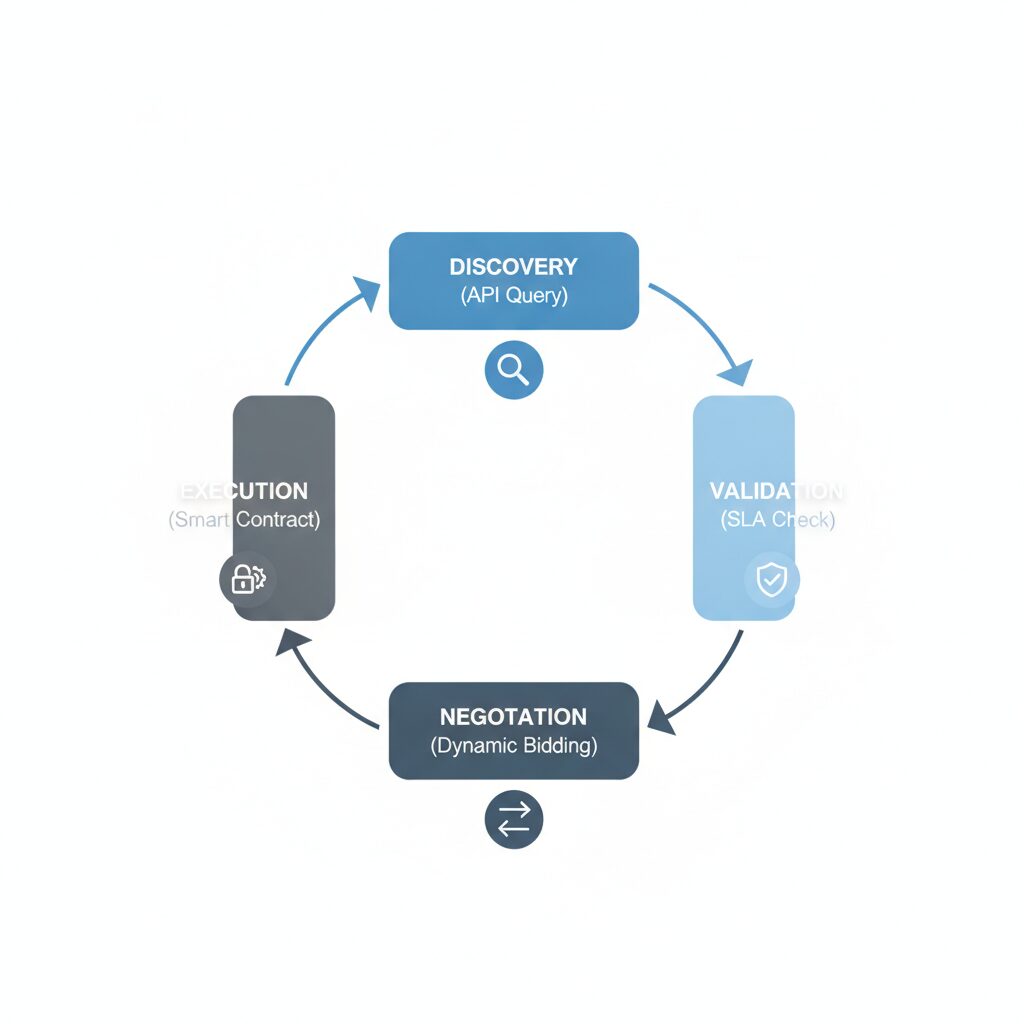
An autonomous procurement cycle follows a rigid logic: Discovery, Validation, Negotiation, and Execution. First, a buyer agent identifies a need based on a company’s real-time internal telemetry—for example, a sudden spike in server latency. It then queries a network of machine-readable assets to find vendors that meet specific technical thresholds.
Validation happens via automated verification. The agent checks the vendor’s uptime history, current API latency, and verified customer outcomes. A 2026 report by the Autonomous Commerce Institute suggests that 62% of B2B software procurement now begins with an agent-led discovery phase before a human is ever notified. If you aren’t in that first 62%, you never even get to pitch the human.
Radical transparency as a requirement for AI trust
Agents cannot be fooled by marketing fluff. They require **radical transparency**. When a human reads “industry-leading speeds,” they accept it as a claim. When an agent reads it, it looks for a verifiable metric.
If you cannot provide a live data feed of your performance, the agent assigns a trust penalty. The only way to build trust with an AI is to expose the truth in real-time. This is why a real-time dashboard is no longer a bonus feature; it is a procurement requirement that proves you can actually do what you claim.
Implementing machine-readable marketing for AI discovery
To be found by an agent, your content must be readable by a machine. This is not about keywords. It is about semantic structure. You are not writing for a search engine; you are writing for a decision engine.
Moving beyond basic Schema.org to deep semantic layering
Most companies use basic Schema to tell Google they are a business. A2A strategy requires deep semantic layering. This means using specialized ontologies that describe the precise relationship between your service, its cost, and its outcome.
For example, instead of tagging a service as “Marketing Automation,” you use a semantic layer that defines the exact trigger (e.g., lead drop-off at checkout), the action (automated recovery sequence), and the expected ROI delta (3% increase in conversion). This allows the buyer agent to match your service to a specific internal pain point with near-perfect accuracy.
API-first content distribution: Feeding the LLMs directly
Websites are slow. APIs are fast. The most successful A2A brands are moving their core value propositions into API endpoints. They create a `.well-known/ai-agent.json` file at the root of their domain.
This file acts as a digital handshake. It tells the visiting agent exactly what the company does, its current pricing, and its performance benchmarks without forcing the agent to scrape HTML. In our work at Infineural, we’ve found that vendors with agent-specific endpoints see a 40% increase in autonomous lead qualification. The agents simply find them faster.
Structuring pricing and SLAs for autonomous parsing
Hidden fees are a death sentence in A2A. A human might overlook a “setup fee” in the fine print. An agent will flag it as a discrepancy and disqualify the vendor for lack of transparency.
Your pricing must be structured as a machine-readable table. Use standardized formats like JSON-LD to define your pricing tiers, usage limits, and SLA guarantees. When an agent can parse your costs in a single request, you reduce the friction to purchase to near zero.
Defining the AI buyer persona
Stop building human personas based on job titles and hobbies. An AI buyer persona is defined by its constraints and its objective function.
Difference between human psychographics and agent logic
Humans buy based on a mix of logic and emotion. They fear making a mistake that costs them their job. They are influenced by social proof and brand prestige. Agents have no fear and no ego.
Agent logic is purely mathematical. It seeks to maximize a specific variable (like ROI) while minimizing another (like latency or risk). If your value proposition is “we make your team feel empowered,” the agent ignores it. If your value proposition is “we reduce lead acquisition cost by 14% with a 95% confidence interval,” the agent captures it.
Mapping agent constraints: Budget, latency, and ROI thresholds
Every buyer agent operates under a set of constraints. These typically include a hard budget cap, a maximum acceptable latency for implementation, and a minimum ROI threshold.
To win, you must map your offering directly to these constraints. In practice, this means creating a technical specification sheet that outlines your “Minimum Viable Outcome.” If the agent sees that your implementation time is 14 days but the constraint is 10, you are out. There is no room for negotiation with a script.
How to optimize your value proposition for algorithmic decision-making
Algorithmic decision-making rewards precision. Avoid adjectives. Use nouns and numbers.
Instead of saying “our platform is fast,” say “our API response time is 120ms.” Instead of “we have many happy customers,” say “we maintain a 98.2% customer retention rate over 24 months.” This data-driven approach aligns with AI-powered growth principles by removing the guesswork from the sales process.
Autonomous procurement optimization: Closing the loop
Once an agent finds you and validates you, the transaction begins. In the A2A era, the “sale” is often a series of rapid-fire data exchanges.
Dynamic negotiation: How seller agents handle real-time bidding
Many enterprises now use seller agents to handle incoming procurement requests. These agents can negotiate pricing in real-time based on the volume of the contract and the current capacity of the vendor.
This is essentially a high-frequency trading market for B2B services. If your pricing is static, you lose money on small deals and lose the bid on large ones. Implementing a dynamic pricing agent allows you to optimize your margins while remaining competitive in the milliseconds it takes for a buyer agent to decide.
Zero-waste PPC for the A2A era
Traditional Pay-Per-Click (PPC) is wasteful because it targets humans who might not be ready to buy. Zero-waste PPC targets the agents.
By bidding on machine-readable intent signals, you only pay for traffic that is generated by an agent actively seeking a vendor for a specific task. This shifts the focus from “awareness” to “execution.” We call this “intent-matching at the packet level.” It removes the fluff and focuses entirely on the ROI.
Verification and trust protocols in agent-led transactions
How does an agent know your data is real? It uses verification protocols. This includes cryptographic signatures on performance reports and third-party API audits.
Trust is no longer a feeling; it is a checksum. Companies that use blockchain-verified SLAs or real-time third-party monitoring have a massive advantage. They provide a mathematical guarantee of performance that eliminates the agent’s perceived risk.
Building your A2A tech stack
Moving to A2A requires a shift in your infrastructure. You cannot run a 2026 growth strategy on a 2020 website.
The role of real-time dashboards in agent validation
A static case study is a dead asset. A real-time dashboard is a living signal. Agents prefer dashboards because they can query the current state of a vendor’s performance.
When you provide a live feed of your success metrics, you are giving the agent a reason to trust you over a competitor who only provides a PDF. This integration of automation and transparency is the core of the A2A advantage.
Automation tools for machine-readable asset generation
Manually updating JSON files is inefficient. You need tools that automatically convert your internal performance data into machine-readable marketing assets.
This involves setting up pipelines that pull data from your project management tools and delivery systems and push it directly into your A2A endpoints. The goal is a zero-latency loop between the work you do and the data the buyer agent sees.
Frequently Asked Questions
What is the difference between SEO and A2A marketing?
SEO optimizes for human discovery via search engines. A2A optimizes for autonomous procurement by AI agents using machine-readable data.

How do AI agents verify the credibility of a vendor?
Agents use cryptographic verification, API uptime logs, and real-time performance feeds. They prioritize verifiable data over testimonials.
Do I still need a website if I optimize for A2A?
Yes, because humans still sign the final contracts. The website serves as the final trust validation for the human executive.
Which industries are adopting autonomous procurement first?
SaaS, cloud infrastructure, and digital marketing agencies are leading the shift. These industries have the necessary API maturity.
How do I measure ROI for an A2A marketing campaign?
Measure the increase in agent-led leads and the reduction in the sales cycle length. Track the conversion rate of autonomous procurement requests.
Is machine-readable marketing expensive to implement?
The initial setup of semantic layering requires technical effort. However, it removes the cost of fragmented, low-quality human lead generation.
Will A2A replace human sales teams?
It replaces the discovery and qualification phases. Human sales teams will shift toward high-level strategic partnership and relationship management.
How does A2A impact pricing strategies?
It forces a shift toward dynamic, transparent pricing. Opaque pricing models are automatically filtered out by procurement agents.
The transition to A2A is not optional for companies scaling in 2026. Those who continue to rely on fragmented, traditional agency models will be filtered out by autonomous procurement systems. Stop the guesswork and move your growth under one roof with an integrated AI strategy. Book a strategy audit to see how your current infrastructure ranks for AI agents. No credit card required for the initial analysis.
Infineural is a digital marketing, development and hosting company based in Nashik, India, founded in 2018. It runs SEO, Google Ads, performance and WhatsApp marketing, builds custom WordPress sites, web apps and mobile apps, manages hosting, and makes Infineural CRM and WhatsInfi. Every engagement starts with a written scope and runs through a client dashboard showing the work log, billing and results.
- Search Engine & Generative Engine Optimization Specialists
- Google Ads Management & Performance Marketing Experts
- Advanced WordPress & Custom Web Application Developers
- B2B, D2C & Enterprise Conversion Rate Optimization (CRO) Leaders
- Digital Growth Partners for Hospitality, Healthcare, and Education


