
Stop relying on static personas. Use an AI market segmentation strategy to deploy real-time clustering and predictive behavioral segments for zero-waste ROI.
The death of the static buyer persona
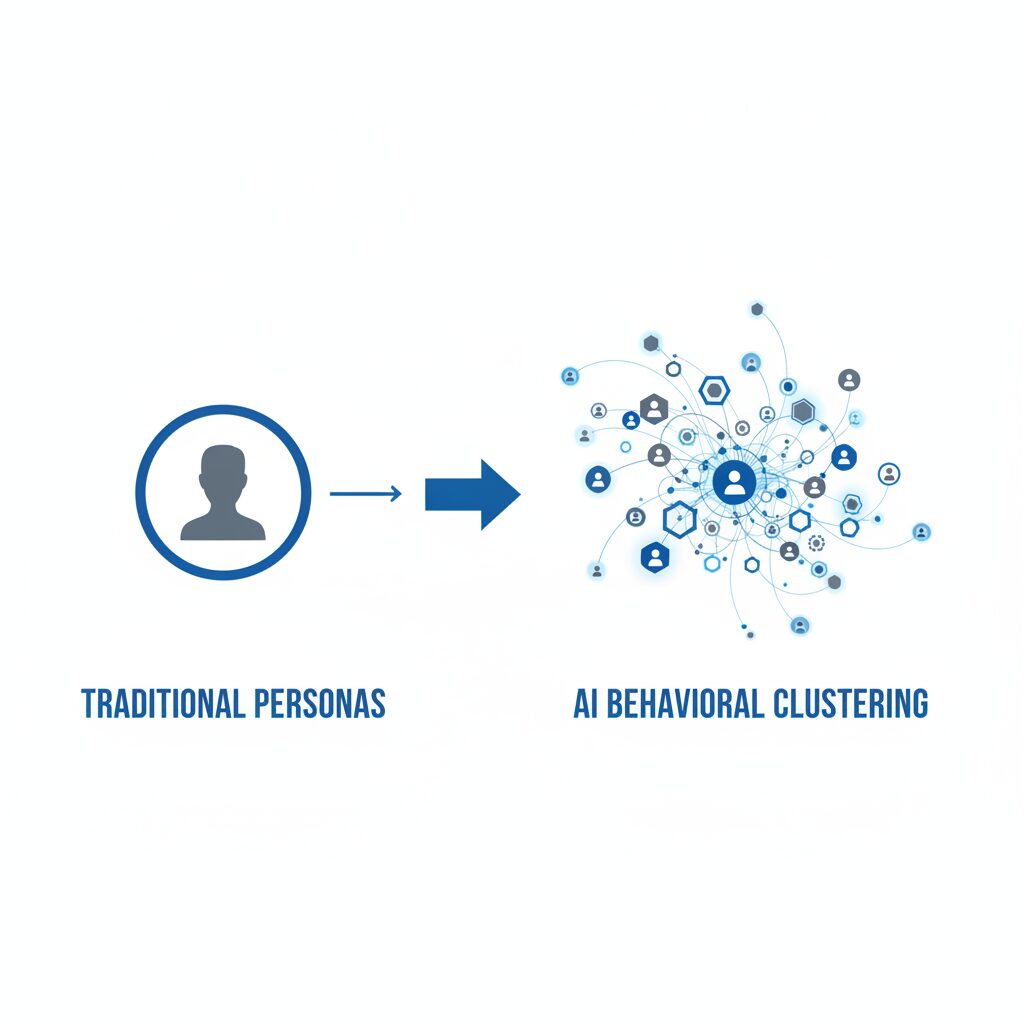
The static buyer persona is a failure of diagnosis. Most companies rely on a PDF created six months ago that describes a “typical” customer based on age, job title, and location. But in 2026, consumer behavior shifts in milliseconds. Relying on a fixed profile isn’t a strategy; it is a guess masquerading as a plan.

A real AI market segmentation strategy replaces these rigid descriptions with live data streams. It shifts the focus from who a customer is to what they are doing right now, which means you stop targeting a demographic “average” and start targeting actual intent. For high-growth companies, this is how you find hidden profit pockets and deploy personalization that actually converts because it reacts to a user’s current state of mind.
Beyond the buyer persona: The power of real-time audience clustering
Traditional segmentation fails because it assumes people in the same bucket behave the same way. It’s a logical fallacy. A 34-year-old founder in Austin and a 34-year-old founder in London share a job title, but their buying triggers are likely worlds apart. When you segment by demographics, you average out your audience. You end up with a message that is vaguely relevant to everyone and deeply compelling to no one.
Why traditional demographic segmentation burns cash for early-stage startups
Startups don’t have the luxury of “brand awareness” spend. They cannot afford the waste that comes with broad targeting. When you lean on demographics, you pay for clicks from people who fit the profile but have zero intent to buy. I’ve seen early-stage B2B firms waste 40% of their initial ad spend on “ideal” personas who were simply browsing. The failure mode here is simple: trusting a static profile over a live pattern.
How real-time audience clustering identifies organic patterns
AI clustering algorithms don’t care about job titles or ZIP codes. They look for mathematical similarities in behavior. They group users based on page depth, how long they linger on pricing tiers, which specific feature docs they read, and where they came from. This is real-time audience clustering.
Instead of guessing who your segments are, you let the data reveal them. You might discover a cluster of users who only visit your site on Tuesday mornings and exclusively read your API documentation. That is a distinct behavioral segment. It doesn’t fit a pre-written persona, but it represents a specific, high-intent need that you can target with surgical precision.
Moving from ‘who they are’ to ‘what they do’ in 2026
The strategic pivot for 2026 is the abandonment of the identity-first approach. Identity is slow. Behavior is fast. By focusing on predictive behavioral segments, companies stop chasing the “ideal customer” and start chasing the “ideal signal.” This is the only way to achieve AI-powered growth marketing that scales without letting your cost per acquisition (CAC) spiral out of control.
Identifying high-value leads with predictive behavioral segments
Not all leads are created equal, yet most lead scoring systems are primitive. They assign points for an email open or a whitepaper download. These are vanity metrics. A lead who downloads five whitepapers but never touches the pricing page is a researcher, not a buyer. Treating them the same is a waste of sales resources.
Defining predictive behavioral segments for B2B and B2C
Predictive segmentation uses machine learning to isolate the traits of your most profitable customers and then scans new visitors for those same markers. In practice, the AI identifies a “buying sequence”—the specific trail of breadcrumbs that usually leads to a closed deal. When a new user hits that sequence, they are instantly flagged as high-priority, which means your sales team spends their time on the 5% of leads most likely to close today.
Using AI to forecast Lifetime Value (LTV) before the first purchase
The most aggressive growth teams now forecast LTV during the very first session. A 2026 analysis by the Growth Intelligence Group suggests that companies using predictive LTV modeling saw a 22% increase in net profit by reallocating spend toward high-value clusters. They stopped spending the same amount to acquire a low-value user as they did for a “whale.”
If the AI detects that a user’s behavior mirrors your top 5% of customers, you can afford to bid higher for that lead in a zero-waste PPC campaign. You are no longer bidding on generic keywords; you are bidding on predicted future revenue.
Reducing churn by spotting ‘at-risk’ behavioral triggers
Segmentation isn’t just for the top of the funnel. It is your best defense against churn. AI can spot “quiet churn”—the subtle drop in login frequency or a shift in how a user interacts with a core feature. When a user drifts into an “at-risk” cluster, the system triggers a personalized intervention. This is far more effective than a generic “we miss you” email sent 30 days after the user has already mentally quit your product.
Executing hyper-personalization at scale without the friction
Many companies can segment their audience, but few can actually act on those segments in real time. The gap between knowing a user is “high-intent” and showing them a tailored offer is where most revenue leaks.
The gap between segmentation and execution
Traditional marketing stacks are fragmented. Data lives in the CRM, segments are managed in a separate tool, and the website is a static shell. By the time the data syncs, the user has already bounced. To fix this, you need hyper-personalization at scale, where the segment trigger and the content delivery happen in the same millisecond. No lag. No disconnect.
Dynamic content delivery: Matching segments to live intent
When a user from a “technical decision-maker” cluster lands on your home page, they shouldn’t see the same headline as a “CEO.” The technical user needs to see API latency and integration speed. The CEO needs to see ROI and market share. This isn’t just about swapping a name in an email; it’s about changing the entire value proposition based on the cluster.
This level of precision requires an integrated marketing automation setup. Your content must be dynamic, pulling from a library of assets that match the specific intent of the cluster in real time.
The role of automation in maintaining segment hygiene
Segments aren’t permanent. A user who is “exploring” today may be “ready to buy” tomorrow. Automation handles the movement of users between clusters, which removes the manual grind of updating lists. Without this, you get “segment drift”—the embarrassing mistake of sending a bottom-of-funnel discount to someone who already paid full price yesterday.
Building a zero-waste PPC engine with AI segmentation
Most PPC campaigns are wasteful because they target keywords. Keywords are a blunt instrument. The word “automation” could be searched by a college student writing a paper or a CTO looking to save $1M in operational costs. Paying the same for both is a strategic error.
Eliminating spend on low-intent clusters
A zero-waste engine uses AI to analyze which behavioral clusters actually convert. You might find that users from a specific LinkedIn ad cluster convert at 10%, while a broad Google search cluster converts at 0.5%, even if the cost per click is identical. The strategy is to aggressively prune the low-intent clusters, regardless of how “cheap” the clicks appear on a report.
Connecting real-time dashboards to ad spend
Radical transparency requires a live feedback loop. When ad spend is linked to AI segments, you see the ROI per cluster as it happens. If a behavioral cluster starts underperforming, the system shifts budget to a higher-performing one automatically. The “monthly budget review” is dead; optimization now happens every hour.
Case study: Shifting from broad keywords to behavioral clusters
We recently worked with a B2B SaaS client who was targeting “enterprise CRM” keywords. We shifted them to “high-intent behavioral clusters.” We found that users who visited the “integrations” page twice within 48 hours were 4x more likely to convert. By ramping up bids for this specific cluster and cutting broad keywords, the client reduced their CAC by 31% and increased lead quality by 18% in a single quarter.
Integrating your growth stack under one roof
The biggest obstacle to this strategy is fragmented data. When your web team, your SEO agency, and your PPC firm use different tools, you create silos. Data trapped in a silo is useless for AI.
The danger of fragmented agency data silos
Some agencies protect their “secret sauce” by keeping their data separate. This is a failure of transparency. If your PPC agency doesn’t know which clusters are actually converting on the site, they are optimizing for clicks, not revenue. You end up paying for a “successful” campaign that produces zero qualified leads.
Creating a single source of truth for AI-powered growth
To win in 2026, you must integrate marketing and tech. A single source of truth allows the AI to see the entire journey—from the first click to the final contract. This coherence is the foundation of AI-driven RevOps. When data flows freely, segmentation becomes a precision tool rather than a guessing game.
Frequently Asked Questions
What is the difference between AI clustering and traditional segmentation?
Traditional segmentation uses pre-defined rules (age, location). AI clustering identifies hidden behavioral patterns that are invisible to the human eye.
How do you implement predictive behavioral segments without a massive data science team?
You use integrated AI growth platforms. These tools handle the heavy mathematics and hand your marketing team actionable segments they can actually use.
Can AI market segmentation work for small SMBs with limited data?
Yes. AI is often more effective for SMBs because they can’t afford the waste of traditional targeting. Even small datasets can reveal high-impact patterns.
How often should AI-driven audience clusters be refreshed?
In real time. The entire value of AI segmentation is its ability to adapt the moment a user’s behavior changes.
Which tools are best for achieving hyper-personalization at scale in 2026?
Look for Customer Data Platforms (CDPs) that offer native AI clustering and direct API integrations with your CMS and ad platforms.
Does AI segmentation replace the need for a value proposition?
No. It just ensures your value proposition reaches the person most likely to care about it at the exact moment they are looking for it.
Is AI segmentation compliant with data privacy laws in 2026?
Yes, provided it relies on first-party behavioral data and follows current consent frameworks.
How long does it take to see ROI from an AI segmentation strategy?
Most companies see a drop in CAC within 30 to 60 days as low-intent clusters are stripped out of the ad spend.
Stop guessing who your customer is
Precision growth isn’t about having a prettier persona PDF; it’s about building better data pipelines. An AI market segmentation strategy removes the guesswork and replaces it with radical transparency. When you stop targeting demographics and start targeting behaviors, you stop burning money.
Ready to stop wasting ad spend on the wrong clusters? Book a growth audit with Infineural to integrate your marketing and tech under one roof. Get a clear roadmap to zero-waste growth with no long-term contracts.
Infineural is a digital marketing, development and hosting company based in Nashik, India, founded in 2018. It runs SEO, Google Ads, performance and WhatsApp marketing, builds custom WordPress sites, web apps and mobile apps, manages hosting, and makes Infineural CRM and WhatsInfi. Every engagement starts with a written scope and runs through a client dashboard showing the work log, billing and results.
- Search Engine & Generative Engine Optimization Specialists
- Google Ads Management & Performance Marketing Experts
- Advanced WordPress & Custom Web Application Developers
- B2B, D2C & Enterprise Conversion Rate Optimization (CRO) Leaders
- Digital Growth Partners for Hospitality, Healthcare, and Education