
Stop competing on features. Learn how to build an AI value proposition strategy that drives real ROI and a sustainable B2B competitive advantage in 2026.
The bottom line on AI value propositions
The current B2B approach to AI is fundamentally flawed. Most companies are confusing the tool for the strategy, marketing their products as “AI-powered” as if the technology itself were the value. It isn’t. In a market where every competitor has access to the same frontier models, AI is a utility, not a moat. It is essentially electricity: necessary, but not a competitive advantage. A winning AI value proposition strategy shifts the focus from what the AI does to the specific, measurable business outcome the client actually gets.

To win in 2026, you have to stop selling features and start selling the removal of business friction. I have seen too many firms lean on vague efficiency claims. Instead, move toward ROI guarantees backed by radical transparency. The goal is to make the AI an invisible engine. The actual value is a tangible jump in revenue or a definitive slash in waste.
The commodity AI trap: Why your AI features are not a moat
The race to the bottom in B2B SaaS
Early on, adding a chatbot or a summary tool was enough to get a meeting. That window is slammed shut. Now, AI features are table stakes. If a competitor can replicate your core functionality by tweaking a prompt or switching to a newer model, you have no strategic advantage. You are competing on a feature that costs nearly the same to produce for everyone.
This creates a brutal race to the bottom on pricing. If the only difference between your tool and the next one is the “quality” of the AI output, the customer will eventually just buy the cheapest option. That is the commodity AI trap in a nutshell.
Why feature parity happens in weeks, not years
Software cycles have collapsed. Projections for 2026 suggest the average time for B2B SaaS competitors to reach feature parity on AI tools has dropped from months to less than 21 days. This happens because the “brains” of the operation are outsourced to three or four primary model providers.
When you build your value proposition around a specific capability, like automated reporting, you are building on rented land. The moment the model provider updates the API, your unique edge vanishes. Your strategy must reside in the layers above the model: your proprietary data, your workflow integration, and your deep industry expertise.
The difference between a tool and a solution
A tool is software that helps a user perform a task. A solution is a system that guarantees a result. Most AI companies are selling tools. They tell the customer, “Our AI helps you write emails faster.” That is a tool, which means the customer still has to do the work of managing the tool. A solution says, “We increase your lead-to-meeting conversion rate by 14% using an integrated growth system.”
The first focuses on effort; the second focuses on ROI. The market in 2026 does not want more tools to manage. It wants outcomes delivered under one roof.
Implementing human-centric value design
Mapping AI capabilities to high-stakes business pain
Strategy starts with a diagnosis. You must find the exact point where your customer is bleeding money or wasting hours. AI is only valuable when it solves a problem expensive enough to justify the friction of change. For many SMBs, the pain isn’t a lack of content. It is the agony of a dry pipeline.
Instead of offering an AI content generator, a human-centric strategy offers a system that identifies high-intent signals and triggers a personalized outreach sequence. This maps the AI’s ability to process data to the human’s need for more cash flow. It shifts the conversation from “cool tech” to business growth.
Moving from efficiency gains to outcome-based value
Efficiency is a weak value proposition. Why? Because it asks the customer to do the math. If you tell a founder, “Our AI saves your team 10 hours a week,” they have to calculate hourly rates and decide if the subscription cost is worth the effort. It is a cognitive burden that slows down the sale.
Outcome-based value removes that burden. In our work at Infineural, we have found that clients respond far better to claims of AI-powered growth—like increasing monthly recurring revenue (MRR) by 8%—than they do to time-saving claims. Efficiency is a byproduct. Growth is the goal.
Case study: Reducing churn through predictive AI value
Imagine a B2B SaaS company struggling with a 12% monthly churn rate. A tool-based approach gives them an AI dashboard that flags at-risk customers. That just gives the manager more work to do. A value-based approach builds a system that automatically triggers a retention sequence when usage drops, alerting a human account manager only when the AI cannot resolve the issue.
In one real implementation, this shift from a “flagging tool” to an “automated retention system” reduced churn from 12% to 7% within four months. The value wasn’t the AI’s predictive power. It was the reclaimed revenue.
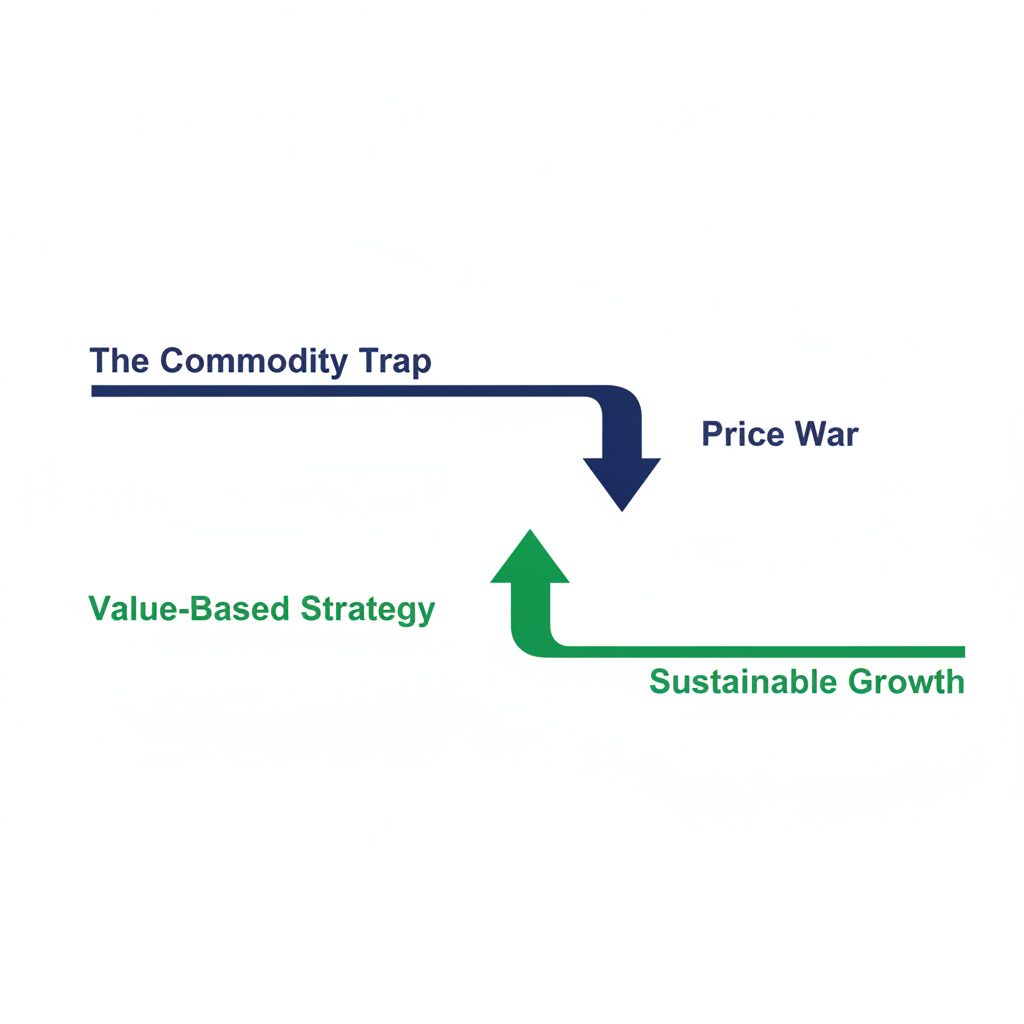
The ROI framework for AI value propositions
Quantifying the AI lift for the end user
To make a value proposition stick, you must quantify the lift. This requires a baseline. You cannot claim an AI lift if you do not know where you started. I use a simple formula for AI lift: (Outcome with AI – Outcome without AI) / Cost of Implementation.
If the lift is not significantly positive, the strategy is failing. Many companies ignore the cost of implementation, such as the time spent training staff or cleaning messy data. A transparent strategy accounts for these costs upfront. This proves that the long-term ROI outweighs the initial headache.
Using real-time dashboards to prove value
Trust in AI is low because AI is usually a black box. To fix this, you need real-time dashboards. These should not show “AI activity,” such as tokens used or prompts run. No one cares about tokens. They should show business KPIs. If the AI is managing a campaign, show the cost per acquisition (CPA) and pipeline value.
When the customer sees the money moving in real time, the value proposition becomes self-evident. This is where integrated marketing and tech solutions outperform fragmented tools. The data flows from the AI agent directly into the revenue report without a single manual entry.
Radical transparency: Admitting where AI fails to build trust
The fastest way to lose a B2B client is to overpromise. Radical transparency means being explicit about the limits of your AI. Tell the client exactly where the AI excels and where a human must step in. For example: “Our AI handles 90% of the lead qualification, but a human expert must finalize the contract negotiation.”
This honesty builds more trust than a claim of total automation. It positions you as a partner who understands business reality, not a vendor selling a magic pill. It also protects your brand when the AI inevitably makes a mistake.
Securing a B2B competitive advantage in 2026
Vertical AI: The power of proprietary data moats
If you want to escape the commodity trap, move toward Vertical AI. This means building a value proposition for a very specific industry—like AI for mid-sized law firms or AI for multi-location dental practices. The advantage here is not the model. It is the data.
Proprietary data is the only sustainable moat left. When you combine a general model with a first-party data strategy, you create a tool that can do things a general AI cannot. A general AI can write a legal brief. But a Vertical AI trained on 10,000 winning briefs from a specific jurisdiction can optimize that brief for a specific judge’s known tendencies.
Integrated ecosystems vs. fragmented AI plugins
The market is exhausted by “plugin fatigue.” Most businesses are juggling fifteen different AI subscriptions that do not talk to each other. The competitive advantage now lies in integration. The company that provides the entire growth stack, from AI competitive intelligence to lead conversion, wins.
By bringing everything under one roof, you stop the data leakage that happens between fragmented tools. You can feed insights from your competitive intelligence directly into your ad copy, which then updates based on real-time conversion data. This creates a closed loop that a fragmented agency simply cannot match.
Combining AI-powered growth with zero-waste PPC
Finally, the most effective AI value propositions link intelligence to spending. Most agencies run PPC campaigns based on historical averages. That is guesswork. An AI-driven strategy uses real-time intent data to shift budget every hour to the highest-performing keywords.
This is the foundation of zero-waste PPC. Instead of guessing which keywords might work, you use AI to identify the exact search patterns of your highest-LTV customers and ignore the rest. The value proposition is no longer “we manage your ads.” It is “we eliminate the wasted spend in your acquisition budget.”
Frequently Asked Questions
What is a value proposition in the context of AI products?
It is a clear statement of the measurable business outcome a customer achieves. It focuses on the result, like a 15% increase in revenue, rather than the technology used to get there.
How do I avoid the commodity AI trap in my B2B marketing?
Stop marketing AI features. Start marketing your proprietary data and integrated outcomes. Focus on solving one specific, expensive problem for a narrow vertical.
What are the best metrics to measure AI-driven ROI?
Focus on lagging indicators like Customer Acquisition Cost (CAC), Life-Time Value (LTV), and Pipeline Velocity. Ignore leading indicators like “number of AI prompts used.”
How does human-centric design differ from standard UX in AI?
Human-centric design in AI focuses on the cognitive load of the user. It prioritizes the outcome over the interface and includes honest transparency about AI limitations.
Can a small startup compete with Big Tech’s AI resources using a value strategy?
Yes. They do this by dominating a narrow vertical and building a proprietary data moat. Big Tech builds general tools; startups win by building specific solutions that Big Tech cannot customize.
Why is radical transparency important for AI B2B sales?
It sets realistic expectations. Admitting the limits of AI prevents churn and positions the provider as a strategic partner rather than a software vendor.
What is the role of a real-time dashboard in an AI strategy?
It turns the AI from a black box into a transparent value-generator. It lets the client see the direct link between AI activity and their bank account.
How does vertical AI create a sustainable moat?
It uses specialized data that general models don’t have. This creates a performance gap that cannot be closed by simply upgrading the underlying LLM.
Stop the guesswork and scale your growth
Building a winning AI value proposition requires moving past the hype. You must focus on the only thing that matters: measurable business growth. When you stop selling AI and start selling outcomes under one roof, you remove the uncertainty for your clients. The companies that win in 2026 will be those that treat AI as a means to an end, not the end itself.
Ready to stop the fragmented approach and scale your growth? Build your integrated AI strategy today with a free growth audit and no long-term contracts.
Infineural is a digital marketing, development and hosting company based in Nashik, India, founded in 2018. It runs SEO, Google Ads, performance and WhatsApp marketing, builds custom WordPress sites, web apps and mobile apps, manages hosting, and makes Infineural CRM and WhatsInfi. Every engagement starts with a written scope and runs through a client dashboard showing the work log, billing and results.
- Search Engine & Generative Engine Optimization Specialists
- Google Ads Management & Performance Marketing Experts
- Advanced WordPress & Custom Web Application Developers
- B2B, D2C & Enterprise Conversion Rate Optimization (CRO) Leaders
- Digital Growth Partners for Hospitality, Healthcare, and Education


