Stop wasting budget on fragmented leads. Learn how to lower B2B customer acquisition cost using zero-waste PPC and AI-powered growth strategies.
The friction that kills B2B margins
Most B2B companies don’t have a growth problem; they have a leak. They bleed budget through disconnected agencies and reporting that hides the truth. When your cost to acquire a customer exceeds their lifetime value, your growth isn’t an asset—it’s a liability. I’ve seen this repeatedly: a high Customer Acquisition Cost (CAC) is rarely caused by a lack of leads. It is a failure of precision.

At Infineural, we often find firms spending $10,000 or more per month on broad-match keywords and vague personas. This creates a flood of low-intent leads, which means your sales team spends their best hours chasing ghosts. Solving this requires a zero-excuse framework. You need to integrate AI-driven precision with a unified tech stack to stop the waste.
Why traditional B2B lead gen is failing in 2026
The old model followed a straight line: awareness, consideration, decision. That path is dead. B2B buyers now operate in a messy, non-linear loop. They use their own AI agents to vet your pricing and reputation before they ever click your landing page. If you are still relying on a static PDF lead magnet, you are fighting a war with outdated maps.
The hidden cost of agency fragmentation
Enterprises love to hire one agency for SEO, another for PPC, and a third for web development. This is a structural mistake. It creates a data gap where the left hand doesn’t know what the right is doing. The PPC team bids on expensive keywords that the web team hasn’t optimized for conversion, while the SEO team drives traffic the sales team can’t actually close. You pay for this misalignment through a bloated CAC that eats your profit margins.
The death of the broad-match keyword strategy
Broad-match keywords used to be a discovery tool. Now, they are a tax on the unaware. Data from recent AI-driven bidding trends shows that algorithms have become overly aggressive. They match broad terms to low-intent queries just to hit a spending target. This results in a spike of “junk” leads, which means your cost per qualified opportunity climbs even as your total lead volume looks “healthy” on a slide deck.
Implementing AI-powered growth to optimize lead quality
Efficiency in 2026 is about removing the human bottleneck from the qualification process. It is an operational failure if your sales team spends 40% of their week qualifying leads that will never buy. The strategic shift is moving from lead generation—which is just a numbers game—to opportunity generation.
Predictive lead scoring to eliminate wasted sales hours
Predictive scoring uses historical conversion data to rank leads the second they arrive. Instead of a manual form that everyone ignores, an AI agent analyzes the lead’s firmographics and behavioral patterns. In one recent project, this shift focused the sales team on the top 15% of leads. The result? The sales cycle dropped by 22 days and the fully loaded CAC fell by 18%.
Using a specialized AI CRM allows you to automate this filtering. This ensures high-value prospects get a human on the phone immediately, while low-intent leads are moved to an automated nurture track where they don’t waste a single minute of your payroll.
Using LLM-driven personalization for higher conversion rates
Generic email sequences are digital noise. Modern B2B buyers ignore them. They want solutions for their specific business constraints. Large Language Models (LLMs) now make hyper-personalization possible at scale. By feeding a prospect’s recent LinkedIn posts or an annual report into a prompt, you can generate outreach that feels researched and authentic.
When outreach is actually relevant, conversion rates climb. This means you need far fewer leads to hit your revenue targets, which directly drives down your cost per acquisition.
Automating the middle-of-funnel with dynamic nurture sequences
The middle of the funnel is where B2B deals go to die. Leads stop responding because the follow-up is robotic and generic. Agentic AI for marketing changes this by creating dynamic nurture sequences. These agents pivot the messaging based on how the prospect interacts with your site. If a lead visits your pricing page three times in two days, the agent triggers a specific ROI case study rather than another generic newsletter.
Achieving B2B lead gen efficiency via zero-waste PPC
Paid search is the fastest way to scale, but it is also the fastest way to burn through a seed round. Zero-waste PPC is the discipline of eliminating every click that cannot realistically convert into a high-LTV customer.
Replacing guesswork with high-intent audience mirroring
Stop guessing what your customers care about. Use your own data. By uploading a list of your top 100 customers, AI platforms can identify the shared behavioral traits and search patterns of your most profitable users. This ensures your budget is spent on people who mirror your best clients, not just people typing in a general industry term.
Real-time bid adjustments based on pipeline velocity
Bidding based on cost-per-click (CPC) is a rookie mistake. You should bid based on pipeline velocity. This requires integrating your CRM with your ad account to see which keywords actually end in a signed contract. If a keyword has a low CPC but a 0% close rate, it is a waste of money. I prioritize keywords with high velocity from lead to contract, even if the initial click costs 3x more.
The impact of negative keyword automation on CAC
Manual negative keyword lists are always outdated. The most efficient teams now use automation to scrub search terms daily. An AI agent scans queries and flags terms that correlate with low-quality leads. This stops your ads from appearing for “free” or “cheap” alternatives, which are the primary budget drains in B2B campaigns.
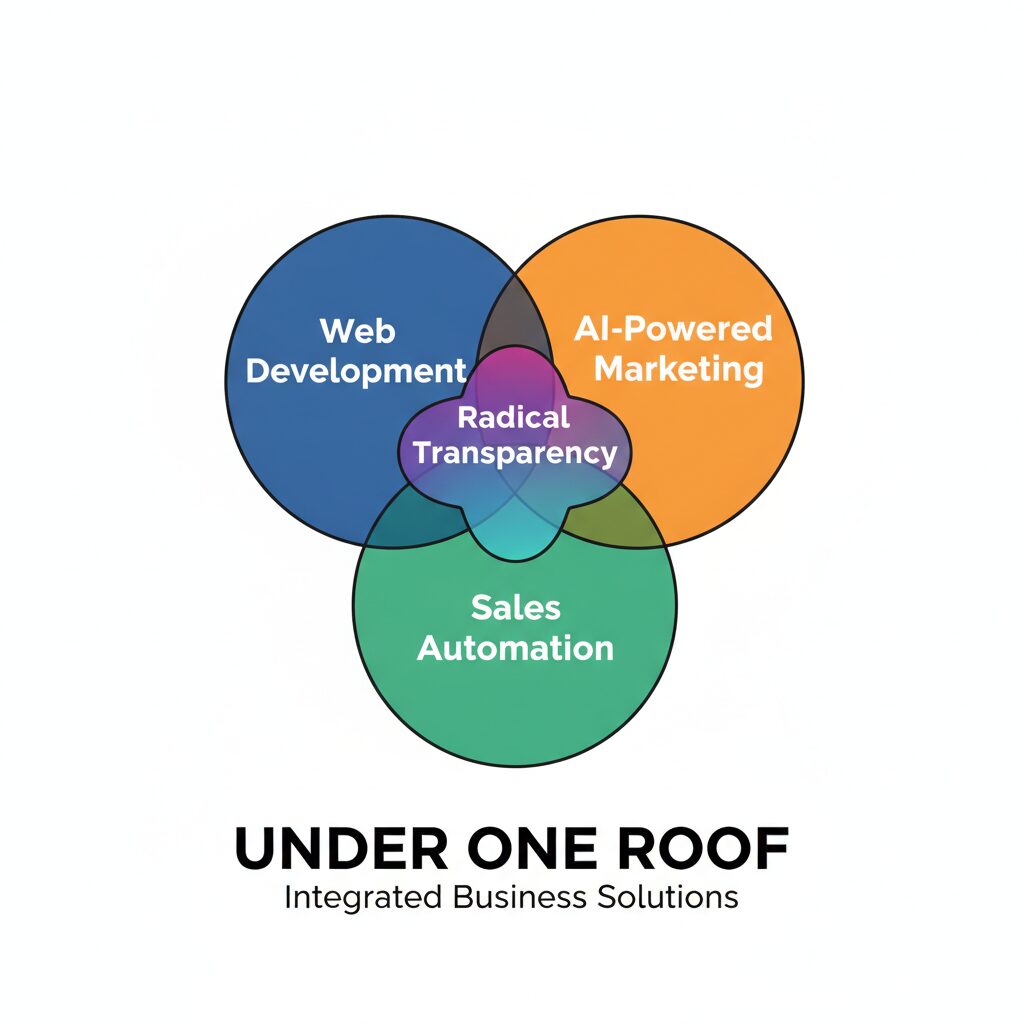
The ‘Under One Roof’ approach to radical transparency
The biggest obstacle to lowering CAC is the lack of a single source of truth. When marketing and tech live in different worlds, you cannot iterate. Radical transparency means you know the exact cost of every lead across every channel in real time.
Merging web development and marketing for faster iterations
If your marketing team finds a high-converting offer, but it takes two weeks for the web team to build the landing page, the momentum is gone. Integrating integrated marketing and tech solutions under one roof removes this friction. You can test a hypothesis, deploy a page, and analyze the CAC shift in 48 hours instead of 14 days.
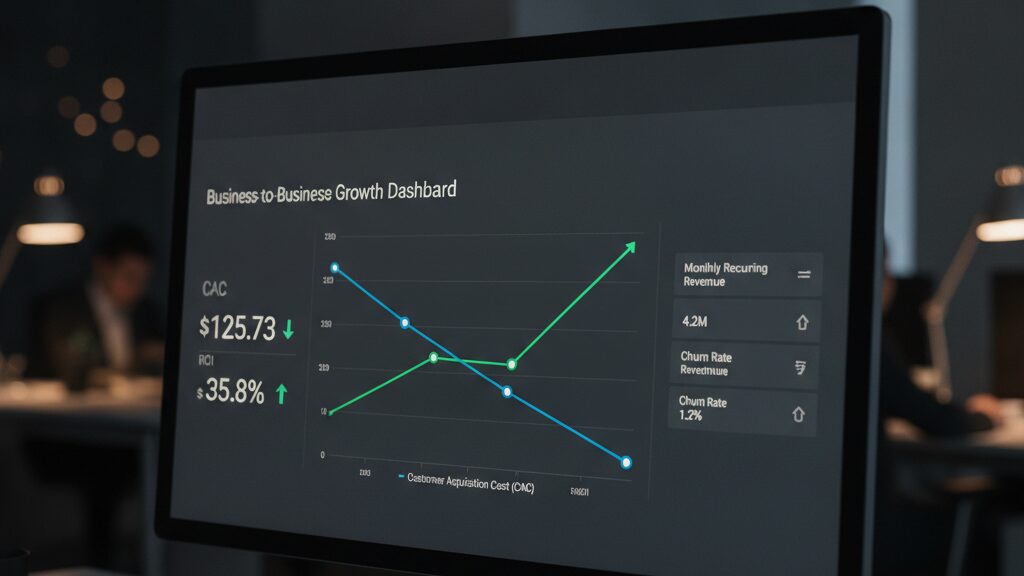
Using a real-time dashboard to track CAC by channel
Many companies calculate CAC once a month. By the time the report hits your desk, the money is already gone. A real-time dashboard provides an immediate view of spending efficiency. You can see a campaign spiking your CAC on Tuesday and kill it by Tuesday afternoon. This is the only way to run a zero-waste growth engine.
Calculating your true CAC: The zero-waste formula
Most B2B founders use a lazy formula: ad spend divided by new customers. This is dangerous. To lower your cost, you have to see the actual cost.
Accounting for fully loaded costs
A fully loaded CAC includes everything: ad spend, software subscriptions, marketing salaries, and the cost of the sales reps who closed the deal. If you ignore labor, you aren’t measuring CAC; you are measuring ad efficiency. Real transparency requires adding every single dollar spent on the acquisition process.
LTV:CAC ratio benchmarks for early-stage startups
A healthy B2B company aims for an LTV:CAC ratio of 3:1. This means the lifetime value of a customer is three times the cost to acquire them. For early-stage startups in aggressive growth phases, a 2:1 ratio is acceptable. But if your ratio dips below 1:1, your business model is broken. You are paying more to get a customer than they will ever pay you. That isn’t growth; it’s a slow liquidation.
Frequently Asked Questions
What is a good B2B customer acquisition cost ratio?
A 3:1 LTV to CAC ratio is the benchmark for healthy growth. This provides the margin needed to cover overhead and reinvest in scaling without burning through cash.
How does AI-powered growth specifically reduce CAC?
AI strips away the waste. It automates lead qualification and personalizes outreach, which means conversion rates rise and sales teams stop wasting time on dead-end prospects.
How long does it take to see a drop in CAC after optimizing PPC?
Most firms see a measurable shift within 30 to 60 days. This provides the necessary window for AI mirroring and negative keyword automation to stabilize lead quality.
Why is radical transparency important in B2B marketing reporting?
It closes the gap between spending and outcomes. Real-time visibility allows you to kill failing channels immediately rather than waiting for a monthly post-mortem.
Can organic content strategies effectively lower B2B CAC?
Yes, by building long-term equity. High-quality organic traffic reduces your dependence on expensive paid clicks, which lowers your blended CAC over time.
How does predictive lead scoring impact the sales cycle?
It clears the pipeline of low-probability leads. This allows reps to focus on high-intent deals, closing them faster and reducing the labor cost per acquisition.
What is the difference between blended CAC and paid CAC?
Paid CAC only looks at ad spend. Blended CAC includes all marketing costs and organic leads, offering a truthful view of your overall efficiency.
How often should a B2B company audit its acquisition costs?
Monitor costs weekly via a real-time dashboard. Perform a deep strategic review of the LTV:CAC ratio every quarter to ensure the model is still viable.
Stop the guesswork
Reducing CAC isn’t about spending less. It is about spending with precision. By bringing your tech and marketing under one roof, you remove the friction that kills your ROI. Stop guessing with your budget. Book a strategy call to build your real-time growth dashboard for free today.
Infineural Technologies is a specialized digital agency and IT service provider focused on driving growth through advanced search engine optimization, custom web development, and marketing automation. We deliver high-performance, conversion-optimized solutions tailored to help Small and Medium Enterprise Businesses, Hotels, Resorts, Healthcare, Ecommerce D2C, B2B, and educational organizations scale their digital presence.
- Search Engine & Generative Engine Optimization Specialists
- Google Ads Management & Performance Marketing Experts
- Advanced WordPress & Custom Web Application Developers
- B2B, D2C & Enterprise Conversion Rate Optimization (CRO) Leaders
- Digital Growth Partners for Hospitality, Healthcare, and Education