
Stop wasting budget on fragmented agencies. Learn how integrated B2B marketing combines dev and growth for radical transparency and higher ROI.
The friction of the fragmented agency model
Most B2B companies run their growth like a broken relay race. The marketing agency tosses a lead over the wall. The web development firm builds a landing page in a vacuum. A third party handles the CRM automation. When the leads stop converting, the finger-pointing starts. The marketer blames the page load speed. The developer blames the traffic quality. Meanwhile, the founder watches three separate retainers hit their inbox while the sales calendar remains a wasteland.

Growth hits a structural wall when the people building the site aren’t the ones driving the traffic. This gap is where your budget simply evaporates. Integrated B2B marketing fixes this by merging the technical build and the growth strategy into a single unit. When the same team managing your zero-waste PPC also owns the code of your conversion funnel, the friction vanishes. This means you stop managing vendors and start managing actual ROI.
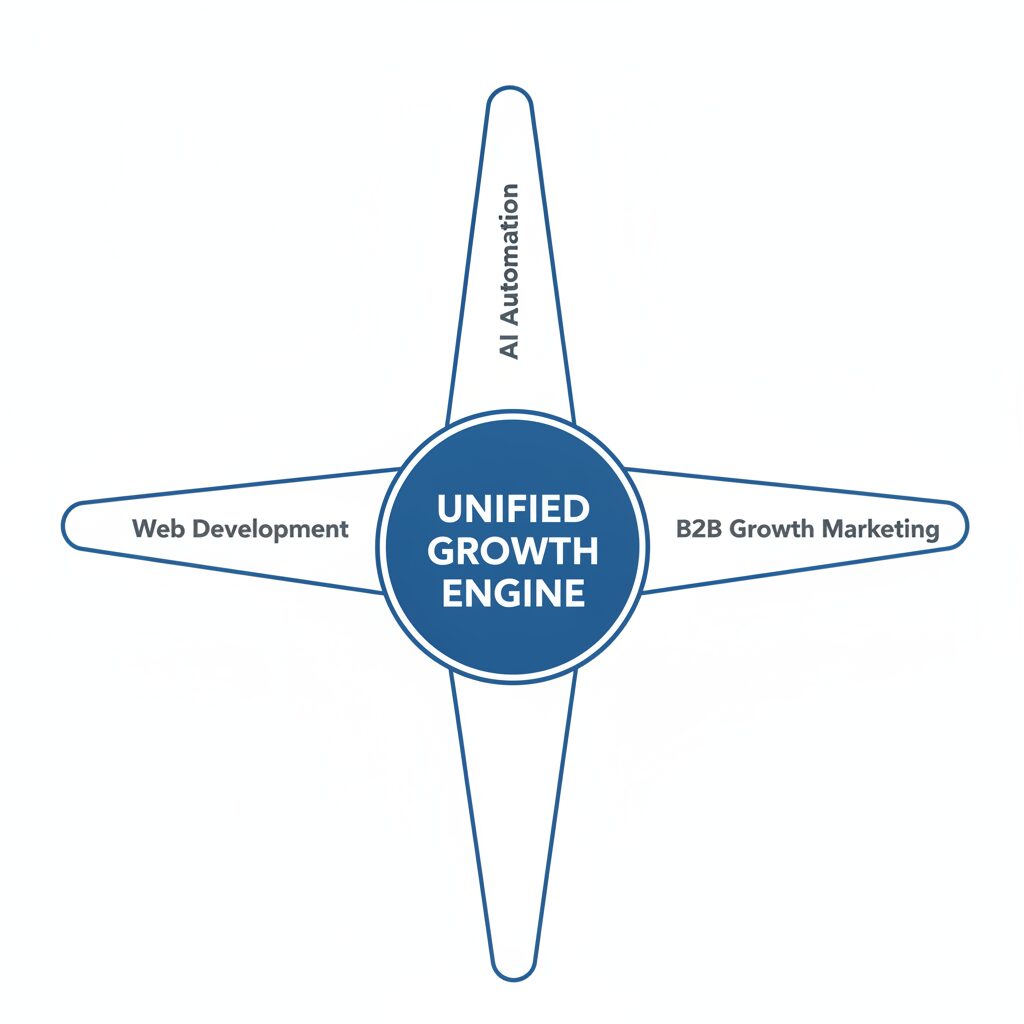
The objective here is radical transparency. You need a system where a shift in ad spend triggers an immediate update in landing page architecture without waiting on a two-week ticket queue. That is the difference between a fragmented list of vendors and a unified growth engine.
The cost of friction: why marketing and dev integration is non-negotiable
The communication gap between creative and code
In a standard setup, a growth marketer describes a change to a project manager. The manager writes a ticket for a developer. The developer implements it three days later. By the time the change is live, the market window has closed. This lag is a hidden tax on your growth. In many cases, this disconnect causes a sharp drop in lead conversion because the original intent is lost in translation. You aren’t just losing time; you’re losing the psychological momentum of the lead.
How siloed workflows lead to slow deployment and lost leads
Siloed workflows create a bottleneck by design. When the dev team is measured by site stability and the marketing team is measured by lead volume, their incentives clash. Developers avoid changes that might risk a layout shift. Marketers push for aggressive pop-ups that tank the user experience. It’s a tug-of-war where the customer loses. Data from the B2B Growth Institute suggests that companies with separate dev and marketing teams take up to four times longer to deploy conversion rate optimization (CRO) tests than integrated teams. That’s months of wasted data and missed revenue.
The blame game: why traditional agencies hide behind opaque reporting
Traditional agencies often use complexity to mask a lack of results. They send monthly PDFs filled with vanity metrics like impressions and reach. Let’s be honest: these reports are designed to look impressive while ignoring the bank account. When the ROI dips, they blame the ‘landing page experience’ or ‘lead quality.’ They do this because they have no control over the other end of the funnel. They are selling you a service, not a business outcome.
Building a unified growth strategy for B2B scale
Aligning your tech stack with your conversion goals
Your tech stack should be a tool, not a hurdle. Too many startups over-engineer their setup, stacking tools that don’t speak the same language. A unified strategy starts by stripping away the noise. We’ve seen cases where replacing three disjointed tools with a single AI-powered growth automation system cut monthly overhead by 30% and stopped the lead attribution leaks that usually plague B2B firms.
AI-powered growth: using automation to bridge the gap between lead and close
The gap between a lead form submission and a sales call is where most B2B deals go to die. In today’s market, waiting an hour to respond is an eternity. Agentic AI now handles the initial qualification, schedules the meeting, and updates the CRM in seconds. By baking this automation directly into the web architecture, you remove the human lag. This means your lead flow changes from a leaky bucket into a high-pressure pipeline.
Mapping the multi-channel campaign to a single source of truth
Multi-channel campaigns fail when data is fragmented. You cannot fix what you cannot see. A unified strategy feeds every touchpoint—LinkedIn ads, organic search, and email—into a real-time ROI tracking dashboard. This removes the guesswork. If a specific LinkedIn segment is driving high-value enterprise leads but zero SMB leads, you shift the budget in real-time. You don’t wait for a monthly report to tell you that you spent $5,000 on the wrong audience.
B2B agency consolidation: moving to an ‘under one roof’ model
Evaluating the risk of fragmented vendor lists
Every additional vendor adds a layer of management overhead. For a founder, this is a massive distraction from the core product. The risk isn’t just the cost; it’s the operational fragility. When your site crashes during a high-spend campaign, you shouldn’t have to play mediator between a hosting provider, a dev agency, and an ad agency. Consolidation eliminates this coordination tax.
Radical transparency: replacing monthly PDFs with real-time dashboards
PDF reports are autopsies. They tell you why you failed last month. Radical transparency requires live data. A real-time dashboard shows the exact cost per acquisition (CPA) for every campaign as it happens. This visibility forces accountability. When the data is live, there is no room for “we think it’s working.” There is only the number.
Zero-waste PPC: how integrated dev enables tighter conversion tracking
Most PPC spend is thrown away on keywords that don’t convert. This usually happens because the tracking is broken or the landing page is a generic homepage that confuses the user. Integrated development allows for the creation of hyper-specific, dynamic landing pages that mirror the ad copy exactly. By implementing zero-waste PPC strategies, we have helped companies cut their CPA by 40% simply by aligning the technical trigger of the ad with a customized conversion path.
Executing the integrated approach: from infrastructure to ROI
Step 1: Auditing the current lead flow and tech bottlenecks
Map every single step a lead takes from the first ad click to the signed contract. Hunt for the friction. Is the form too long? Does the page take four seconds to load on a mobile device? Is the lead sitting in an inbox for six hours before a human sees it? This is the diagnosis phase. You can’t scale a broken process.
Step 2: Deploying AI-driven automation for lead qualification
Once you find the leaks, plug them. Instead of a static ‘Contact Us’ form, use an AI-driven qualifier. This agent asks the lead about their budget, timeline, and pain points in a natural conversation. By the time the lead reaches your sales team, they are already vetted. This ensures your expensive sales talent only spends time on high-probability deals.
Step 3: Implementing live tracking to optimize spend in real-time
The final step is the feedback loop. Connect your ad spend, your website analytics, and your CRM revenue data into one view. When a specific campaign delivers a 4x ROI, you scale it immediately. When another sits at 0.5x, you kill it. That is the essence of AI-powered growth: rapid experimentation backed by hard data.
Frequently Asked Questions
What is the difference between integrated marketing and traditional agency services?
Traditional agencies sell siloed services like SEO or PPC as standalone products. Integrated marketing merges development and growth into one team. This removes the friction between “the people who drive traffic” and “the people who build the pages.”
How does combining development and marketing improve B2B lead quality?
It allows for the instant optimization of landing pages and the use of AI qualifiers. Which means you stop sending low-intent “tire kickers” to your sales team and only pass through high-intent leads.
What are the main risks of B2B agency consolidation?
The obvious risk is putting all your eggs in one basket. If the agency lacks a broad skill set, you’re stuck. However, the efficiency gains of having a unified team usually far outweigh the risk of managing five different vendors who don’t talk to each other.
How do real-time dashboards replace traditional marketing reports?
Dashboards provide live data on CPA and revenue. This allows for immediate budget shifts. PDFs are historical documents that often hide failures behind vanity metrics.
Can a unified growth strategy work for small SMBs or only enterprises?
It’s actually more critical for SMBs. When you have a limited budget, you can’t afford to waste 20% of your spend on fragmented communication or broken PPC tracking.
Stop the agency blame game
Fragmented marketing is a legacy model that fails in a fast-moving B2B environment. The friction between your ‘growth people’ and your ‘tech people’ is a direct drain on your profit. You do not need more vendors. You need a unified system that treats development and marketing as a single engine for growth.
If you are tired of opaque reports and slow deployment, it is time to audit your pipeline. Find out where your leads are leaking and where your communication is breaking down.
Book a growth audit today to identify the leaks in your integrated B2B marketing setup. No credit card required. Just a direct look at your ROI.
Infineural is a digital marketing, development and hosting company based in Nashik, India, founded in 2018. It runs SEO, Google Ads, performance and WhatsApp marketing, builds custom WordPress sites, web apps and mobile apps, manages hosting, and makes Infineural CRM and WhatsInfi. Every engagement starts with a written scope and runs through a client dashboard showing the work log, billing and results.
- Search Engine & Generative Engine Optimization Specialists
- Google Ads Management & Performance Marketing Experts
- Advanced WordPress & Custom Web Application Developers
- B2B, D2C & Enterprise Conversion Rate Optimization (CRO) Leaders
- Digital Growth Partners for Hospitality, Healthcare, and Education