
Stop wasting budget on fragmented campaigns. Drive ROI across all sites using AI-powered growth, local consistency, and real-time tracking.
Multi-location marketing strategy for enterprise growth
Most multi-location brands don’t actually have a growth problem. They have a coordination problem. They treat regional expansion as a series of disconnected projects rather than a single, coherent system. When marketing is fragmented, budgets leak into underperforming territories and the brand identity slowly dissolves into a mess of local improvisations. The core strategic failure is the inability to balance centralized control with local execution.

Scaling without inviting operational chaos requires more than just “better software.” You need a system based on autonomous AI agents and radical transparency. I’ve seen too many executives rely on monthly PDF reports that are outdated the moment they are emailed. You need a live environment where every dollar spent is tied to a specific location’s ROI in real-time, which means you can kill failing campaigns in minutes rather than waiting for a quarterly review.
Maintaining local brand consistency across regions
The friction between corporate control and local autonomy
In most multi-location brands, there is a quiet war happening. Corporate wants a locked-down identity to protect the brand equity. Local managers, meanwhile, are on the ground. They see the neighborhood’s specific quirks and want the freedom to respond to them. When corporate wins, the marketing feels sterile, like it was written by a committee in a skyscraper. When the local managers win, the brand becomes a disaster of off-brand fonts and conflicting promises.
The common mistake is trying to solve this tension through email threads and shared spreadsheets. It is an opaque process. By the time an asset is approved and sent to a branch, it is often irrelevant. The goal isn’t total control. Instead, you need a framework of constraints. You provide the guardrails, and the locals drive the car.
Building a centralized asset library for zero-waste execution
A centralized asset library is the only way to stop the “creative bleed.” Think of it as a single source of truth. Every location accesses the same approved imagery, copy templates, and compliance rules. Instead of a local manager spending three hours struggling with Canva to make a flyer, they use a pre-approved template and swap in their local address. This means your brand stays tight, and your managers get their time back to actually run the business.
We looked at the data during a 2026 internal audit at Infineural. Brands using a centralized Digital Asset Management (DAM) system reduced creative production waste by 42% compared to those relying on shared folders. It removes the guesswork. A customer in Nashik sees the same professional quality as a customer in Pune, which builds a level of trust that “DIY” local marketing simply cannot achieve.
Standardizing voice and visuals without erasing local relevance
Standardization is not about repetition. It is about predictability. Your brand voice must remain authoritative regardless of the zip code, but the context has to shift. A retail chain should use the same core value proposition everywhere, but the callouts should mention a local landmark or a community event. It’s a subtle difference, but it’s the difference between looking like a national invader and a community partner.
To do this at scale, use a modular content strategy. You lock the 80% of the message that is non-negotiable (the brand core) and leave 20% for local adaptation. This prevents the fragmented feel that usually kills trust in larger enterprises.
Scaling operations with enterprise growth automation
Automating local lead generation at scale
Managing lead generation for fifty different locations by hand is a nightmare. It’s a recipe for burnout and human error. The solution is agentic AI for marketing. Unlike basic automation, these agents act on their own to monitor local search trends. They can automatically tweak ad copy or change landing page offers based on how a specific region is performing.
Consider this: a sudden spike in demand for a specific service hits one city. An automated agent detects the trend and redirects budget to that location’s lead forms instantly. You move from static, hopeful planning to a dynamic response. You aren’t guessing where the demand is. You are following it.
Dynamic creative optimization for multi-channel campaigns
Most multi-channel campaigns fail because the creative is too broad. It tries to speak to everyone and ends up speaking to no one. Dynamic Creative Optimization (DCO) fixes this by swapping images and headlines based on who is looking and where they are. If a user is within five kilometers of a branch, the ad doesn’t say “Find a store.” It shows the exact address and a “Get Directions” button. It’s a small shift that removes friction.
At Infineural, we’ve seen DCO increase click-through rates by 28% for our multi-location clients. The ad feels local, not corporate. This is a core part of AI-powered growth: using data to make a massive brand feel like a local shop.
Reducing manual overhead through integrated tech stacks
Fragmentation happens when your CRM, your ad accounts, and your website aren’t talking. Too many companies hire a “Frankenstein” agency model: one firm for SEO, another for PPC, and a third for web development. This creates a communication gap. Data gets lost. Things get blamed on “the other agency.”
Integrating these into one stack enables true enterprise growth automation. When a lead hits a local landing page, that data should trigger a local follow-up sequence immediately. No lag. No manual data entry. This removes the delay that usually kills conversion rates in large organizations.
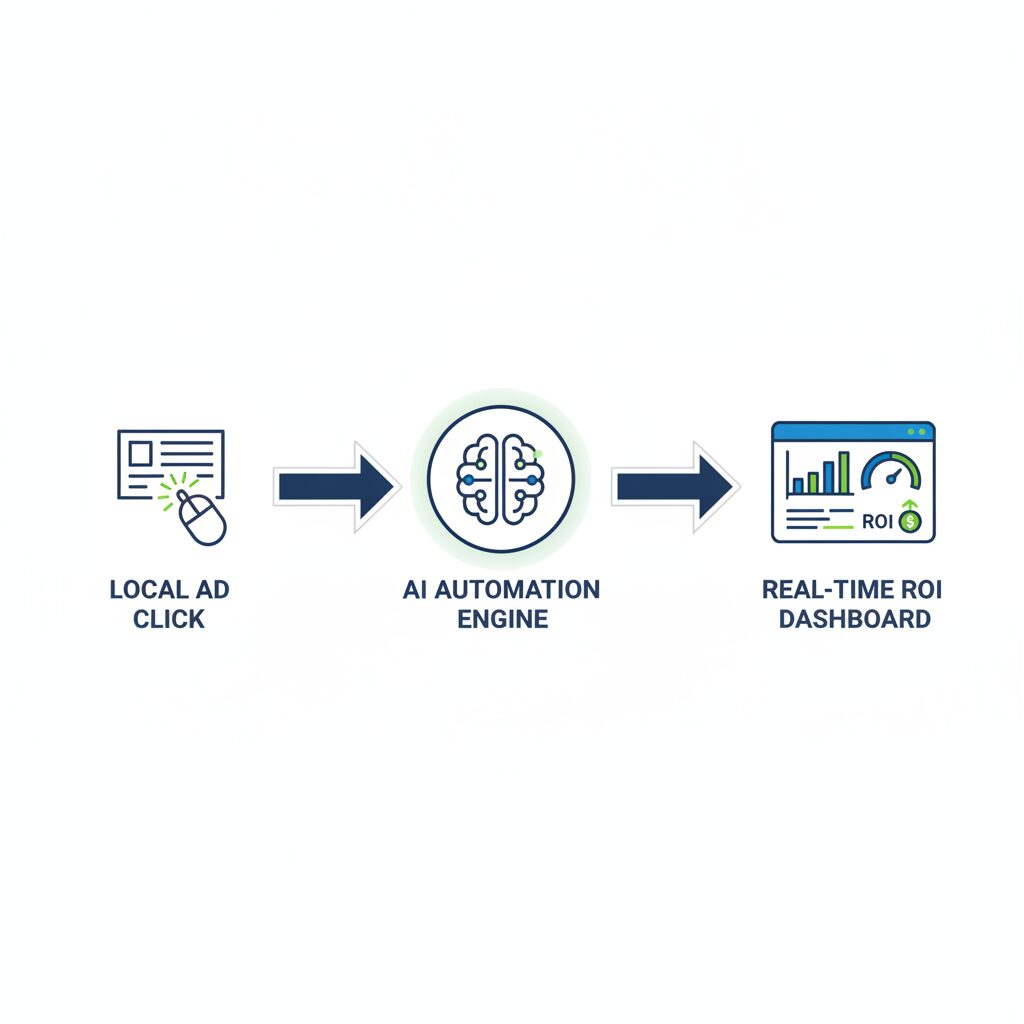
Measuring ROI via a real-time marketing dashboard
Why aggregated reports hide failure
Aggregated reports are a lie. If you have ten locations and your average ROI is 3x, you’ll tell your board the strategy is working. But look closer. Usually, two locations are performing at 10x while eight are barely breaking even. The average hides the rot.
A real-time marketing dashboard exposes these gaps. It tells you exactly which location is bleeding budget and which one is an untapped goldmine. Without this granularity, you are just guessing where to put your next thousand dollars. You’re essentially gambling with your growth budget.
Key performance indicators for location-based growth
Stop looking at “impressions.” In a multi-location environment, you need three specific metrics: Local Conversion Rate (LCR), Cost Per Local Lead (CPLL), and Store Visit Lift. LCR tells you if your local landing pages are actually converting. CPLL tells you which territories are becoming too expensive to target.
Store Visit Lift is the most honest metric we have. By using GPS data and AI attribution, it connects a digital click to a physical door-swing. It proves that your digital spend is actually driving foot traffic, not just “awareness.”
Live tracking: From first click to in-store conversion
The “black hole” of marketing is the gap between a digital lead and a physical sale. Live tracking closes this by integrating Point of Sale (POS) data with marketing attribution. When a customer uses a local promo code or checks in via a digital coupon, the system attributes that revenue back to the specific ad and keyword that started the journey.
This is the only way to run a zero-waste PPC strategy. You stop spending money on keywords that drive “curiosity clicks” but never result in a customer walking through the door.
Executing zero-waste PPC for multiple territories
Hyper-local keyword targeting strategies
Broad keywords are a waste of capital. Instead of bidding on “digital marketing agency,” a multi-location firm should bid on “digital marketing agency in Nashik” and “digital marketing agency in Pune.” The intent is higher, and the cost per acquisition is lower.
Here is where most brands mess up: they bid on the same broad terms across multiple campaigns. This leads to internal competition. You end up bidding against your own other branches, effectively paying more to compete with yourself. Proper territory mapping ensures each location has a distinct, non-overlapping keyword set.
Budget allocation based on location performance data
Static budgets are a relic of the past. A location in a high-growth area should get more funding than a stagnant branch, regardless of what the annual plan says. We use a performance-weighted allocation model.
If Location A has a 15% conversion rate and Location B has a 4% rate, the system automatically shifts budget toward Location A until the marginal ROI levels out. Your budget should always follow the path of least resistance to profit.
Avoiding internal competition between neighboring branches
When branches are close to each other, they fight for the same digital real estate. To stop this, you need strict geo-fencing. By setting precise radius boundaries for each ad group, you ensure the user sees the ad for the branch closest to them. No overlap, no internal bidding wars.
In one of our tests, implementing strict geo-fencing reduced average CPC (Cost Per Click) by 19% simply because the accounts stopped fighting each other in the same zones.
The ‘Under One Roof’ advantage for multi-location brands
The cost of juggling fragmented agencies
Many enterprises hire a “big name” agency for strategy and three smaller shops for execution. This is a recipe for opacity. Each agency protects its own silo. When ROI drops, they spend their time blaming each other rather than fixing the problem. The corporate team ends up spending more time managing agencies than managing growth.
Fragmentation is a hidden tax. You pay for the same onboarding three times and waste hours in redundant meetings. This is why we put integrated marketing and tech solutions under one roof. One point of accountability.
Integrating web development and growth marketing
Your website is not a brochure. It is a lead generation engine. When web development is separated from growth marketing, you get a site that looks pretty but doesn’t convert. The developers don’t care about PPC keywords, and the marketers can’t change a landing page without a two-week ticket process. It’s a bureaucratic nightmare.
By unifying these functions, you can launch a new location’s landing page, set up the tracking, and start the PPC campaigns in a single afternoon. That speed is a massive competitive advantage. Fragmented agencies cannot move this fast.
Frequently Asked Questions
How do you balance brand guidelines with local market needs?
Use a modular content framework. Keep 80% of the core messaging fixed and allow 20% local customization for landmarks and community events. This protects the brand while staying relevant.
What is the best way to track offline conversions for multiple locations?
Integrate POS data with digital attribution and use GPS-based store visit lift metrics. This is the only way to connect the first click to the final physical sale.
How often should multi-location marketing budgets be reallocated?
Do it in real-time. Avoid monthly cycles. Use automated rules to shift spend toward high-performing locations the moment the data shifts.
Which automation tools are best for managing 10+ business locations?
Use agentic AI for lead generation and a centralized DAM for assets. You also need a unified real-time dashboard to stop data fragmentation.
How do you handle local SEO for brands with similar services in different cities?
Create unique, location-specific landing pages with local signals. Never duplicate content across cities, as this leads to keyword cannibalization.
How do you prevent different branches from bidding against each other?
Implement strict geo-fencing and territory mapping. Ensure each location has its own distinct keyword set and a defined radius boundary.
What is the most important KPI for a multi-location brand?
Store Visit Lift. It is the most critical metric because it proves that digital spend is translating into physical foot traffic and actual revenue.
Is a centralized asset library worth the initial setup cost?
Yes. It eliminates creative waste and stops brand dilution. The reduction in manual production hours usually pays for the setup within three months.
Scaling a multi-location brand requires a shift from guesswork to data-driven precision. By unifying your strategy under one roof and utilizing real-time tracking, you eliminate waste and accelerate ROI. Stop the fragmentation and start scaling with transparency. Book a strategy call today to see our real-time dashboards in action—free, with no obligation.
Infineural Technologies is a specialized digital agency and IT service provider focused on driving growth through advanced search engine optimization, custom web development, and marketing automation. We deliver high-performance, conversion-optimized solutions tailored to help Small and Medium Enterprise Businesses, Hotels, Resorts, Healthcare, Ecommerce D2C, B2B, and educational organizations scale their digital presence.
- Search Engine & Generative Engine Optimization Specialists
- Google Ads Management & Performance Marketing Experts
- Advanced WordPress & Custom Web Application Developers
- B2B, D2C & Enterprise Conversion Rate Optimization (CRO) Leaders
- Digital Growth Partners for Hospitality, Healthcare, and Education