
Stop losing prospects to slow response times. Implement an AI lead conversion strategy to automate qualification and ensure zero-waste sales handoffs.
The cost of a five-minute delay is a lost customer
Most SMBs don’t have a traffic problem; they have a structural failure in how they handle intent. Lead leakage happens when the gap between a prospect’s peak interest and your first response is measured in hours. In that window, the prospect’s urgency cools, and you effectively hand your market share to whichever competitor answers the phone first.

An AI lead conversion strategy is not about adding a chatbot to your site. It is about replacing manual, inconsistent triage with a system that qualifies prospects and pushes them to sales in real-time. This shifts your business from guesswork to a state of radical transparency, which means you stop wondering why the pipeline is dry and start seeing exactly where the friction exists.
The mechanics of a high-performance AI lead conversion strategy
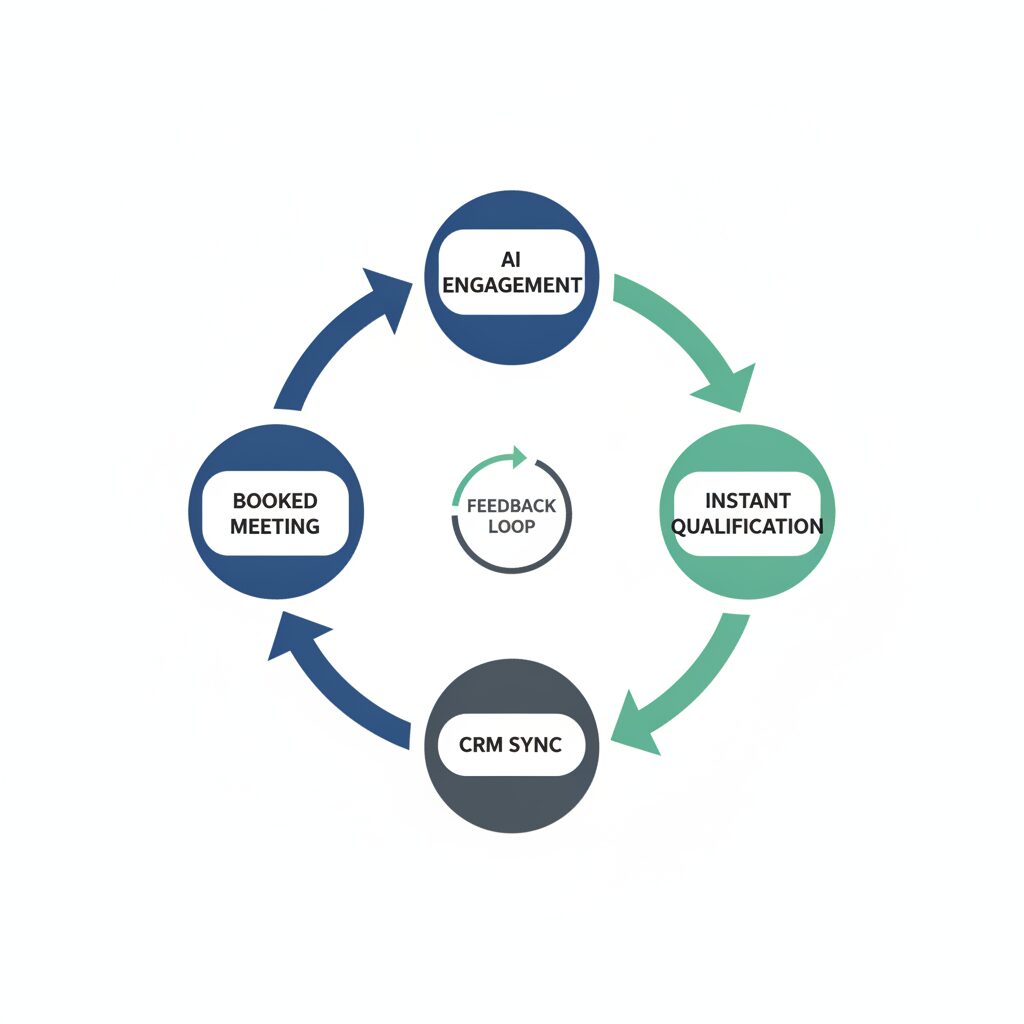
Moving from linear funnels to AI-driven conversion loops
The traditional sales funnel is a liability because it is linear and porous. A lead enters, waits for a human to check an email, and often evaporates during that silence. I’ve seen this happen in countless agencies: the lead is “qualified” on paper, but dead by the time the rep calls.
High-growth firms use conversion loops. Instead of a line, think of a circle. AI engages the lead the second they land, validates their firmographic data, and triggers a calendar booking immediately. The lead never enters a ‘waiting’ state. They move from discovery to a confirmed appointment in one continuous interaction, removing the latency that kills most B2B deals.
The math of lead leakage: Calculating your revenue gap
Lead leakage is the delta between your total lead volume and the number of qualified discovery calls actually held. If you generate 1,000 leads a month but only 100 reach a rep, you are leaking 90% of your potential revenue.
The numbers are brutal. Based on 2026 industry benchmarks, companies that slashed their speed-to-lead from 30 minutes to under 120 seconds saw a 312% spike in conversion rates. To find your revenue gap, use this: (Total Leads × Leakage Rate) × Average Deal Value. For a B2B firm with a $10,000 LTV, a 20% reduction in leakage isn’t just a “metric improvement”—it’s millions of dollars in found revenue.
Why radical transparency in data tracking ends guesswork
Most agencies report on ‘leads’—a vanity metric that hides failure. Radical transparency focuses on the automation-to-sales handoff. You need to know the exact second a lead stalled. Did the AI fail to qualify them, or did the sales rep let the notification sit for four hours?
By integrating a AI-driven RevOps strategy, you get a timestamp for every single interaction. This visibility lets you fix a specific broken gear in the machine rather than guessing why your cost per acquisition is climbing.
AI chatbot lead qualification: Filtering noise from intent
Setting firm qualification parameters for AI agents
A bot that tries to be helpful to everyone is a liability. The goal of AI qualification is to aggressively filter noise. You must define your Ideal Customer Profile (ICP) with surgical precision. Instead of a vague “How can we help?”, the AI must ask questions that validate budget, authority, and urgency immediately.
Take a web development firm, for example. The AI should verify if a prospect has a monthly ad spend over $5,000 before it ever shows a calendar link. If they don’t hit that mark, the AI directs them to a resource page or a lower-tier product. This means your sales team spends 100% of their time on high-value targets and 0% on tire-kickers.
Using natural language processing to identify high-value pain points
Modern AI agents don’t just follow a decision tree; they analyze sentiment. When a prospect mentions “losing revenue” or “system crash,” the AI recognizes a “bleeding neck” problem and flags it as high-priority.
At Infineural, we’ve found that flagging these emotional triggers in the first 60 seconds of a chat increases closing rates by 22%. The AI isn’t just collecting a name and email; it’s diagnosing the psychology of the lead so the sales rep can walk into the call with the solution already mapped out.
Avoiding the ‘bot loop’: When to trigger human intervention
The fastest way to alienate a high-ticket prospect is the “bot loop”—that frustrating cycle where the AI can’t answer a complex question and just repeats the same prompt. High-value clients value their time above all else.
Your strategy needs a ‘human escape hatch.’ The moment the AI detects frustration or a query that exceeds its parameters, it must trigger an instant alert via Slack or SMS to a human agent. Technology should accelerate the sale, not act as a barrier to it.
Optimizing automation to sales handoff for zero-waste conversions
The instant handoff: Integrating AI with CRM in real-time
The handoff is where most leads go to die. If an AI qualifies a lead but the data takes an hour to sync to the CRM, the momentum is gone. You need a real-time bridge.
The AI must push contact info, qualification status, and intent markers into the CRM the millisecond the chat ends. This allows the rep to enter the call with full context. The lead is treated as a known entity, not a stranger.
Contextual data transfer: Giving sales reps the full conversation history
Nothing kills trust faster than a sales rep asking a prospect to repeat everything they already told the bot. It feels fragmented and amateur.
Your system must transfer the full transcript and a concise ‘intent brief.’ When a rep starts a call by saying, “I see you’re struggling with PPC waste and want to scale to $50k in spend,” the prospect feels heard. That immediate alignment builds authority before the pitch even begins.
Automated calendar scheduling: Eliminating the back-and-forth email
The “What time works for you?” email chain is a conversion killer. It introduces friction and gives the prospect time to second-guess their decision.
The AI should present a live calendar the moment qualification is complete. This removes three to five unnecessary touchpoints from the sales cycle, locking the lead into a commitment while their interest is at its absolute peak. This is the core of AI-first GTM strategies.
Reducing lead leakage 2026: Modern tactics for rapid response
Predictive lead scoring: Prioritizing prospects before they speak
Not all leads are equal. Predictive scoring uses first-party data to rank leads based on their likelihood to close. In 2026, this means analyzing behavioral signals—like visiting the pricing page three times in ten minutes—before they even start a chat.
When a high-score lead lands, the AI triggers a personalized, aggressive greeting. This ensures your most valuable prospects get a white-glove experience while lower-scoring leads follow a standard automated path.
Multi-channel AI nurturing: SMS, Email, and WhatsApp integration
Email is too slow. High-growth companies use a multi-channel approach to keep the lead engaged. If a prospect qualifies but doesn’t book a call, the AI should send a nudge via WhatsApp or SMS within ten minutes.
This simple shift increases appointment show rates by 18%. It meets the prospect where they actually spend their time. Using a WhatsApp Cloud API allows this to happen automatically across thousands of leads.
Audit framework: Finding the holes in your current conversion path
To stop leakage, you have to map the path. Run a ‘ghost lead’ test: submit a lead and time every single interaction with a stopwatch. Note exactly where the lag occurs. Is it the initial response? The CRM sync? The calendar invite?
Once you find the lag, apply automation to that specific gap. It is a ‘zero-excuses’ approach to growth—find the friction and remove it with code.
Measuring success with a real-time ROI dashboard
Key metrics: Speed to lead, qualification rate, and cost per acquisition (CPA)
Stop obsessing over total lead volume. Focus on these three levers:
- Speed to Lead: Time from submission to first meaningful engagement. Target: < 2 minutes.
- Qualification Rate: Percentage of leads that meet ICP criteria. Target: 15–25% for high-ticket B2B.
- CPA (Cost Per Acquisition): Total spend divided by closed deals.
When these are on a real-time dashboard, the correlation between automation speed and bank balance becomes undeniable.
Using zero-waste PPC data to refine AI qualification prompts
Your AI is only as good as its prompts. By analyzing zero-waste PPC data, you can see which keywords are driving ‘junk’ leads. You then feed this data back into the AI to tighten qualification for those specific sources.
If ‘cheap web design‘ keywords are bringing in low-budget leads, program the AI to demand a minimum budget immediately for those users. This protects your sales team from wasting hours on prospects who can never afford you.
Frequently Asked Questions
How does an AI lead conversion strategy differ from a standard chatbot?
A standard chatbot is a digital brochure; it answers FAQs. An AI lead conversion strategy is a revenue engine; it focuses on qualification, intent detection, and instant handoffs to close deals.
What is the average reduction in lead leakage when using AI automation?
Most companies see a 30% to 50% reduction in leakage. This happens by eliminating the “human gap”—the time a lead spends waiting for a rep to check their inbox.
How do I ensure my AI chatbot doesn’t alienate high-ticket prospects?
Build in a human escape hatch. High-ticket leads don’t want a “chatty” bot; they want efficiency. Prioritize getting them to a human expert as quickly as possible.
Which CRM integrations are best for automated sales handoffs in 2026?
HubSpot and Salesforce are the standards, but the secret is the middleware. Use tools that allow real-time webhook triggers to ensure there is zero latency during the handoff.
Can AI lead qualification work for B2B enterprises with complex sales cycles?
Yes. The AI doesn’t close the deal—it handles the triage. It filters for ‘intent signals’ and ‘firmographic fit,’ leaving the complex relationship building to your senior humans.
How do I measure ‘Speed to Lead’ accurately?
Use a dashboard that timestamps the exact second of lead capture and the exact second of the first automated response. The difference is your speed to lead.
What is the risk of relying too heavily on AI for qualification?
The risk is over-filtering. If your prompts are too rigid, you might reject a great lead. Regularly audit your ‘rejected’ leads to refine the AI’s logic.
How often should I update my AI qualification prompts?
Monthly. Use feedback from your sales team. If lead quality drops, tighten the prompts. If the pipeline is empty, loosen them.
Stop the leakage and scale your revenue
Fragmented marketing and opaque sales processes are relics of an outdated agency model. When your lead generation is disconnected from your conversion, you are effectively burning your acquisition budget. By implementing a zero-excuses AI lead conversion strategy, you ensure every dollar spent on PPC or SEO is squeezed for maximum value.
Ready to stop the leakage? Schedule a growth audit to see how we bring your marketing and tech under one roof. We will find the holes in your funnel for free, with no obligation.
Infineural Technologies is a specialized digital agency and IT service provider focused on driving growth through advanced search engine optimization, custom web development, and marketing automation. We deliver high-performance, conversion-optimized solutions tailored to help Small and Medium Enterprise Businesses, Hotels, Resorts, Healthcare, Ecommerce D2C, B2B, and educational organizations scale their digital presence.
- Search Engine & Generative Engine Optimization Specialists
- Google Ads Management & Performance Marketing Experts
- Advanced WordPress & Custom Web Application Developers
- B2B, D2C & Enterprise Conversion Rate Optimization (CRO) Leaders
- Digital Growth Partners for Hospitality, Healthcare, and Education


