
Stop fragmented growth. Use a data-driven Revenue Operations (RevOps) strategy to align sales and marketing and remove B2B growth bottlenecks.
The Structural Rot Behind Revenue Leaks
Revenue doesn’t leak because of a bad product or a weak sales pitch. It leaks because of structural friction. When marketing owns the lead, sales owns the deal, and customer success owns the renewal, you aren’t running a growth engine. You are running three separate businesses that happen to be fighting over the same customer.

This fragmentation creates invisible, expensive gaps. I’ve seen leads qualify in a CRM only to sit untouched for six hours because of a notification lag. I’ve seen marketing burn $20k on a campaign that generates hundreds of leads the sales team refuses to call because the “intent data” was missing. These aren’t personnel failures. They are system failures.
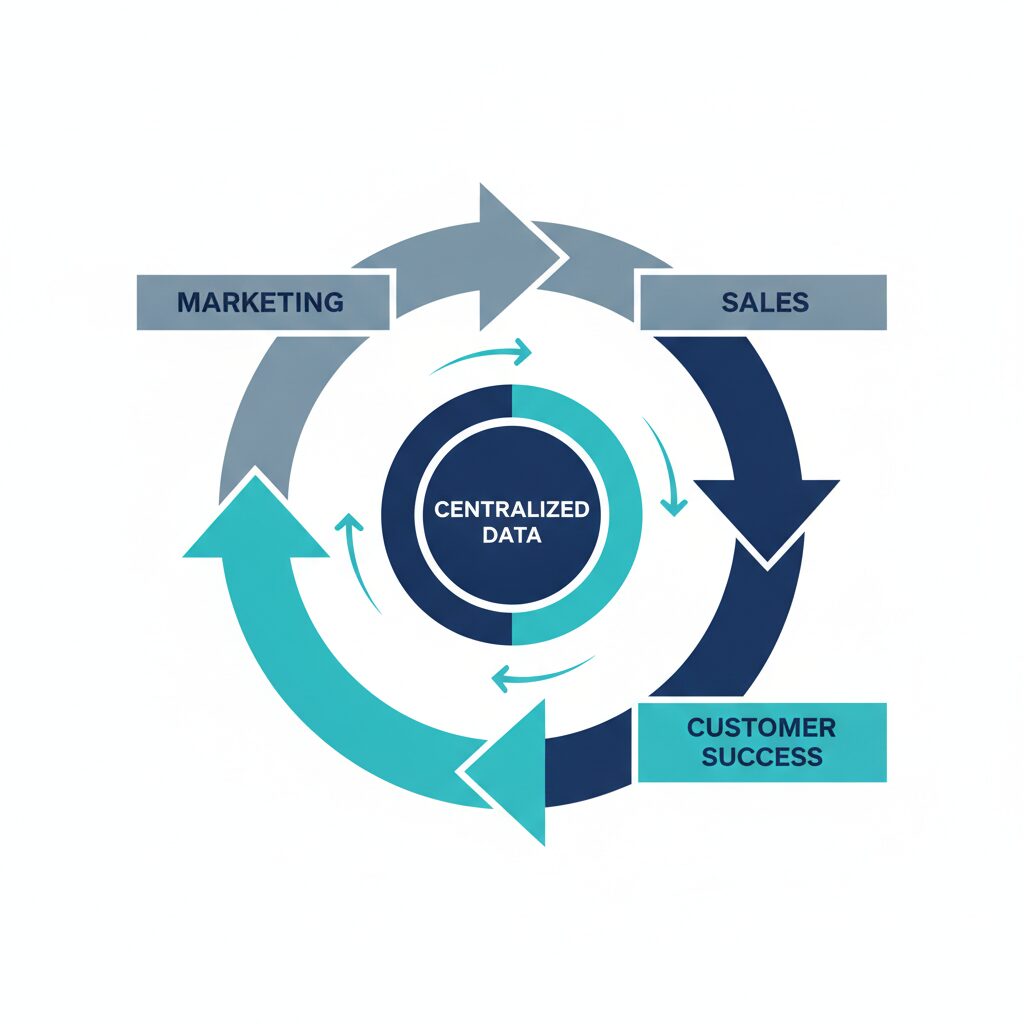
A Revenue Operations (RevOps) strategy solves this by treating the entire customer journey as one integrated pipeline. It replaces corporate guesswork with a hard look at the data. By aligning people, processes, and software under one roof, companies stop the bleeding and start scaling with surgical precision—which means your growth becomes a predictable math problem rather than a hopeful prayer.
Solving Sales and Marketing Alignment Through Structural Integration
The Hand-off: A Recipe for Internal Conflict
Most B2B companies rely on “the hand-off.” Marketing ‘throws’ a lead over the wall to sales. This is a broken model because it incentivizes the wrong behavior. Marketing is rewarded for lead volume (quantity). Sales is rewarded for closed deals (quality). When lead quality dips, these two teams spend their Fridays arguing about lead definitions instead of actually closing revenue.
This friction kills your margins. We have tracked cases where companies spiked their customer acquisition cost by 30% simply because high-intent leads were miscategorized by a disconnected tool and ignored by the sales team. The money was spent; the lead was there; the system failed.
Shared KPIs: Moving Beyond the MQL
Strategy is the art of identifying the critical challenge and applying focused force to break it. In RevOps, the critical challenge is the misalignment of goals. You cannot fix this with a “better culture.” You fix it by replacing department-specific quotas with shared revenue KPIs.
Stop tracking ‘Marketing Qualified Leads’ (MQLs)—a metric that often rewards marketing for sending junk to sales. Instead, track Pipeline Velocity: the actual speed at which a lead moves from first touch to closed-won. Data from 2026 Revenue Intelligence reports shows that companies using shared velocity metrics saw a 22% jump in win rates. They stopped arguing and started moving.
The Single Source of Truth
You cannot optimize what you cannot see. Most firms are blind because their data is scattered across five different platforms. One tool claims the lead came from LinkedIn. Another says it was an organic search. The CRM insists it was a referral. This isn’t just confusing; it’s a waste of capital.
A RevOps strategy implements one single source of truth. Every interaction is logged in one place with a standardized naming convention. When you have one clean data set, you stop guessing which channels work and start investing in zero-waste PPC strategies based on actual closed-won data, not vanity clicks.
Identifying and Removing Growth Bottlenecks
Mapping the Journey to Find the Friction
Growth bottlenecks usually hide in the transitions. Take the gap between a demo request and the first discovery call. If that gap exceeds fifteen minutes, your conversion rate plummets. That is a structural bottleneck, not a “lack of hustle” from your reps.
To find these, you have to map the lead-to-cash process. Look for where the pipeline stalls. If 40% of your deals die at the proposal stage, the problem isn’t your sales team’s closing skills. The problem is likely a friction point in your pricing transparency or a bureaucratic approval process that kills momentum.
Data Silos: The Financial Drain
Data silos are more than a technical annoyance; they are a tax on your ROI. When sales data doesn’t flow back to marketing, your marketing team keeps bidding on keywords that attract low-quality leads. They are effectively paying to acquire people who will never buy.
Solving this requires an integrated B2B marketing approach. By feeding closed-won data back into ad platforms in real-time, the AI optimizes for actual revenue. You stop paying for “leads” and start paying for customers.
Auditing for Zero-Waste Efficiency
Zero-waste efficiency means every dollar and every hour is spent on the highest-probability outcome. An audit involves stripping away every manual, redundant step. If a sales rep is manually copying data from a form into a CRM, you are paying a professional salary for data entry. That is waste.
At Infineural, we recently removed three manual data entry steps from a client’s onboarding flow. This crashed the time-to-value for the customer from seven days down to two hours. The result? An immediate spike in early-stage satisfaction and a much faster path to the first renewal.
Implementing AI Revenue Orchestration
From Basic Automation to Agentic Orchestration
Standard automation is linear and rigid: ‘If X happens, do Y.’ It’s a digital conveyor belt. AI revenue orchestration is agentic. It analyzes the lead’s context, current pipeline capacity, and historical win rates to decide the best next move.
Consider this: instead of a generic “just checking in” email, an AI orchestrator notices a lead has visited the pricing page three times in two hours. It immediately alerts the account executive and drafts a personalized message referencing the specific pricing tier the lead viewed. This is the leap from simple automation to agentic AI for marketing.
Predictive Forecasting: Killing the “Gut Feeling”
Most B2B forecasting is a guess based on a sales rep’s “gut feeling” or “happy ears.” This is a dangerous way to run a business. Predictive forecasting uses hard historical data and real-time signals to project revenue.
2026 AI analytics benchmarks show that predictive models now hit 94% accuracy for SMB quarterly forecasts. By analyzing signal data—email open rates, meeting frequency, and stakeholder involvement—AI identifies which deals are actually moving and which are just placeholders in the CRM.
Personalization That Actually Scales
Personalization usually fails because it doesn’t scale. You cannot write a thousand unique, high-quality emails a day. AI orchestration solves this via dynamic data insertion at scale.
By linking the CRM with an AI content engine, you can launch AI-powered growth marketing campaigns that mention the lead’s specific industry pain, their latest company news, and the exact feature that solves their problem. It happens automatically, but it reads like a human wrote it.
A Framework Based on Radical Transparency
The Real-Time Dashboard vs. The Monthly Autopsy
Monthly reports are autopsies. They tell you why you failed last month, but they don’t help you win today. Real growth requires radical transparency via a real-time dashboard.
An executive dashboard should show the pipeline’s health live. You need to see the exact moment a bottleneck forms—like a sudden drop in lead-to-demo conversion—so you can pivot your strategy in hours, not after the next board meeting.
Speed as a Competitive Advantage
The only sustainable advantage in 2026 is the speed of iteration. When you track revenue in real-time, you can experiment and pivot instantly. If a new ad creative is driving high-intent leads on Tuesday morning, you can double the budget by noon.
Companies relying on monthly reports are always fighting the last war. Live tracking allows you to respond to shifts in buyer behavior the moment they happen.
The Zero-Excuses Culture
When data is opaque, people make excuses. ‘The leads were bad.’ ‘The market shifted.’ ‘The pricing is too high.’ Data visibility kills the excuse.
When the dashboard shows that leads have a 40% conversion rate but the sales team is only calling them after 48 hours, the conversation changes. It’s no longer about the “quality” of the lead; it’s about the speed of the response. This isn’t about blame. It’s about accountability to the data.
The RevOps Tech Stack: Tools for Growth
CRM and Marketing Automation
The CRM is the heart of the stack, but it’s only as good as the data flowing into it. Integration must be bi-directional. Marketing needs to know when a lead is disqualified so they can stop wasting budget on that segment. Sales needs to see every whitepaper the lead downloaded to understand their intent before the first call.
Revenue Intelligence Platforms
Revenue Intelligence tools go beyond the CRM by analyzing the actual conversations in meetings and emails. They flag ‘at-risk’ deals by detecting a shift in buyer sentiment or a sudden lack of engagement from the decision-maker. This allows you to intervene before the deal is dead.
Data Orchestration Layers
You likely use twenty different SaaS tools. Connecting them with basic plugins creates a fragile web that breaks constantly. A data orchestration layer—like n8n or custom AI middleware—acts as the central nervous system. It ensures data moves accurately across the stack, providing the foundation for automation for B2B startups.
Frequently Asked Questions
What is the difference between RevOps and SalesOps?
SalesOps is a narrow focus on sales efficiency. RevOps is a broad strategic framework that integrates sales, marketing, and customer success to optimize the entire revenue lifecycle from first touch to renewal.
How do I start a RevOps strategy in a small B2B startup?
Start with a lead-to-cash audit. Find the single biggest friction point where leads are stalling. Align your teams around one shared KPI, like pipeline velocity, before you spend a dime on complex new software.
What are the most common RevOps KPIs for 2026?
Focus on Pipeline Velocity, CAC Payback Period, and Net Revenue Retention (NRR). These three metrics tell you if your growth is efficient or just expensive.
How does AI revenue orchestration differ from standard CRM automation?
Standard automation is a set of rigid “if/then” rules. AI orchestration uses real-time signals and predictive data to dynamically adjust the customer journey based on the lead’s actual behavior.
Who should own the RevOps function in a growing organization?
In the early days, the founder or COO usually handles it. As you scale, you need a dedicated Head of Revenue Operations to ensure the departments stay aligned and the data stays clean.
Stop the Leaks and Scale Your Growth
Siloed teams and fragmented management are the fastest ways to incinerate your budget. Real growth comes from an integrated system where data flows without friction and AI handles the orchestration. Stop guessing where your revenue is disappearing and start tracking it in real-time.
Book a growth audit today to identify your specific revenue leaks and implement an AI-powered growth system under one roof. No credit card required—just a data-driven path to scale.
Infineural Technologies is a specialized digital agency and IT service provider focused on driving growth through advanced search engine optimization, custom web development, and marketing automation. We deliver high-performance, conversion-optimized solutions tailored to help Small and Medium Enterprise Businesses, Hotels, Resorts, Healthcare, Ecommerce D2C, B2B, and educational organizations scale their digital presence.
- Search Engine & Generative Engine Optimization Specialists
- Google Ads Management & Performance Marketing Experts
- Advanced WordPress & Custom Web Application Developers
- B2B, D2C & Enterprise Conversion Rate Optimization (CRO) Leaders
- Digital Growth Partners for Hospitality, Healthcare, and Education
This article was drafted with AI assistance and thoroughly reviewed, edited, and fact-checked by our editorial team before publishing.