
Stop guessing your growth. Use an AI-first go-to-market strategy to accelerate market penetration and scale ROI with radical transparency. Book your audit.
Why Most GTM Strategies Fail
Most go-to-market plans fail because they aren’t actually strategies—they are lists of goals. They rely on a fundamental misalignment between the data they collect and the actions they take. Traditional strategies are built on fragmented spreadsheets, feedback loops that take weeks to close, and the guesswork of agencies that charge for activity rather than actual revenue. This creates a lethal lag where the market shifts, but the company is still executing a plan from last quarter.

An AI-first go-to-market strategy closes this gap. It moves the engine of growth from human-led intuition—which is often just a fancy word for guessing—to AI-led automation. Humans shift into the role of governors, providing the strategic guardrails. Instead of praying a campaign hits the mark, you build a systemic loop where real-time data dictates distribution. It is a move toward radical transparency, which means you stop wasting capital on friction in the customer acquisition process.
The AI Product Growth Framework
Strategy is not a goal; it is a way of overcoming a specific obstacle. For most companies, the obstacle is the crushing cost of customer acquisition (CAC) relative to the lifetime value (LTV) of the user. An AI-native framework solves this by automating the most expensive, manual parts of the funnel, which means your margins expand as you scale rather than shrink.
Defining your AI-native value proposition
Your value proposition cannot be that your product “uses AI.” That is a feature, not a strategy. By 2026, AI is the baseline—it’s like saying your software “uses a database.” A true AI-native value proposition focuses on the specific outcome the AI enables. For example, don’t tell a customer your tool uses LLMs to write emails. Tell them you’ve reduced their lead response time from four hours to four seconds. That is a competitive advantage.
In our work at Infineural, we see founders confuse the engine with the destination. The market doesn’t pay for your tech stack; it pays for the removal of a pain point. If your AI shrinks a manual process from ten hours of grueling data entry to ten minutes of review, that is your strategic leverage.
Mapping the automated user journey
A manual user journey is a series of clunky hand-offs. Every hand-off is a point where a customer can get bored, confused, or annoyed and simply leave. An automated journey uses AI to anticipate the user’s next move before they make it. This means the system adjusts the onboarding flow in real-time based on actual behavior. If a user lingers on the pricing page for two minutes, an AI agent can trigger a personalized incentive based on their industry vertical immediately, without waiting for a sales rep to wake up.
This turns the user journey into a growth loop. Data from the Growth Analytics Institute suggests that companies using real-time journey adjustments see a 22% jump in trial-to-paid conversion rates. They aren’t just “better” at onboarding; they are faster at proving value.
Reducing time-to-value (TTV) through instant gratification
The biggest killer of early-stage growth is the “empty state.” If a user spends three days configuring a tool before they see a single result, they will churn. They don’t have three days; they have about three minutes of patience. An AI-first GTM prioritizes the “aha moment” by using AI to handle the heavy lifting during onboarding.
Stop asking users to upload a CSV and wait for a report. Instead, have your AI scrape their public data and present a diagnostic report within thirty seconds of sign-up. This creates an instant gratification loop. It anchors the user to the value of the product before they ever encounter the complexity of the full feature set.
Market Penetration for AI-Driven Products
Entering a crowded market requires more than a “better” product. It requires a more efficient way to capture demand. AI allows you to stop shouting into the void and start using predictive precision.
Identifying high-intent segments with predictive analytics
Traditional segmentation is lazy—it uses demographics like “Company Size” or “Job Title.” AI-first segmentation uses behavioral intent. By tracking signals across the web—search patterns, sudden shifts in job postings, or changes in a competitor’s tech stack—you can find companies in a “buying window” before they even think to fill out a contact form.
When you do this, you stop burning budget on broad audiences. You target the 3% of your market that is actually ready to buy this week. This is the core of a demand generation strategy that prioritizes high-quality signals over raw lead volume.
Displacing legacy incumbents using zero-waste PPC
Most companies burn 30% to 50% of their ad spend on keywords that drive clicks but zero conversions. It’s a massive leak in the bucket. Zero-waste PPC uses AI to analyze search intent at a granular level, bidding only on high-converting clusters and killing underperforming assets in real-time.
To beat an incumbent, you don’t outspend them—you out-maneuver them. By using AI to generate a thousand ad variations and testing them in 48-hour sprints, you find the exact psychological trigger that makes a customer switch. This precision allows a lean startup to steal market share from a giant burdened by a slow, fragmented agency budget.
Pricing models that align with AI-generated outcomes
The per-seat SaaS model is a relic. It’s dying because AI reduces the number of people needed to do the work. If your AI does the work of five people, charging per seat is essentially taxing your own efficiency. The shift must move toward outcome-based pricing.
If an AI agent handles customer support, charge per resolved ticket, not per user. According to the 2026 SaaS Pricing Report, outcome-based models increased average contract value (ACV) by 18% for AI-native companies. We dive deeper into this in our guide to AI pricing strategy shifts.
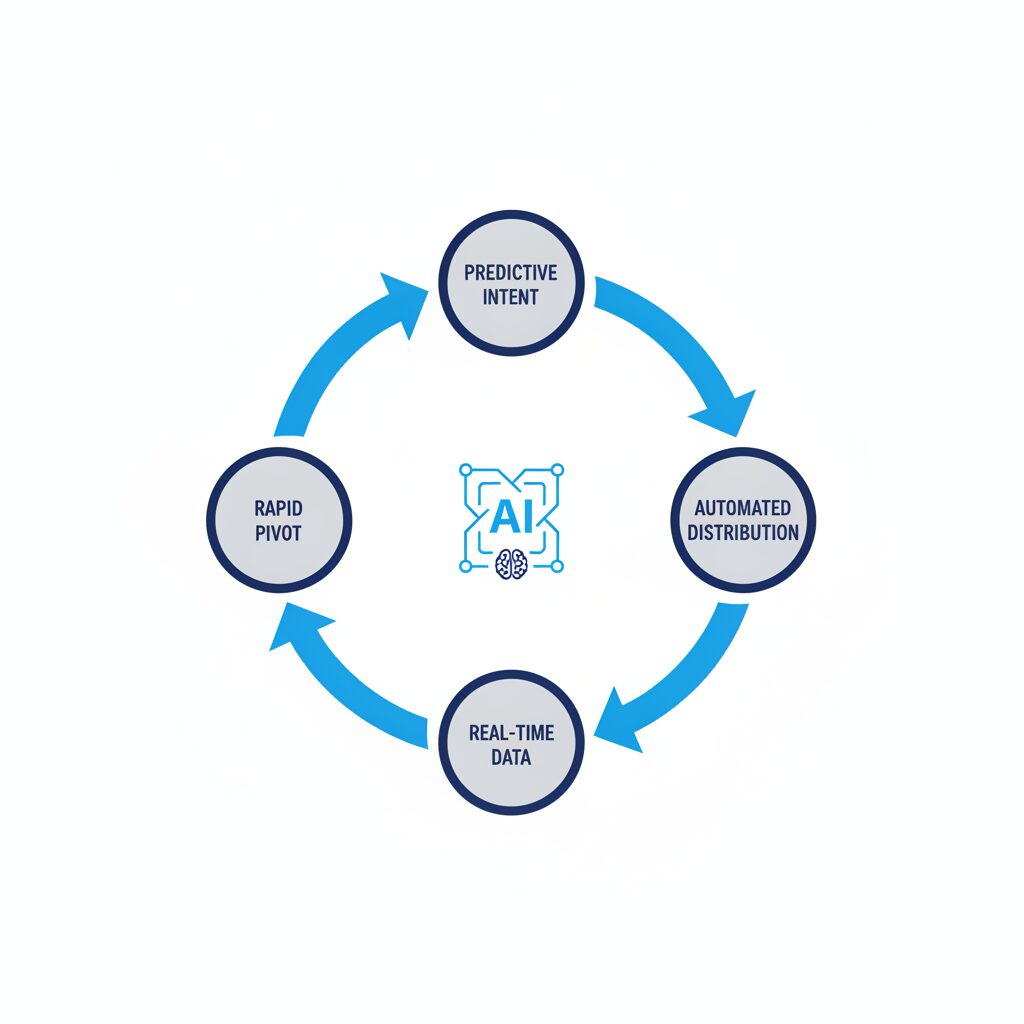
Lean GTM for AI Startups
The goal of a lean GTM isn’t just to save money; it’s to maximize the number of experiments you can run per dollar. In 2026, the limiting factor isn’t your headcount. It’s the speed of your feedback loop.
Building a growth team of one: AI agents as your workforce
A solo founder can now operate with the output of a ten-person marketing team by using AI agent orchestrators. You don’t need a separate copywriter, an SEO specialist, and a media buyer. You need one growth architect who knows how to manage a fleet of agents.
One agent handles competitive intelligence, another drives the content velocity strategy, and a third optimizes the daily ad spend. The human role shifts from execution to curation. The danger here is treating AI like a tool for tasks. Instead, treat the agent as an owner of the outcome.
Rapid experimentation: The 48-hour test loop
Planning marketing in quarters is a recipe for failure. It’s too slow. An AI-first GTM operates in 48-hour loops: hypothesis, deployment, data collection, and pivot.
It works like this: find a friction point in the funnel, use AI to build three different solutions, deploy them as A/B tests, and let the AI analyze the win by day two. If it works, scale it. If it doesn’t, kill it. This removes the emotional attachment to “creative ideas” and replaces it with a cold commitment to data.
Avoiding the ‘feature trap’ in early-stage scaling
Founders love adding features. They think more tools equal more growth. This is a fallacy. Growth comes from solving one specific problem exceptionally well for one specific group of people. Adding features usually just adds friction to the onboarding process.
Focus on the one core loop that drives ROI for the customer. If your product lowers a company’s customer acquisition cost, double down on that. Use AI to refine that single outcome rather than building a suite of mediocre tools that dilute your brand.
Executing with Radical Transparency
The traditional agency model survives on opacity. Those polished monthly reports are often designed to hide a lack of results behind “vanity metrics” like impressions or reach. An AI-first approach demands total visibility.
The real-time dashboard: Ending the monthly report cycle
Waiting thirty days to find out a campaign failed is a strategic disaster. Radical transparency requires a real-time dashboard connected directly to your CRM and ad platforms. You should see every dollar spent and every lead generated in a live feed.
When the data is live, inefficiency has nowhere to hide. You can see the exact hour a creative asset starts to decay and replace it instantly. This level of real-time ROI tracking is the only way to stay lean.
Multi-channel campaigns integrated under one roof
Fragmented agencies lead to fragmented messaging. When the SEO team isn’t talking to the PPC team, the customer gets a disjointed experience. An integrated system ensures the keyword that triggered the ad is the same one that headlines the landing page and the same one that guides the AI chatbot’s greeting.
This creates a seamless transition. By housing strategy, tech, and execution together, you eliminate the communication overhead that slows down most SMBs. This is how you scale without the waste common in SaaS GTM strategies.
Zero excuses: Tracking every dollar to a conversion
In an AI-first GTM, “brand awareness” is not an acceptable excuse for a lack of revenue. Every single activity must tie back to a conversion event. If a channel cannot be tracked to a lead or a sale, it is a waste of capital.
This requires a strict attribution model. Using AI-driven attribution, you can see the exact path a user took across five different touchpoints before they bought. This allows you to prune the dead weight from your budget and move funds to the channels that actually move the needle. Stop juggling agencies and start scaling a system.
Frequently Asked Questions
What is the difference between a traditional GTM and an AI-first GTM?
Traditional GTM relies on human intuition, manual execution, and lagging reports. AI-first GTM uses predictive analytics, automated distribution, and real-time data loops to drive growth.
How do you measure ROI in a lean AI GTM framework?
ROI is measured by tracking the direct cost of AI-driven acquisition against the lifetime value of the customer in real-time. We focus on cost per conversion event, not vanity metrics.
Which AI tools are essential for market penetration in 2026?
You need AI agent orchestrators for workflow, predictive intent platforms for lead sourcing, and real-time BI dashboards for total transparency.
How can solo founders compete with venture-backed GTM budgets?
By using AI to achieve higher content velocity and more precise targeting. In this environment, speed of iteration beats raw spending power every time.
What is the biggest failure mode for AI product growth?
The ‘feature trap.’ This happens when founders build more tools instead of refining the core value loop that solves a specific customer problem.
Does an AI-first GTM replace the need for a marketing strategist?
No, it evolves the role. The strategist stops managing tasks and starts managing the AI agents and the overarching strategic direction.
How long does it take to see results from an AI-first GTM?
Because of the 48-hour test loops, you see initial data signals within days. Full market penetration depends on product-market fit, but the feedback loop is nearly instant.
Can traditional businesses transition to an AI-first GTM?
Yes, but it requires a hard reset. You have to dismantle fragmented agency relationships and integrate your marketing and tech stacks into a single, transparent system.
An AI-first go-to-market strategy isn’t about adding new tools to an old process; it’s about rebuilding the process around the tools. Stop juggling fragmented agencies and start scaling with a transparent, integrated system. Book a strategy audit to automate your growth and stop the guesswork—no obligation, no hidden fees.
Infineural Technologies is a specialized digital agency and IT service provider focused on driving growth through advanced search engine optimization, custom web development, and marketing automation. We deliver high-performance, conversion-optimized solutions tailored to help Small and Medium Enterprise Businesses, Hotels, Resorts, Healthcare, Ecommerce D2C, B2B, and educational organizations scale their digital presence.
- Search Engine & Generative Engine Optimization Specialists
- Google Ads Management & Performance Marketing Experts
- Advanced WordPress & Custom Web Application Developers
- B2B, D2C & Enterprise Conversion Rate Optimization (CRO) Leaders
- Digital Growth Partners for Hospitality, Healthcare, and Education