
Master AI personalization psychology to drive growth. Avoid hyper-personalization pitfalls and implement AI ethics for higher ROI. Start your free audit.
The personalization paradox
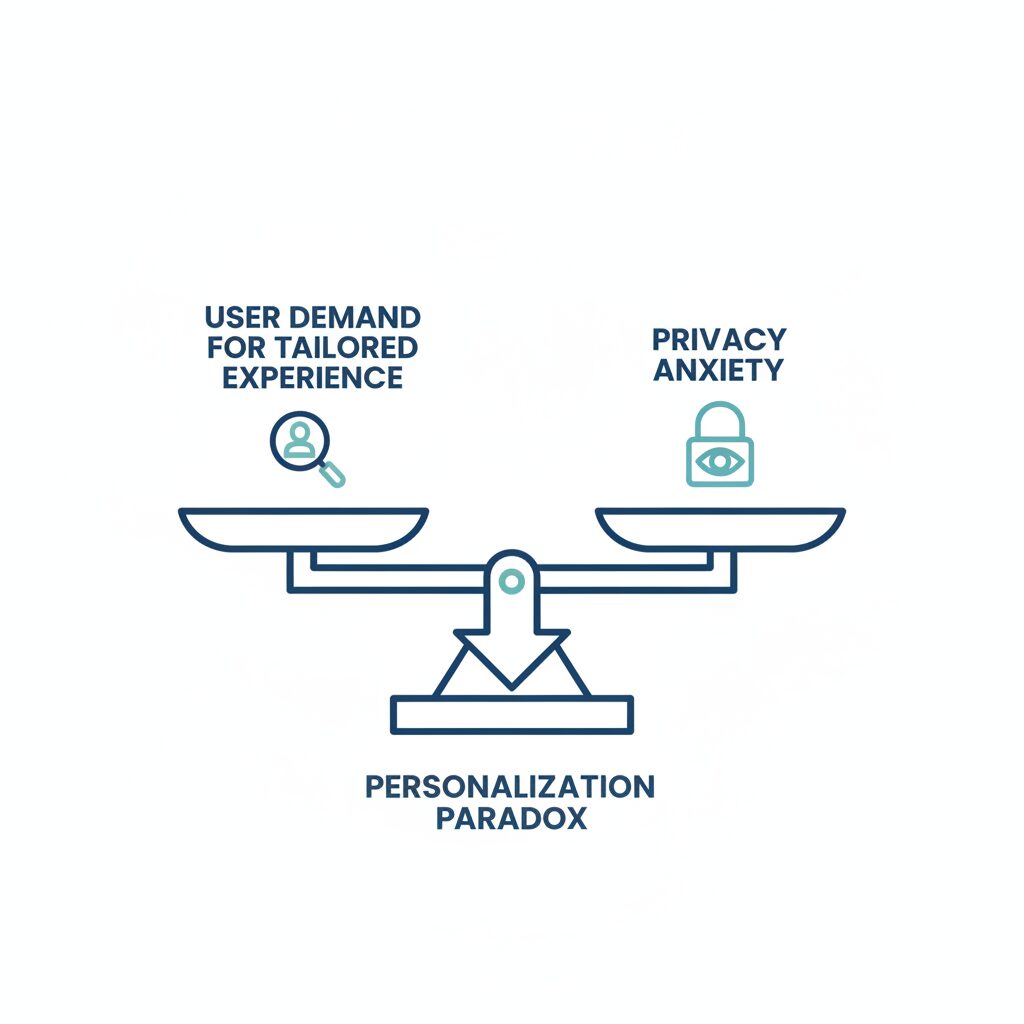
Users want experiences tailored to their exact needs, but they have a visceral instinct to close the tab the moment they feel watched. This is the personalization paradox. By 2026, the thin line between a conversion and a bounce will depend entirely on how you handle this psychological friction.

Most growth teams make a fundamental strategic error: they mistake data collection for personalization. They treat a human being as a bundle of attributes to be targeted. That is not a strategy; it is a database query. True AI personalization psychology focuses on the cognitive triggers that actually drive a decision, rather than the data points that simply describe a person.
The objective is to drive a measurable lift in LTV through radical transparency. When you align AI actions with how the human brain actually works, you stop the “creepiness” response and replace it with the feeling of being understood. Which means you scale conversions without making your customers feel like they are being stalked.
The cognitive drivers of conversion rate optimization
Conversion is a psychological event. AI is simply the tool that allows us to trigger that event at a speed and scale that no human team could ever manage. To win, you have to stop relying on basic segmentation and start applying specific cognitive biases via real-time data.
Applying anchoring and loss aversion via real-time data
Anchoring happens when the first piece of information a person sees sets the mental benchmark for everything else. For example, an AI-driven pricing page can identify a lead’s company size and industry, then present a high-tier enterprise plan first. A 2026 study by the Behavioral Economics Institute showed that anchoring the initial price point 20% higher than the target plan increased the perceived value of the mid-tier option by 14%. This works because the mid-tier option suddenly looks like a bargain, which means you can maintain higher margins without losing volume.
Loss aversion is a more powerful driver. We hate losing what we already have more than we enjoy gaining something new. When your AI flags a user who is about to churn, don’t just throw a discount at them. Instead, show them exactly what data or progress they will lose if they leave. One B2B SaaS client saw retention jump by 22% by switching their messaging from “Save 10%” to “Don’t lose your 12 months of historical growth data.” The fear of loss is a far more potent motivator than a small discount.
The IKEA effect: letting users co-create their AI experience
The IKEA effect is the tendency to overvalue things we helped build. Most companies use AI to hide the “sausage making,” presenting a polished, magic result. Honestly, that is a mistake.
When you let users calibrate their own AI preferences—letting them pick their growth goals or tweak their automation triggers—they develop a sense of psychological ownership. At Infineural, we saw that users who spent just three minutes configuring their own onboarding dashboard had a 31% higher 90-day retention rate than those who got a “pre-optimized” setup. When users build the tool, they are invested in its success.
Reducing cognitive load through predictive interface adaptation
Cognitive load is the mental effort required to process information. Too much of it leads to decision paralysis, where the user simply gives up. Your AI should act as a filter, not a firehose.
Predictive interfaces adapt in the moment. If a user’s behavior shows they are still in the research phase, the AI can hide the “Book a Demo” button and push the “Case Studies” section to the front. By stripping away irrelevant options, you lower the mental energy needed to take the next step. This creates a direct path to value, which means fewer users dropping off due to overwhelm.
Navigating hyper-personalization pitfalls
Precision is not the same as effectiveness. There is a tipping point where AI optimization becomes counterproductive, killing trust and plateauing your growth.
The ‘Creepy Valley’ effect: when AI crosses the privacy line
The “Creepy Valley” happens when an AI reveals knowledge the user never explicitly shared. Mentioning a private conversation or a niche behavior from a third-party app triggers an immediate defensive reaction. It feels like a violation. This can shatter trust in a single session.
The root cause is over-reliance on third-party data. The most effective personalization relies on first-party data—the actual actions a user takes on your own platform. If you want to scale without scaring people off, you need a first-party data strategy that values user-granted information over inferred shadows.
Algorithmic bias and the danger of the echo chamber
AI models optimize for the past. This creates a feedback loop where users only see options that fit their existing profile. In a B2B setting, a founder might never be shown a high-growth strategy because the AI has pigeonholed them as a “conservative” spender.
This echo chamber kills discovery. To fix this, you have to introduce “controlled randomness.” I recommend dedicating 5% of your personalized experiences to unexpected, high-value offers. This keeps your growth from stagnating and helps you discover new user personas you didn’t know existed.
Over-optimization: why too much precision kills discovery
When every single pixel is tuned for one conversion goal, the experience feels sterile. Users can tell when they are being pushed through a predefined funnel. It starts to feel like manipulation rather than assistance.
Over-optimization often leads to “local maxima.” You might find the best possible version of a mediocre page, but you’ll miss the chance to find a radically better approach. You must balance AI precision with raw, human-centric experimentation.
Customer experience AI ethics and the trust gap
Ethics in AI isn’t a legal checkbox. It is a competitive advantage. In a market full of opaque agencies and hidden data harvesting, being radically transparent is how you build brand loyalty.
Radical transparency in data collection
Most companies bury their data collection in a 40-page Terms of Service document. That is the old agency playbook. A strategic growth approach tells the user exactly why the data is being collected and how it actually helps them.
Stop using generic cookie banners. Instead, use a value-based disclosure: “We track your interaction with our pricing page so we can suggest the plan that saves you the most money.” When the benefit is immediate and clear, users opt in. This turns a legal chore into a trust-building exercise.
The shift from passive consent to active value exchange
Passive consent—the “by using this site you agree” model—is dead. Modern users expect an active value exchange. If you want a user’s email or behavioral data, you have to provide an immediate, tangible reward.
This could be a custom AI-generated report, a personalized growth audit, or a tool they can’t get anywhere else. When the exchange is explicit, the data you collect is higher quality because it comes from a user who is actually invested in the outcome.
Governing AI autonomy to prevent brand erosion
Giving an AI total autonomy over customer communication is a gamble. AI can hallucinate or adopt a tone that clashes with your brand. This leads to fragmented messaging that confuses the customer and weakens your authority.
The solution is a human-in-the-loop model. Let the AI generate the personalized variations, but have a senior strategist set the guardrails. This ensures your AI-powered growth stays consistent and authoritative.
Implementing a psychology-first AI growth framework
To move from theory to execution, you need a structured process. Stop guessing and start mapping behavioral triggers to specific AI actions.
Step 1: Mapping behavioral triggers to AI actions
Identify the “critical challenge” your user is facing. Build a matrix: the X-axis is the user behavior (e.g., visiting the pricing page three times in 48 hours) and the Y-axis is the psychological trigger (e.g., loss aversion). The intersection is your AI action: a personalized message highlighting the cost of inaction.
Step 2: Deploying zero-waste PPC via personalized landing pages
Traditional PPC wastes budget by sending every click to the same landing page. Use AI to route traffic based on search intent. Someone searching for “AI automation for SMBs” should see a page focused on efficiency and cost-cutting. Someone searching for “Enterprise AI scaling” should see ROI and governance. This approach to zero-waste PPC ensures your spend matches the user’s current psychological state.
Step 3: Monitoring ROI via live tracking dashboards
You cannot optimize what you do not measure. Fragmented reporting is the enemy of growth. You need a real-time dashboard that links AI triggers directly to revenue.
Track the “Lift”—the actual difference in conversion rates between the personalized experience and the control group. If a specific trigger isn’t moving the needle within 14 days, kill it. Test a new hypothesis. This is the only way to avoid the guesswork typical of traditional agencies.
Frequently Asked Questions
What is the difference between personalization and hyper-personalization in AI?
Personalization uses broad segments to tailor content to a group. Hyper-personalization uses real-time AI to tailor the experience to a single individual based on what they are doing right now.
How does AI personalization psychology affect B2B conversion rates?
It drives conversions by removing cognitive friction and using triggers like anchoring to make the value proposition undeniable. This usually leads to higher lead quality and a faster sales cycle.
What are the legal risks of using AI for behavioral targeting in 2026?
The biggest risks are non-compliance with new privacy laws regarding “inferred data.” The best defense is radical transparency and an explicit value exchange.
How can startups implement AI personalization without a massive data set?
Start with “zero-party data.” Ask users about their goals during onboarding. Use those explicit answers to trigger your first personalized experiences.
What is the ‘creepiness factor’ in AI UX design and how do you avoid it?
The creepiness factor happens when an AI knows something the user didn’t tell it. Avoid this by only using data the user has explicitly shared or actions they have taken on your site.
Eliminate the guesswork from your growth
Most companies are still stuck in a fragmented agency model based on guesswork and opaque reports. It is a waste of budget and a risk to your brand. If you are ready to build an integrated, psychology-backed growth engine, we can help.
Stop the fragmentation and maximize your ROI. Start scaling your revenue with a free audit of your current AI growth stack. No credit card required.
Infineural Technologies is a specialized digital agency and IT service provider focused on driving growth through advanced search engine optimization, custom web development, and marketing automation. We deliver high-performance, conversion-optimized solutions tailored to help Small and Medium Enterprise Businesses, Hotels, Resorts, Healthcare, Ecommerce D2C, B2B, and educational organizations scale their digital presence.
- Search Engine & Generative Engine Optimization Specialists
- Google Ads Management & Performance Marketing Experts
- Advanced WordPress & Custom Web Application Developers
- B2B, D2C & Enterprise Conversion Rate Optimization (CRO) Leaders
- Digital Growth Partners for Hospitality, Healthcare, and Education


