
Stop relying on linear funnels. Learn how to build a growth loop strategy that drives compounding acquisition and sustainable ROI for B2B startups.
Linear funnels are a structural liability
Most B2B growth models are built on a lie: the idea that acquisition is a straight line. You buy ads, you capture a lead, you close a deal. That isn’t a strategy. It is a transaction. This linear approach requires a constant, expensive injection of capital just to keep the lights on. The moment you stop spending, the leads vanish. You aren’t building a business; you’re renting a customer base.

A growth loop strategy replaces this fragile line with a closed system. In a loop, the output of one cycle becomes the fuel for the next. Instead of pouring leads into a leaky bucket, you build a machine where every new customer helps pull in the next one. This shifts your business from relying on rented attention to generating its own momentum, which means your cost per acquisition actually drops as you scale.
Why linear funnels kill compounding growth
Traditional acquisition obsession focuses on the “top of the funnel.” Agencies love this because it’s easy to sell. They promise a flood of MQLs (Marketing Qualified Leads) and traffic spikes. But volume isn’t the same as velocity. In a linear system, your Customer Acquisition Cost (CAC) almost always climbs as you exhaust your cheapest channels. You end up paying more for lower-quality leads.
The anxiety of the leaky bucket
Linear systems ignore the carnage that happens after the conversion. I’ve seen companies spend $10,000 on a campaign to snag 50 customers, only to watch 20% of them churn within 90 days. That’s not growth; it’s a treadmill. You are forced to spend more just to maintain your current size. At Infineural, we see this constantly in startups that scale their ad spend before they’ve actually fixed their retention hooks. It’s a recipe for burnout.
The math: Additive vs. Multiplicative
Linear growth is additive. If you acquire 10 customers a month, you have 120 after a year. Boring. Predictable. Compounding growth is multiplicative. If every single customer brings in just 0.2 new customers, your growth rate accelerates without you spending an extra dime on ads. This is the fundamental difference between earning a salary and owning an investment portfolio. One is a trade of time for money; the other is an asset that works while you sleep.
The anatomy of product-led marketing loops
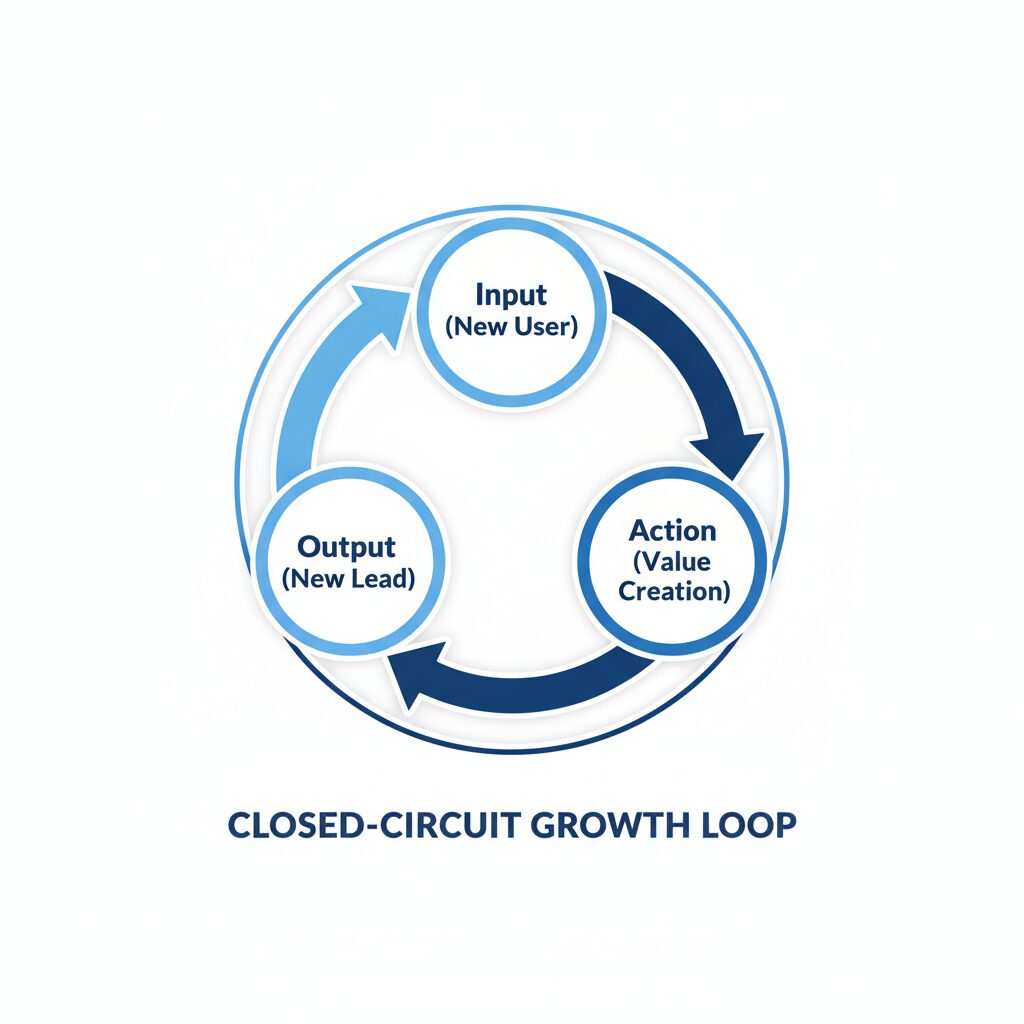
A growth loop has three moving parts: the input, the action, and the output. The output must feed directly back into the input. If there is a gap in that circle, you’re back to a linear funnel.
Defining the loop: Input, Action, and Output
Let’s look at a concrete example. The input is a new user. The action is that user creating a public-facing asset—like a shared report or a public project—using your software. The output is the visibility of that asset to other professionals, which serves as the input for the next user. The loop is closed. Your product does the heavy lifting of distribution, which means your marketing budget doesn’t have to.
Content loops: Turning users into search-optimized assets
Most B2B companies treat content like a megaphone. They shout into the void and hope someone hears them. A content loop is different. It uses actual user data to generate new assets. For instance, when a platform publishes anonymized industry benchmarks based on its users’ real-time data, that data attracts new users who want to see how they stack up against the competition. This creates a cycle of data acquisition and organic traffic. It’s the engine behind AI-powered growth systems.
Paid loops: Turning PPC into a fuel source
Most people view paid acquisition as a sunk cost. In a growth loop, it’s fuel. You use zero-waste PPC to acquire high-LTV (Lifetime Value) customers. The profits from these customers are immediately plowed back into the same high-performing channels. The critical variable here is the speed of the return. If your payback period is 30 days, you can compound your lead flow every month. If it’s 12 months, your loop is too slow to matter.
Scaling with B2B viral loops
People dismiss “viral loops” as B2C gimmicks for apps like TikTok. Dropbox and Slack get cited as examples, but B2B virality isn’t about “refer a friend” discounts. In the enterprise world, virality is about utility and professional necessity.
Why B2C tactics fail in the boardroom
Enterprise buyers don’t give a damn about a $10 referral credit. They care about efficiency, risk mitigation, and looking good to their boss. A “Refer a Friend” button in a SaaS dashboard is usually a waste of pixels because it offers no professional value. The incentive has to be baked into the work itself.
Value-based loops: Utility as an invitation
The best B2B loops are value-based. This happens when the product is objectively more useful when other people use it. Take a project management tool. To actually get the value, the user *has* to invite their team. The invitation isn’t a marketing tactic; it’s a requirement for the product to function. Growth becomes a byproduct of utility.
Integration loops: The ecosystem effect
Integration loops happen when your product plugs into another tool. When a user connects your app to their CRM or Slack, they expose your product to every other admin managing those tools. Each integration is a new discovery point. Our internal data suggests that companies with three or more deep integrations see a 40% higher organic acquisition rate than those operating in a silo.
Transitioning to customer-led growth
Growth loops don’t end at the sale. The most powerful loops happen *after* the contract is signed. This is where you stop hunting for customers and start letting your customers build your company for you.
The feedback loop: Data-driven roadmaps
Too many companies guess what features to build based on a “gut feeling.” A customer-led strategy uses a closed feedback loop. User behavior data triggers a product update, which solves a specific pain point, which boosts retention, which triggers more referrals. I suggest replacing “feature requests” with behavioral triggers. If 30% of your users drop off at a specific step in your onboarding, fixing that one step is your highest-ROI growth activity. Period.
Expansion loops: The seat-growth engine
Expansion loops focus on increasing the LTV of your existing base. In a seat-based model, as your customer’s team grows, your revenue grows automatically. This is a loop because the increased value provided to the team makes the tool indispensable, leading the company to buy more seats or upgrade their tier. It takes the pressure off your top-of-funnel acquisition.
Radical transparency as a retention tool
Retention is the engine. If people leave, the loop breaks. We push for radical transparency. This means giving customers a real-time dashboard that shows exactly what they are getting for their money. When a client sees their ROI in real-time, trust is automated. They don’t need a quarterly review call to decide to stay; the data makes the decision for them.
Designing your growth loop: A strategic framework
Building a loop requires a different mindset than launching a campaign. You are designing a system, not writing a message.
Step 1: Identify the primary value exchange
Ask yourself: what does the user get, and what does the system get back? If the user gets a custom report, does the system get a lead? If the user gets an integration, does the system get visibility? The exchange must be fair. If you ask for a forced referral before providing value, you’ll kill the loop instantly.
Step 2: Map the loop sequence
Draw the path: New User $rightarrow$ Action $rightarrow$ Output $rightarrow$ New User. Look for the gaps where you have to manually intervene or spend money to nudge the user forward. Those gaps are friction. Your sole goal is to remove every manual step from that sequence.
Step 3: Optimize for cycle time
The speed of the loop is the speed of your growth. If it takes six months for a customer to refer a peer, your compounding is glacial. Find ways to move the “Output” action earlier. Can they share a “win” on day three instead of day ninety?
Step 4: Use AI for loop velocity
AI is the catalyst here. Use it to personalize the output. Instead of a generic referral email, use AI to generate a custom case study based on the user’s actual performance data and send it to their peers. You’ve just turned a boring “ask” into a high-value insight.
Measuring loop efficiency and ROI
Standard KPIs like CAC and LTV are too blunt for loops. They tell you if you’re profitable, but they don’t tell you if you’re compounding.
Beyond CAC: The viral coefficient
The viral coefficient (K) is the only metric that matters for loop health. The math is simple: K = (Average number of invitations sent per user) x (Conversion rate of those invitations). If K is greater than 1, your growth is exponential. If K is 0.2, you’re growing, but you’re still relying on a linear input. The goal is to push K as close to 1 as possible.
Tracking velocity via real-time dashboards
You can’t manage what you can’t see. Your dashboard should track “cycle time”—the average time it takes for a new user to trigger the output that brings in the next user. When you see cycle time drop from 14 days to 7 days, you’ve effectively doubled your growth rate without spending a cent more on ads.
Frequently Asked Questions
What is the main difference between a growth loop and a marketing funnel?
A funnel is a linear process that ends in a conversion; it requires constant new inputs. A loop is a closed system where the conversion itself feeds back into the acquisition process.
How do you implement a growth loop in a high-ticket B2B business?
Stop focusing on volume and start focusing on value-based loops, like integration or content loops. High-ticket growth relies on authority and evidence, not “lead magnets.”
Which growth loop is best for early-stage startups?
Content loops. They build long-term organic authority and allow you to capture search intent while building a library of assets that compound over time.
How do you measure the success of a product-led marketing loop?
Track the viral coefficient (K) and the loop cycle time. Success looks like a decreasing CAC over time as your organic acquisition takes over.
Can you combine multiple growth loops in one business?
You should. Most successful B2B companies run a paid loop for immediate lead flow and a content or viral loop for long-term compounding.
Do growth loops replace the need for a sales team?
No. They replace the need for low-quality prospecting. Loops bring in higher-intent users, letting your sales team focus on closing rather than chasing.
How long does it take for a growth loop to show results?
Loops start slower than linear campaigns. But once the compounding effect hits the inflection point, growth accelerates rapidly. This usually happens after the first few cycles are completed.
Is AI necessary for a growth loop to work?
Not strictly, but it drastically increases velocity. AI automates the personalization and distribution of the “outputs” that drive new inputs.
Stop chasing leads and start building a system
Compounding growth isn’t the result of a “hack” or one viral post. It’s the result of deliberate architecture. When your user experience is designed to drive acquisition, growth becomes an inevitability rather than a struggle. If you’re tired of agency guesswork and want a zero-excuses, AI-powered growth system, we can help you map your first loop. Book a strategy call to see our real-time dashboard in action and start generating compounding ROI today—no long-term contracts, just results.
Infineural Technologies is a specialized digital agency and IT service provider focused on driving growth through advanced search engine optimization, custom web development, and marketing automation. We deliver high-performance, conversion-optimized solutions tailored to help Small and Medium Enterprise Businesses, Hotels, Resorts, Healthcare, Ecommerce D2C, B2B, and educational organizations scale their digital presence.
- Search Engine & Generative Engine Optimization Specialists
- Google Ads Management & Performance Marketing Experts
- Advanced WordPress & Custom Web Application Developers
- B2B, D2C & Enterprise Conversion Rate Optimization (CRO) Leaders
- Digital Growth Partners for Hospitality, Healthcare, and Education