
Stop chasing dead-end leads. Build a demand generation strategy that influences buying committees and scales ROI through AI-powered growth.
The failure of the lead generation treadmill
The B2B world is obsessed with a metric that doesn’t actually matter: the Marketing Qualified Lead (MQL). Most companies are trapped on a treadmill, celebrating a spike in MQLs while their sales teams scream about “poor lead quality.” This isn’t a communication gap between departments. It is a strategic failure. It happens because companies fundamentally misunderstand how people buy today. Modern buyers don’t want to be ‘captured’ by a gated PDF. They want to be educated. They want to solve their problem before they ever have to endure a 30-minute “discovery call” with a salesperson who is just reading a script.

A demand generation strategy stops the pursuit of contact info and starts the process of creating desire. The logic is simple: if you provide the value upfront, the prospect arrives at your contact form already convinced. They aren’t a ‘lead’ to be nurtured through a generic email sequence; they are a buyer ready to sign a contract.
Demand gen vs lead gen: Why your pipeline is stalling
The failure of the gated content model
Gating content is a relic. It worked when information was scarce. In 2026, a lead gate is just friction. When you force a prospect to trade their email for a whitepaper, you aren’t generating demand—you’re just collecting data. The result is a bloated CRM filled with “window shoppers” who wanted a free document but have zero intention of buying your software.
I’ve seen this play out in dozens of organizations. Sales teams end up wasting roughly 40% of their week chasing ghosts. These are people who triggered a “lead” notification but aren’t actually in-market for a solution. When the email address becomes the primary metric of success, the quality of the pipeline inevitably collapses.
Defining demand generation in a zero-waste ecosystem
Demand generation is the act of creating a conscious desire for your specific solution. While lead gen focuses on volume, demand gen focuses on intent. It is the difference between getting 1,000 random people to download a generic guide and getting 10 key stakeholders to realize their current manual process is leaking $50,000 a month in wasted labor.
A zero-waste ecosystem removes the friction of the ‘marketing-to-sales handoff.’ Instead of tossing a cold contact over the fence, marketing delivers a buyer who has already consumed your best insights and calculated their own ROI. This is the core of an integrated B2B marketing model: the tech and the strategy are no longer siloed.
Shifting from capture to creation
To fix this, you have to stop asking for information and start giving it away. Ungate your best assets. When you provide value without a toll booth, you build trust. In B2B, trust is the only currency that actually closes deals. When a buyer trusts your expertise before the first call, the sales cycle shrinks because the ‘education phase’ happened on their own time, not yours.
The AI-powered B2B growth framework
Mapping the modern buyer’s journey
The linear funnel is a myth. Buyers don’t move in a straight line; they move in a loop of research, validation, and internal consensus. Gartner data suggests B2B buyers spend only 17% of their journey meeting with suppliers. The other 83%? They’re on Reddit, in Slack groups, or asking AI agents for an honest opinion of your product.
Your strategy must meet them in those dark corners. This requires AI-powered growth. You need content that doesn’t just rank on Google, but provides the specific, nuanced answers that AI agents pull when a buyer asks, “Which vendor actually solves X without requiring a six-month implementation?”
Integrating marketing and tech under one roof
Fragmented agencies are pipeline killers. When your SEO agency doesn’t talk to your PPC team, and neither talks to your developers, you leak revenue. You end up with a high-performing ad that sends a buyer to a landing page that doesn’t match the ad’s promise, which then triggers a generic automation sequence that feels like spam.
You need a seamless loop. For instance, using n8n AI agent automation allows you to trigger personalized outreach only when a high-intent action occurs—like a prospect visiting your pricing page three times in 48 hours. That isn’t an “automated sequence.” It’s timely relevance.
Using AI to identify high-intent signals
Most traffic is noise. AI now lets us separate ‘informational intent’ (the student researching a topic) from ‘transactional intent’ (the Director of Ops looking for a provider). By tracking behaviors—like spending five minutes on a comparison page or using a pricing calculator—you can identify accounts that are actively in a buying window.
The numbers bear this out: accounts showing high-intent signals often convert at rates as high as 62%, compared to 3% for cold leads. When you spot these signals, your sales team stops cold calling and starts ‘warm intervention.’ (If you’re scaling, we suggest plugging specialized intent data platforms directly into your RevOps stack to automate this).
Scaling buying committee influence
Identifying the champion, the blocker, and the economic buyer
You aren’t selling to a person; you’re selling to a committee. And that committee is usually fighting with itself. The champion wants the tool to make their daily life easier. The blocker—often IT or Legal—fears the implementation headache or a security breach. The economic buyer only cares about the bottom line and the risk of doing nothing.
The biggest mistake I see is the ‘one-size-fits-all’ sales deck. The champion needs a feature walkthrough to feel empowered. The blocker needs a detailed migration plan and a security audit to feel safe. The economic buyer needs a hard business case. If you don’t arm your champion with specific assets to defeat the blocker, the deal will die in ‘internal review’ for six months.
Multi-channel campaigns for diverse personas
Your buyers don’t all hang out in the same place. The CFO is on LinkedIn; the Lead Engineer is in a private Discord or a niche technical blog. Your campaigns must be persona-specific.
In one recent project, we boosted pipeline velocity by 22% by running targeted LinkedIn Matched Audiences campaigns specifically for the economic buyers of accounts where the technical champion had already engaged. It’s a pincer movement: the champion wants it, and the buyer sees the business case. Consensus happens faster.
Creating ‘consensus-ready’ sales assets
Your content should make your champion look like a genius inside their company. Don’t just give them a PDF. Give them a ‘Business Case Template’ or a ‘Comparison Matrix’ they can copy and paste directly into an internal slide deck. When you provide the internal selling tools, you remove the burden of persuasion from your champion and place it on your data.
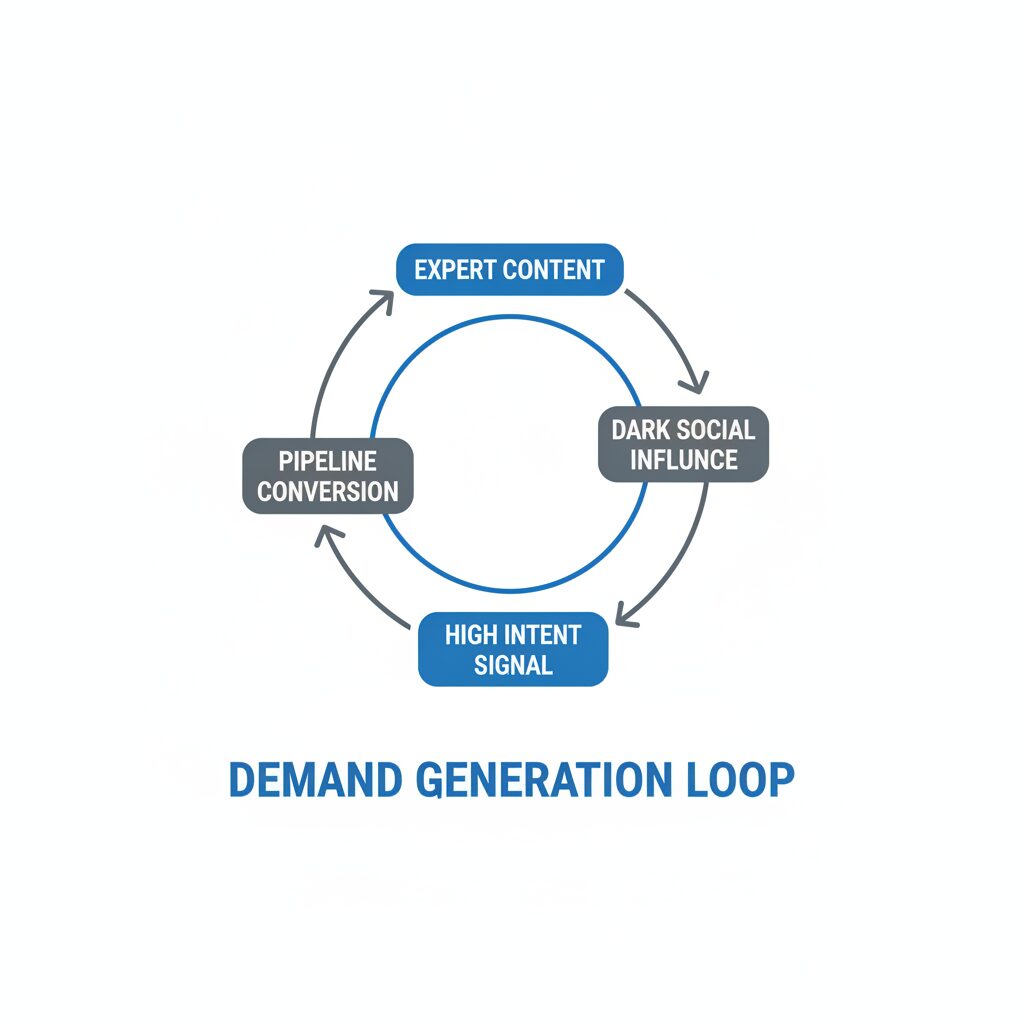
Executing a dark social strategy
Why your attribution software is lying to you
Last-click attribution is a lie. If a buyer hears about you on a podcast, reads a recommendation in a private Slack community, and then searches your brand name on Google to book a demo, your software credits Google. It ignores the podcast and the Slack group entirely.
When companies obsess over these flawed metrics, they cut spending on the very channels that actually create demand. If you only invest in what you can track with a pixel, you will only ever do what your competitors are doing.
Generating demand in untrackable channels
The real decisions happen in high-trust environments: Slack, Discord, podcasts, and peer networks. You can’t “buy” your way into these spaces with ads. The only way to win is through expert-led content. This means your executives can’t just post corporate PR; they have to be active participants, solving problems in public without a pitch.
Be the most helpful person in the room. A recommendation from a peer in a private Slack channel carries more weight than a million dollars in ad spend. This is the reality of a modern omnichannel attribution strategy—acknowledging the dark social influence while using the final conversion as the anchor.
The role of expert-led content in trust building
People buy from people. The most effective assets are those with a sharp, unique point of view. Stop writing ‘5 Tips for B2B Growth‘—that’s filler. Write ‘Why Most B2B Growth Strategies Fail in 2026.’ Challenge the status quo. Use data to show why the old way of doing things is now a liability. That is how you create a category of one.
Measuring ROI with radical transparency
Moving beyond MQLs to pipeline velocity
Forget ‘leads.’ Start measuring pipeline velocity. This is the actual speed at which a prospect moves from first touch to closed-won. The formula is simple: (Qualified Opportunities × Average Deal Value × Win Rate) / Length of Sales Cycle.
When you pivot to demand generation, your MQL count will likely drop. Don’t panic. Your win rate and average deal size will typically climb. You’re no longer filling the top of the funnel with noise; you’re filling it with high-intent buyers.
Building a real-time dashboard for growth tracking
Radical transparency means connecting spend directly to revenue. You should know, in real-time, which channels are attracting high-value accounts, even if they haven’t filled out a form yet. A growth-focused dashboard tracks: 1. Account-based engagement, 2. Pipeline velocity, and 3. CAC relative to LTV. If you’re scaling fast, stop using manual spreadsheets and integrate a professional BI tool.
Optimizing for zero-waste PPC
Paid search should be your ‘harvesting’ tool, not your primary demand generator. Use zero-waste PPC to capture the demand you’ve already created. Stop bidding on broad, expensive keywords like ‘marketing agency’ and start bidding on high-intent long-tail keywords and your own brand terms.
By targeting only those who have already been primed by your expert content, you lower your CAC while increasing conversion quality. In our experience, this shift can cut wasted ad spend by 30% within the first 90 days.
Frequently Asked Questions
What is the main difference between demand generation and lead generation?
Lead generation is about collecting emails via gates. Demand generation is about creating a desire for your product so that buyers arrive at your door ready to transact.
How do you measure the success of a dark social strategy?
You can’t track it with pixels. Instead, use ‘self-reported attribution.’ Add a mandatory ‘How did you hear about us?’ free-text field to your demo form. That’s where you’ll see the real influence of podcasts and Slack.
How many people are typically in a B2B buying committee in 2026?
On average, six to ten stakeholders. This usually includes a champion, an economic buyer, and several technical or legal evaluators.
Which AI tools are best for demand generation automation?
n8n is excellent for workflow automation, and AI-driven intent platforms are essential for spotting high-intent signals and triggering timely outreach.
How long does it take to see ROI from a demand gen pivot?
Lead gen gives you immediate, low-quality spikes. Demand gen compounds. It typically takes three to six months to see the full effect, but once it hits, pipeline velocity and win rates increase significantly.
Stop guessing and start growing
A real demand generation strategy replaces hope with a system of radical transparency and AI precision. If you’re tired of managing fragmented agencies and want to build an integrated growth engine that actually moves the needle on ROI, let’s map it out. Book a growth strategy audit today—no hidden fees, no fluff, just data.
Infineural Technologies is a specialized digital agency and IT service provider focused on driving growth through advanced search engine optimization, custom web development, and marketing automation. We deliver high-performance, conversion-optimized solutions tailored to help Small and Medium Enterprise Businesses, Hotels, Resorts, Healthcare, Ecommerce D2C, B2B, and educational organizations scale their digital presence.
- Search Engine & Generative Engine Optimization Specialists
- Google Ads Management & Performance Marketing Experts
- Advanced WordPress & Custom Web Application Developers
- B2B, D2C & Enterprise Conversion Rate Optimization (CRO) Leaders
- Digital Growth Partners for Hospitality, Healthcare, and Education