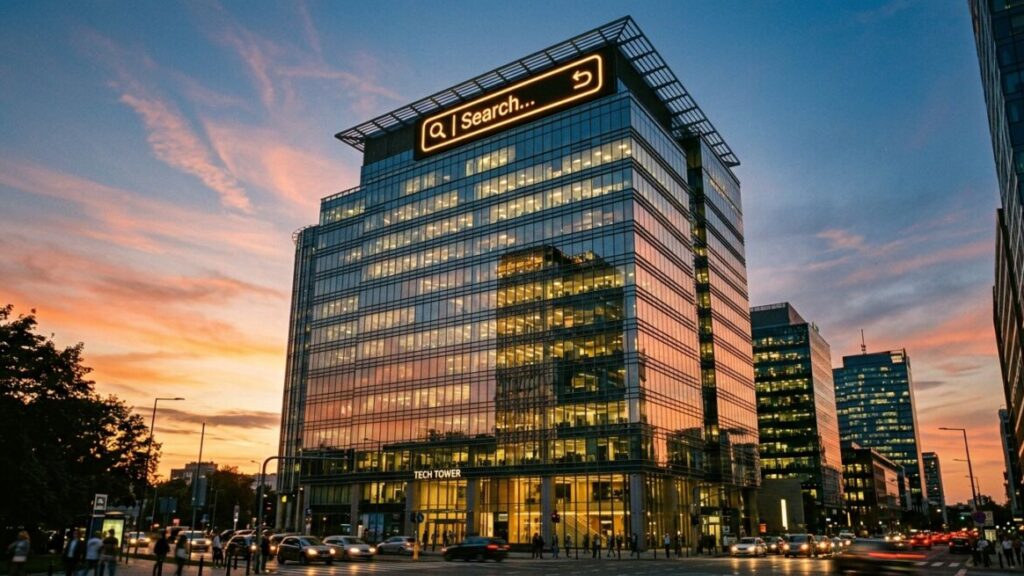
Does a $30M domain actually help you rank? Discover how the world's most expensive domain names affected SEO in 2026 through trust, CTR, and AI authority.
The $30 Million Question: Does Price Drive Rankings?
You have seen the headlines. Voice.com sells for $30 million. Sex.com goes for $13 million. Business.com moves for $345 million. But does spending a fortune on a domain actually help you rank on page one? Or is it just a massive vanity project for billionaires?

Here is the bottom line. A high price tag does not buy you a top spot in Google automatically. But it does buy you something more valuable in 2026: Instant Authority. In our work at Infineural Technologies, we have seen that premium domains act as a force multiplier for every other SEO effort you make.
Think about it. When you see a link for “Insurance.com,” do you trust it more than “cheap-insurance-quotes-4-u.net”? Of course you do. That trust leads to a higher Click-Through Rate (CTR). And guess what? High CTR is a massive signal to search engines that your site is the right answer. This is how the world’s most expensive domain names affected SEO—not through a secret code, but through human psychology and brand dominance.
The Psychology of the “Power Domain” in 2026
Why do these domains still matter so much in 2026? It is because search has changed. We are no longer just looking at blue links. We are looking at AI-generated answers and trust-based results. A premium domain tells the AI that you are the definitive source for that topic. It is a shortcut to E-E-A-T (Experience, Expertise, Authoritativeness, and Trustworthiness).
And let us be real. Most people think SEO is just about keywords. It is not. It is about being the brand that people expect to see. When a company buys a domain like Crypto.com, they are not just buying a URL. They are buying the right to be the leader in the user’s mind. That mental real estate translates directly into search dominance.
But does this mean you need millions? Not necessarily. But understanding how these giants use their domains can change your strategy. They use their name to attract high-quality backlinks without even trying. People naturally link to “Home.com” because it sounds official. This natural link equity is something we often discuss when looking at these 15 Top Interesting Unknown Facts SEO Experts Use to Rank to stay ahead of the competition.
Direct Navigation: The Hidden SEO Signal
Did you know that thousands of people still type “Hotels.com” directly into their browser? This is called direct navigation. It is the holy grail of traffic. Why? Because it is 100% free and 100% brand-loyal. But there is a secret SEO benefit here too.
Search engines monitor how many people search for your brand name or visit you directly. If millions of people go to “Vacation.com” without clicking an ad, Google assumes that site is the ultimate authority. This “Brand Signal” lifts the rankings for every single page on that site. It creates a rising tide that lifts all boats.
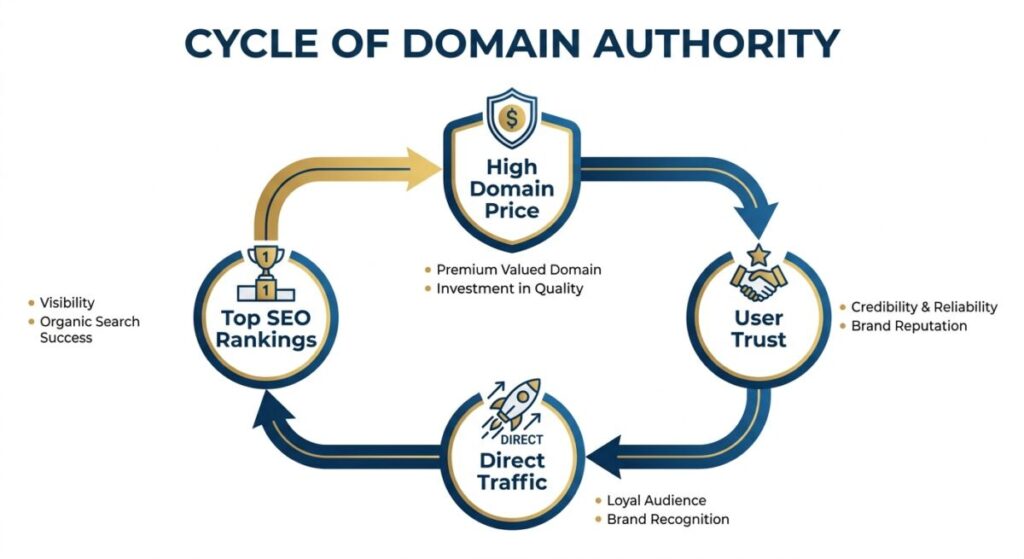
In the March 2026 “Trust-First” update, Google made it clear. Brands that exist outside of search results will rank better within them. Expensive domains are the fastest way to build that external brand presence. It is a cycle of success. High price leads to high trust, which leads to more direct traffic, which leads to better rankings.
The Death of the Exact Match Domain (EMD) Myth
Years ago, you could buy “Best-Cheap-Laptops-Online.com” and rank in a week. Those days are gone. In 2026, “Exact Match Domains” (EMDs) that look spammy are actually penalized. But there is a huge difference between a spammy EMD and a “Category Killer” domain.
A category killer is a one-word domain like “Cars.com” or “Coffee.com.” These are not spam. They are assets. The SEO impact here is huge because the domain itself is the primary keyword. When people search for “Cars,” the domain matches the intent perfectly.
But wait. Does this mean you should go out and buy a multi-million dollar domain today? Probably not. We have found that 11 Hidden Ranking Factors for Niche Websites often matter more for smaller businesses. You can win without the big name, but you have to work twice as hard to build the same level of trust.
The ‘Acquisition SEO’ Play: Link Equity and 301 Power in 2026
When a corporation spends $30 million on a domain like Voice.com, they aren’t just buying a name; they are buying a pre-existing digital ecosystem. In 2026, the SEO impact of these expensive domains is largely driven by their ‘Link Heritage.’ These domains often come with thousands of high-authority backlinks from legacy news sites, government institutions, and academic journals that are impossible to replicate manually.
The 301 Redirect Strategy for Instant Authority
Many SEO experts use a strategy called ‘Acquisition SEO’ where a premium domain is purchased and redirected to a sub-folder of an existing site. This transfers the domain authority instantly. However, in the 2026 ‘Trust-First’ environment, Google’s algorithms are smarter. They look for ‘Topical Relevance’ during the transfer. If you buy a premium domain in the finance space and redirect it to a gambling site, you will likely face a manual penalty. This is one of the many 15 Top Interesting Unknown Facts SEO Experts Use to Rank today.
Expensive domains act as a shield against algorithmic volatility. Because they are recognized as ‘Entity Leaders,’ they are often the last to be hit by broad core updates. For niche players, understanding these 11 Hidden Ranking Factors for Niche Websites can help bridge the gap without the multi-million dollar price tag.
How AI Search Engines (GEO) View Premium Domains
Search is evolving into Generative Engine Optimization (GEO). Tools like SearchGPT and Google Gemini are looking for the most “authoritative” source to summarize. When an AI scans the web, it looks for signals of permanence. A domain that sold for $20 million is a signal of permanence.
Think about it from the AI’s perspective. It wants to give the user a safe, accurate answer. A company that invests heavily in its digital infrastructure is less likely to be a fly-by-night scam. So, the AI is more likely to cite “Health.com” than a newer, cheaper domain. This is one way how the world’s most expensive domain names affected SEO in the age of artificial intelligence. They became anchors of truth in a sea of AI-generated content.
And it is not just about the name. It is about the history. Most expensive domains have been around since the 90s. That age is a huge ranking factor. If you want to see how age and speed work together, check out how page load speed actually affects ranking in our recent study. A fast, old, expensive domain is nearly unbeatable.
The Backlink Magnet Effect
Here is a secret. It is easier to get a backlink if your domain is “Travel.com” than if it is “Bobs-Travel-Tips-2026.com.” Why? Because journalists and bloggers want to link to sources that look like they will be around forever. They want their own articles to stay relevant.
When you own a premium domain, your outreach success rate skyrockets. We have seen cases where a simple domain change increased backlink acquisition by 400% without changing the content. That is the power of perception. This organic link growth is the real reason these domains are worth the money. They save you millions in future marketing costs.
But be careful. Just because a domain is expensive doesn’t mean it’s clean. Always check the “toxic history” of a domain before buying. Sometimes a big name carries big baggage.
Case Study: The Voice.com Impact
Let us look at a real example. In 2019, MicroStrategy sold Voice.com for $30 million. At the time, people laughed. But look at where they are in 2026. By building a high-end NFT and social platform on that domain, they bypassed years of “sandbox” time that new sites usually face.
They didn’t have to prove to Google that they were serious. The domain did that for them. Within months, they were ranking for competitive terms that usually take years to crack. This is the definition of “SEO efficiency.” You are trading capital for time. For a massive corporation, $30 million is a small price to pay to save five years of SEO labor.
Is a Premium Domain Right for You?
So, should you liquidate your 401k for a domain? No. But you should think about your “Brandability.” If you cannot afford “Shoes.com,” find a name that sounds like it could be worth millions one day. Avoid hyphens. Avoid numbers. Avoid weird TLDs unless you are in a specific niche like .ai for tech.
The goal is to create a “Trust Bridge” between you and the user. The shorter that bridge, the faster your SEO will work. Remember, search engines are just trying to mimic human behavior. If humans love your name, the algorithm will eventually love it too.
At Infineural Technologies, we focus on these high-level strategies to ensure our clients don’t just rank, but dominate. It’s about the whole picture—from the name to the server speed to the content quality.
Premium Domains in the Age of AI Search & SGE Optimization
In 2026, search is no longer just about keywords; it’s about being the ‘Preferred Entity’ for AI models. When Google’s SGE (Search Generative Experience) or OpenAI’s SearchGPT generates a response, it pulls from sources it deems most authoritative. A premium, expensive domain name provides a massive signal of ‘Entity Confidence’ to these AI models.
Why LLMs Prefer Short, Expensive Domains
Large Language Models (LLMs) are trained on vast datasets where short, generic domains (like Health.com or Crypto.com) appear more frequently as citations. This frequency creates a bias in the AI’s output. If you own the primary domain for a category, the AI is statistically more likely to cite you as the definitive source. To stay ahead, marketers must focus on AI Overview Optimization to ensure their premium assets are actually being summarized in the search results.
Furthermore, as we see in the Technical SEO Guide to Hindi, Tamil, and Bengali SGE, the linguistic simplicity of an expensive, one-word domain translates better across multilingual search environments. It reduces the ‘token cost’ for the AI and provides a clear, unambiguous brand signal regardless of the user’s language.
The Hidden Risks: When a $1M Domain Becomes a Toxic Asset
Price does not always equal performance. In the history of expensive domain sales, there are numerous examples of domains that were previously used for spam or gray-hat SEO. Before investing millions, performing a deep forensic audit is mandatory. In 2026, search engines maintain a ‘Domain Sentiment History’ that survives even ownership changes.
Forensic SEO Audits for Premium Domains
If a domain was used as a PBN (Private Blog Network) in 2022, it might still carry a ‘Trust Debt’ in 2026. This is why many firms use Secret SEO Tools vs Mainstream Software to uncover hidden penalties that don’t show up in standard reports. If you are looking to acquire an asset, you might even need to consult a specialized SEO Agency in Nashik or elsewhere that understands the nuances of regional domain history and global impact.

A high-priced domain also attracts more negative SEO attacks. Competitors are more likely to target a site like ‘Insurance.com’ with spammy link injections than a smaller site. Constant monitoring and a robust technical foundation are required to protect such a massive investment.
Frequently Asked Questions
Does buying an expensive domain instantly improve my ranking?
No, it does not guarantee a top spot immediately. However, it provides a massive head start in trust and click-through rates that makes ranking much easier.
What is the most expensive domain ever sold?
Business.com holds a top spot at $345 million, though many private sales likely exceed this. These prices reflect the domain’s potential for total market dominance.
Do one-word domains rank better than long-tail ones?
Usually, yes, because they are easier to remember and carry higher authority signals. They also attract more natural backlinks from other websites.
Is .com still the best TLD for SEO in 2026?
Yes, .com remains the gold standard for global trust and recognition. While other TLDs are rising, .com still dominates direct navigation traffic.
Can a bad domain name hurt my SEO?
Yes, spammy, long, or hyphenated names can lower your CTR and make users hesitate to click. This tells search engines that your result is not desirable.
How does domain age affect SEO?
Search engines view older domains as more stable and trustworthy. Most expensive domains have a history going back decades, which is a major ranking signal.
What should I look for when buying a premium domain?
Check the backlink history, ensure there are no past manual penalties, and verify that the name is easy to spell and pronounce.
Do AI search engines prefer expensive domains?
AI engines prioritize “authoritative sources,” and expensive domains often have the history and brand signals that AI uses to define authority.
Ready to take your search strategy to the next level? Don’t let a weak domain or outdated SEO tactics hold you back. At Infineural Technologies, we build digital empires using data-driven insights and cutting-edge technology. Contact us today to see how we can transform your online presence in 2026.
Do expensive domain names help with SEO in 2026?
Yes, but not directly through the price tag. Expensive domains typically have high brand equity, short lengths, and legacy link profiles that signal authority to AI search models and increase user click-through rates (CTR).
Is an Exact Match Domain (EMD) still worth millions?
Only if it is a ‘Category Killer’ domain like Cars.com. In 2026, spammy, hyphenated EMDs are penalized, but short, single-word domains are highly valued for their ability to dominate brand entity signals in AI search results.
How does domain price affect AI search citations?
AI models prioritize domains with high frequency in training data and strong E-E-A-T signals. Premium domains often possess decades of citations, making them the primary choice for AI-generated summaries and overviews.
Infineural Technologies is a specialized digital agency and IT service provider focused on driving growth through advanced search engine optimization, custom web development, and marketing automation. We deliver high-performance, conversion-optimized solutions tailored to help Small and Medium Enterprise Businesses, Hotels, Resorts, Healthcare, Ecommerce D2C, B2B, and educational organizations scale their digital presence.
- Search Engine & Generative Engine Optimization Specialists
- Google Ads Management & Performance Marketing Experts
- Advanced WordPress & Custom Web Application Developers
- B2B, D2C & Enterprise Conversion Rate Optimization (CRO) Leaders
- Digital Growth Partners for Hospitality, Healthcare, and Education