
Stop guessing with your growth. Learn how the fractional marketing leadership model scales startups without the overhead of a full-time CMO. Get started.
The structural gap in growth scaling
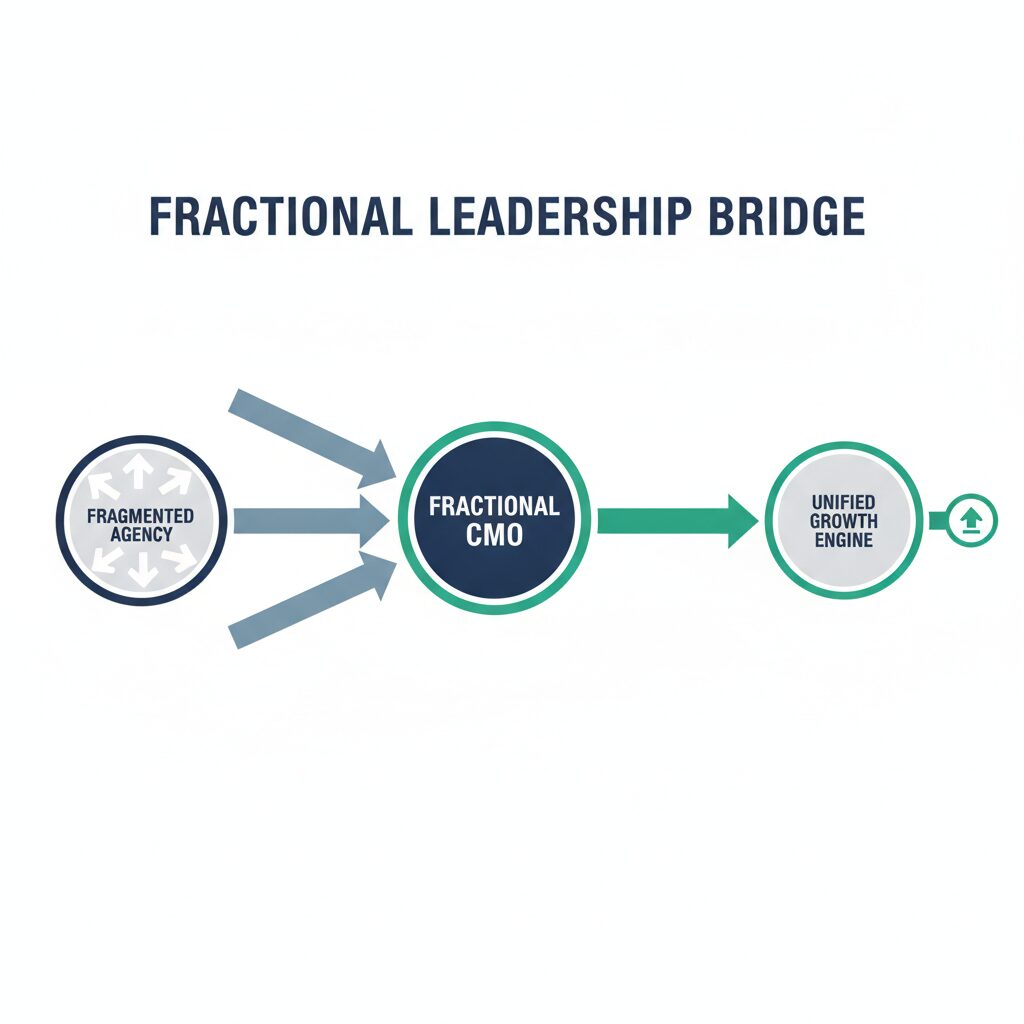
Most founders eventually hit a ceiling. You reach a point where managing the day-to-day operations and driving aggressive growth becomes a contradiction. You can’t do both well. Usually, this leaves you with two bad options: gamble on a full-time executive with a $250,000 base salary or outsource your soul to a fragmented group of agencies that don’t talk to each other. This gap is exactly where the fractional marketing leadership model fits. This isn’t a consulting gig. It is a structural fix. It provides high-level strategy, a brutal transparency in spending, and AI-driven growth without the permanent weight of a C-suite salary.

In the real world, this model kills the ‘hope-based’ marketing approach. You know the one: where you launch a campaign and just hope the leads start rolling in. Instead, you get the architectural rigor of an enterprise leader but keep the lean agility of a startup. By bringing growth, tech, and strategy under one roof, you stop paying the ‘fragmentation tax’—that invisible waste that happens when agencies optimize for their own deliverables instead of your bottom line.
What is the fractional marketing leadership model?
Defining the fractional executive role
A fractional leader is an embedded executive who owns a specific outcome. Let’s be clear about the difference here. A consultant delivers a polished slide deck, tells you it looks great, and then disappears. A fractional leader lives in your Slack, attends your leadership meetings, and manages your budget. They hold your execution team’s feet to the fire. While they are paid for their time, their actual value is measured by the ROI they unlock. This is a shift in ownership, which means you stop being the primary project manager for your own growth.
At Infineural, we see it constantly: founders who are exhausted from managing five different vendors. The fractional model creates a single point of accountability. The leader doesn’t just point to a destination on a map; they get in the driver’s seat and steer the vehicle.
The shift from execution-only agencies to strategic leadership
Most agencies are just execution engines. They are great at the “how”—running ads or churning out blogs—but they almost never ask “why.” They operate on a deliverables mindset. They’ll send you a monthly report bragging about a 20% increase in clicks, but those clicks don’t pay the bills if they don’t turn into revenue.
Strategic leadership starts by questioning the premise of the ad itself. Our 2026 internal audits of mid-market B2B firms show that companies using strategic leadership models saw a 22% jump in lead-to-customer conversion. This didn’t happen because they spent more money. It happened because the leader identified the actual sales bottleneck and aligned the marketing spend to break it.
Core deliverables: Strategy, ROI tracking, and team orchestration
The fractional leader provides three specific assets. First is the growth strategy: a cold-eyed diagnosis of your current market position and a guiding policy to overcome it. Second is the tracking mechanism. They replace opaque, “trust us” reports with a real-time dashboard. This means you know exactly where every dollar is going at 2 PM on a Tuesday, not thirty days after the month ends.
Third is team orchestration. Whether you have a few juniors in-house or a handful of external vendors, the fractional leader ensures everyone is rowing in the same direction. They kill the friction of fragmented communication and replace it with a zero-excuses execution framework.
Fractional vs full-time CMO: Determining your need
When to choose a fractional leader
You need a fractional leader when your growth is erratic—some months are great, some are ghost towns—but your revenue doesn’t yet justify a $300,000 annual executive package plus equity. If you are spending between $20,000 and $100,000 per month on acquisition, you have enough skin in the game to require professional leadership, but not enough to support a full-time C-suite hire.
This is for the ‘scaling’ phase. You’ve found product-market fit, but you don’t know how to pour fuel on the fire without burning the house down. The fractional leader provides the guardrails for that acceleration.
The cost-benefit analysis of full-time leadership
A full-time CMO is a long-term bet. They make sense for enterprises with complex, multi-year brand plays or those needing deep internal cultural integration. But the cost is steep: base salary, bonuses, equity, and the crushing risk of a bad hire. Replacing a failed full-time CMO can cost a company 1.5x their annual salary when you factor in lost momentum and headhunter fees.
The fractional model strips away that risk. You scale the engagement up or down based on your business cycle. You pay for the expertise you need today, not the title you think you’ll need in five years.
Risk mitigation in early-stage scaling
Scaling too fast is a classic way to fail. Many companies hire a full-time CMO who immediately tries to build a massive department before the unit economics are even proven. The result is a bloated payroll and a mountain of inefficient spend.
A fractional leader takes the opposite approach: zero-waste PPC and lean experimentation. They prove the channel first. Only after the ROI is validated do they help you hire the full-time staff to manage those channels. This sequence protects your runway and ensures you aren’t hiring for a system that doesn’t work.
How to hire a fractional CMO who drives ROI
Audit your current growth gaps
Before you hire, you have to diagnose. Is your problem a lack of leads, a low conversion rate, or a high churn rate? If you hire a ‘growth’ expert when you actually have a retention problem, you’re just paying someone to pour water into a leaky bucket. We suggest performing a full audit of your AI customer lifecycle marketing to find exactly where the leak is.
Here is a red flag: a qualified leader will start the process by asking for your data, not by pitching their services. If they promise a ‘proven system’ before they’ve seen your numbers, they are a vendor, not a leader.
Vetting for data-driven decision making and AI proficiency
By 2026, any marketing leader who can’t manage an AI stack is a dinosaur. You need someone who knows how to use AI agents for deep research, content velocity, and lead scoring. Ask them specifically how they integrate automation to cut out manual labor.
Look for concrete examples of AI-driven RevOps strategy implementation. They should be able to tell you how they reduced customer acquisition costs (CAC) by automating the top-of-funnel qualification process. If their experience is just ‘managing an agency,’ keep looking.
Structuring the engagement: Retainers vs performance-based incentives
Avoid hourly billing. Hourly billing rewards inefficiency—the slower they work, the more they make. Instead, use a monthly retainer that covers a set amount of leadership capacity.
To make sure your interests are aligned, add a performance-based incentive. Tie a bonus to a specific KPI, like a 15% increase in qualified pipeline or a 10% reduction in CAC. This transforms the relationship from a monthly expense into a profit-sharing partnership.
Scaling marketing leadership without the bloat
Building a zero-waste PPC and acquisition engine
Most companies waste about 30% of their ad spend on keywords and audiences that will never convert. A fractional leader stops this bleed by implementing zero-waste PPC, which means aggressively pruning underperforming assets in real-time.
They operate with a ‘kill-fast’ mentality. If a campaign doesn’t show a clear path to ROI within a defined window, it’s shut down. No ego, no sentimentality. This discipline ensures that every dollar spent is an investment in data or revenue, not a donation to Google or Meta.
Integrating AI automation into the marketing stack
The goal is to keep the team lean. Instead of hiring three more copywriters, a fractional leader builds an AI content engine that maintains your brand voice while scaling output. They use tools like n8n or custom AI agents to handle the boring stuff: lead routing and personalized follow-ups.
If you want to tighten your tech, we recommend looking into n8n AI agent setups to automate the bridge between marketing and sales. This eliminates that common gap where leads die in a spreadsheet because no one followed up.
Transitioning from fractional to full-time leadership
The fractional model is often a bridge. Once the growth engine is humming and your revenue is predictable, you might decide to bring the role in-house. The beauty of this setup is that the fractional leader can actually help you write the job description for their own replacement.
They know exactly what skills you need because they’ve been doing the work. They can vet the candidates and onboard the new CMO, which means you get a seamless handoff without the usual dip in performance.
Common failure modes of the fractional model
The ‘Strategy-Only’ trap: Lack of execution
The biggest risk is hiring a leader who provides a beautiful strategy but doesn’t ensure it actually happens. That’s just expensive consulting. A real fractional leader owns the outcome. They don’t just say ‘you need better landing pages’; they manage the designer and the developer until the page is live and converting.
If your fractional leader spends all their time in meetings and zero time in the accounts or the dashboard, you’ve fallen into the strategy-only trap. This is usually a failure of how the engagement was structured from day one.
Misalignment on radical transparency and reporting
The model fails when the leader hides behind ‘vanity metrics.’ If you are seeing reports on ‘reach’ and ‘engagement’ but you can’t see ‘pipeline value’ and ‘CAC,’ you are being lied to by the data.
Radical transparency means the founder knows exactly what is failing. A great leader will tell you a campaign failed and explain why, rather than trying to spin the data to look better. When reporting becomes an exercise in optics rather than an exercise in truth, the leadership has failed.
Frequently Asked Questions
What is the average cost of a fractional CMO?
Most range from $5,000 to $15,000 per month. This is a fraction of the $20,000+ monthly cost of a full-time executive package when you include benefits and equity.
How many hours per week does a fractional marketing leader typically work?
Usually 5 to 15 hours. Remember: you aren’t paying for hours; you are paying for the quality of their decision-making and the accuracy of their strategy.
Can a fractional CMO manage my existing agency partners?
Yes. In fact, that’s one of their most valuable functions. They act as the technical and strategic filter so you don’t have to decipher agency jargon.
What are the KPIs for measuring a fractional leader’s success?
Focus on pipeline growth, a lower CAC, and the accuracy of the ROI forecast. Ignore social media followers—they don’t pay the rent.
How does a fractional model differ from a marketing consultant?
A consultant gives you a map and a set of instructions. A fractional leader takes the wheel and drives the car to the destination.
The path to integrated growth
Scaling isn’t about throwing more budget at the problem; it’s about a shift in leadership. The fractional marketing leadership model gives you the architectural rigor of an enterprise CMO with the lean agility of a startup. Stop accepting fragmented results and opaque reports from a dozen different agencies.
Get your growth, tech, and strategy under one roof. Start building your growth engine today with a free strategy audit from Infineural—no credit card required.
Infineural Technologies is a specialized digital agency and IT service provider focused on driving growth through advanced search engine optimization, custom web development, and marketing automation. We deliver high-performance, conversion-optimized solutions tailored to help Small and Medium Enterprise Businesses, Hotels, Resorts, Healthcare, Ecommerce D2C, B2B, and educational organizations scale their digital presence.
- Search Engine & Generative Engine Optimization Specialists
- Google Ads Management & Performance Marketing Experts
- Advanced WordPress & Custom Web Application Developers
- B2B, D2C & Enterprise Conversion Rate Optimization (CRO) Leaders
- Digital Growth Partners for Hospitality, Healthcare, and Education