
Stop guessing your spend. Learn how to use AI-powered growth and zero-waste PPC to optimize marketing budget allocation for maximum ROI.
The diagnosis of budget waste
Most founders treat their marketing budget like a lottery ticket. They dump capital into a fragmented mess of agencies and hope for a win. This kind of guesswork is where ROI goes to die. Let me be clear: strategy is not a vague goal or a “desire” for growth. Strategy is the act of overcoming a specific, identified obstacle. In B2B marketing, that obstacle is almost always the gap between spend and real-time visibility.

The old model of quarterly budget planning is a relic. When you rely on a PDF report from thirty days ago to decide next month’s spend, you are driving a car by looking in the rearview mirror. You’ll hit the wall before you see it. Growth in the AI era requires radical transparency. I’ve found that the only way to achieve this is by integrating your tech and marketing under one roof. This removes the friction and “information silos” typical of fragmented agency models, which means you stop paying three different vendors to ignore the same data.
Marketing spend optimization through radical transparency
The fragmented agency model fails because of misaligned incentives. It is a structural flaw. A PPC agency is incentivized to increase spend to show more volume. An SEO agency wants more time to justify their monthly retainer. Neither is incentivized to tell you that a specific channel has hit a point of diminishing returns. This creates a blind spot. Your budget leaks through overlapping efforts and conflicting data points that no one is tasked with reconciling.
To stop the leak, you need a real-time dashboard. This isn’t about “having more data.” It’s about the speed of the feedback loop. When you see your actual cost per acquisition (CAC) updated hourly, you stop making decisions based on “average monthly performance,” which is usually a lie. In our own experience, we’ve seen teams cut wasted spend by 22% in a single month simply by shifting budgets from underperforming ad sets to high-converting ones on Tuesday, rather than waiting for the end-of-month review.
Your allocation must also match your growth stage. A seed-stage startup should put 80% of its budget into high-intent capture to prove product-market fit. If you can’t capture existing demand, you don’t have a product people want. At the scale stage, the focus shifts toward demand generation. If a scale-stage company still spends 90% on bottom-of-funnel search terms, they will hit a growth ceiling. They are fighting over a small pool of existing searchers instead of growing the pool itself.
Implementing zero-waste PPC
Zero-waste PPC is a discipline. It is the aggressive removal of every single click that cannot possibly lead to a conversion. Most agencies use a “set and forget” approach to negative keywords. They block the obvious junk, but they miss the subtle shifts in user intent. This is where AI-driven intent matching changes the math. You stop targeting keywords and start targeting the intent behind the query.
When you run this system, the AI analyzes the search terms that lead to actual pipeline, not just “clicks” or “impressions.” For example, I worked with a B2B client who was spending 15% of their budget on “educational” queries. These people wanted to learn, not to buy, resulting in a 0% conversion rate. By automating negative keyword scrubbing, we redirected that wasted spend into high-intent clusters. The result was a CAC drop from $420 to $285 in six weeks.
This requires a zero-excuse approach to audits. Review the search term report daily. If a keyword is costing money without providing a lead, kill it. There is no room for “brand awareness” in a PPC budget for a growth-stage SMB. Every dollar must be accountable to a specific outcome on the dashboard, or it is a waste.
Measuring AI marketing ROI
Last-click attribution is a lie. It gives all the credit to the final touchpoint and ignores the three webinars, two whitepapers, and the LinkedIn post that actually convinced the buyer to click “buy.” To see the real picture, you need a model that accounts for assisted conversions. This is how AI-powered growth strategies use predictive modeling to identify the real catalysts in the journey.
The CAC to LTV (Lifetime Value) ratio is the only metric that determines long-term survival. Based on 2026 B2B benchmarks, a healthy ratio is 1:3 or higher. If your ratio is 1:1, you are effectively buying customers at a loss. If it is 1:5, you are likely under-spending. You are leaving market share on the table for a competitor who is willing to pay more to acquire a high-value lead.
Predictive modeling allows you to move your money before the crash. By spotting early signals—like a 10% spike in lead cost or a dip in lead-to-opportunity conversion—AI can trigger a budget reallocation. This happens before you waste thousands of dollars on a campaign that has stopped working. Budgeting shifts from a seasonal event to a continuous process of optimization.
Strategic distribution across multi-channel campaigns
The most common failure in budget allocation is the “all-in” bet. A founder finds one channel that works and pours every dollar into it until performance tanks. This happens because of diminishing returns. Every channel has a saturation point. The next dollar spent will always yield less than the previous one once you’ve captured the “low-hanging fruit.”
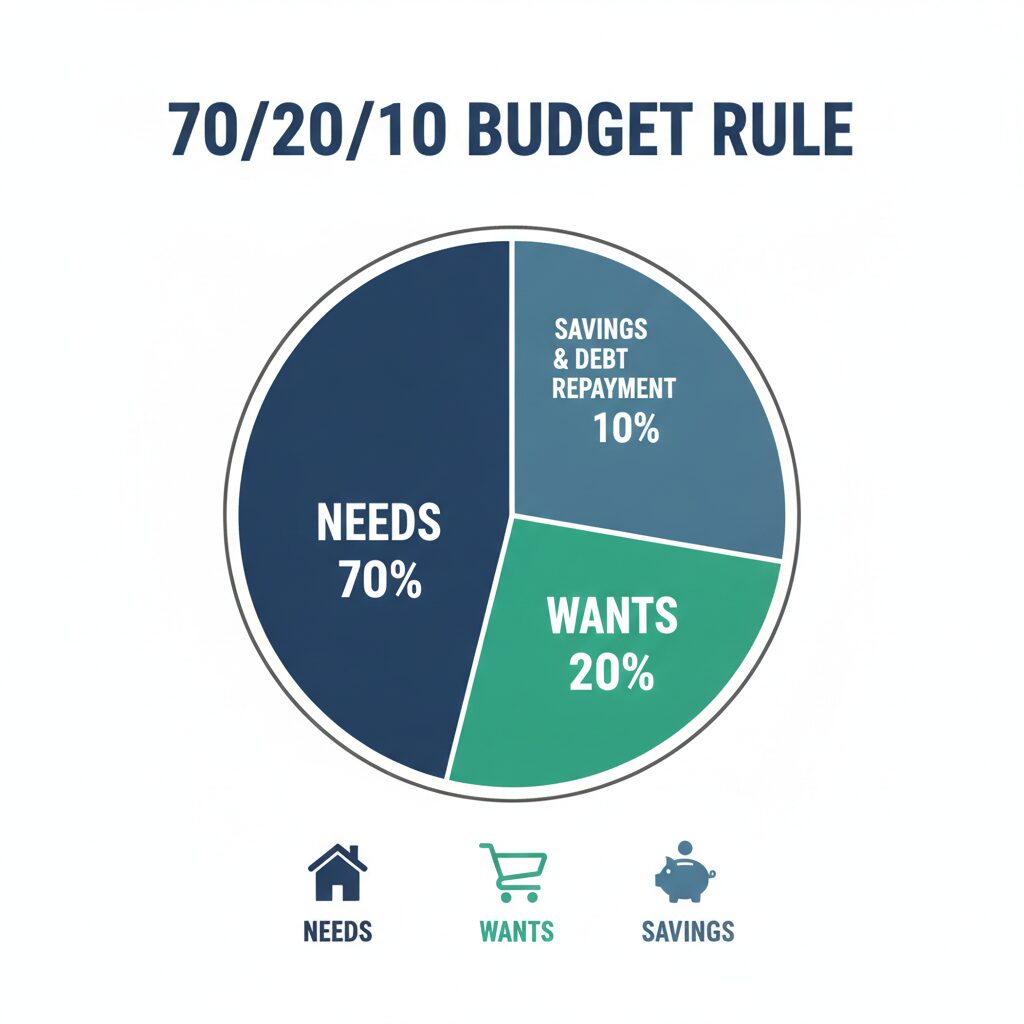
I recommend the 70-20-10 rule. It is a risk-adjusted framework for growth. Put 70% of your budget into proven, high-performing channels to keep the lights on. Put 20% into channels that show promise but need tuning. Reserve 10% for high-risk, high-reward experiments. This structure ensures you maintain your current revenue engine while building the next one. You aren’t gambling; you’re diversifying.
The secret to scaling is balancing high-intent capture with demand generation. High-intent channels, like Google Search, are limited by volume. You cannot simply spend more to get more leads if the market isn’t searching for you. You must use the 20% and 10% buckets to create demand via social and content. This increases the volume of people searching for your solution, which then feeds more leads into your 70% high-intent bucket.
Frequently Asked Questions
How much of a marketing budget should be allocated to experimental channels?
Stick to the 10% rule. This lets you test new platforms or creative angles without risking your core revenue pipeline. If an experiment works, it graduates into the 20% bucket.
What is a healthy CAC to LTV ratio for early-stage B2B startups in 2026?
Aim for 1:3. This ensures the customer’s lifetime value is triple the acquisition cost, leaving you enough margin to cover operational overhead and profit.
How does AI-powered growth reduce the cost of customer acquisition?
AI cuts CAC by killing low-intent traffic in real-time and adjusting bids based on conversion probability. It removes the human lag that usually leads to overspending on bad leads.
How often should a company re-evaluate its marketing budget allocation?
Weekly. If you are using a real-time dashboard, quarterly reviews are far too slow. Ad auctions move in minutes, not months.
What are the most common signs of budget waste in PPC campaigns?
Look for high spend on keywords with low conversion rates and “stale” negative keyword lists that haven’t been updated in over 30 days.
Can AI replace a marketing strategist for budget allocation?
No. AI handles the data processing and the execution. A strategist is still needed to define the policy and the business goals. The AI optimizes the path, but a human must choose the destination.
Why is last-click attribution misleading for B2B budgets?
B2B buying cycles are long. They involve multiple stakeholders and touchpoints. Last-click ignores the early-stage content that actually built the trust required to convert.
Does a larger budget always lead to more leads?
No. Because of diminishing returns, you eventually hit a point where the cost to acquire the next lead increases exponentially. At that point, more money actually lowers your overall ROI.
Stop the guesswork in your growth strategy
Budgeting is not a seasonal chore. It is a continuous process of optimization. By removing the opaque layers of traditional agencies and adopting a zero-waste PPC discipline, you transform your marketing from a cost center into a predictable revenue engine. Stop guessing and bring your growth strategy under one roof.
Start optimizing your spend today with a free budget audit and zero-risk consultation.
Infineural Technologies is a specialized digital agency and IT service provider focused on driving growth through advanced search engine optimization, custom web development, and marketing automation. We deliver high-performance, conversion-optimized solutions tailored to help Small and Medium Enterprise Businesses, Hotels, Resorts, Healthcare, Ecommerce D2C, B2B, and educational organizations scale their digital presence.
- Search Engine & Generative Engine Optimization Specialists
- Google Ads Management & Performance Marketing Experts
- Advanced WordPress & Custom Web Application Developers
- B2B, D2C & Enterprise Conversion Rate Optimization (CRO) Leaders
- Digital Growth Partners for Hospitality, Healthcare, and Education