
Stop relying on legacy relationships. Use AI-powered growth and radical transparency to build a high-converting industrial sales funnel. Scale now.
The Growth Ceiling in Industrial Manufacturing
Most industrial firms are coasting on the fumes of legacy relationships. They rely on fragmented outreach and “who they know,” treating growth as a happy accident of tenure rather than a deliberate technical process. When your pipeline depends on a few old handshakes, you aren’t managing a strategy; you’re gambling on your Rolodex. This is the crux of the problem: a reliance on luck is a strategic vulnerability.
To break through this ceiling, manufacturing firms have to systematize their growth. This isn’t about “better marketing”—it’s about replacing vague agency promises with a real-time data infrastructure. By integrating marketing and technical operations under one roof, you align your technical specifications with actual buyer intent. This removes the friction that kills deals, which means your sales cycle shrinks from a crawl to a sprint.
The Structural Failure of Traditional Sales
Traditional industrial marketing is a mess of silos. You have one agency managing the website, another running Google Ads, and a third handling PR. Each is incentivized to report “success” in their own narrow vacuum. This structure creates data gaps that are impossible to bridge. You cannot track a lead from the first click to the final invoice because the data is fractured across three different dashboards.
The result? You pay for “impressions”—a vanity metric that doesn’t pay the bills—while your sales team complains that the leads are garbage.
In our work at Infineural, we’ve seen that this fragmentation is the primary reason for wasted ad spend. The failure isn’t the ad copy; it’s the lack of a single source of truth. When lead generation is decoupled from your CRM, you optimize for clicks. But clicks don’t buy industrial equipment.
Integrating your marketing and tech stack solves this. It allows for integrated B2B marketing where the website functions as a lead-capture engine rather than a digital brochure. By unifying the stack, you get radical transparency. You can see exactly which keyword led to which five-figure contract, which means you can stop guessing where to put your budget and start investing in what actually works.
This level of transparency means killing the monthly PDF report. Those are autopsy reports; they tell you why you failed last month. Instead, use a live tracking system. When a plant manager in Ohio searches for a specific alloy tolerance and converts, your sales team should know in seconds. In a market of legacy giants, speed is your only real unfair advantage.
Architecting the Industrial Sales Funnel
An industrial sales funnel isn’t a straight line; it’s a web of technical validation and risk mitigation. You aren’t selling to a person; you’re selling to a committee of engineers, procurement officers, and CFOs. Each person in that room has a different nightmare they are trying to avoid.
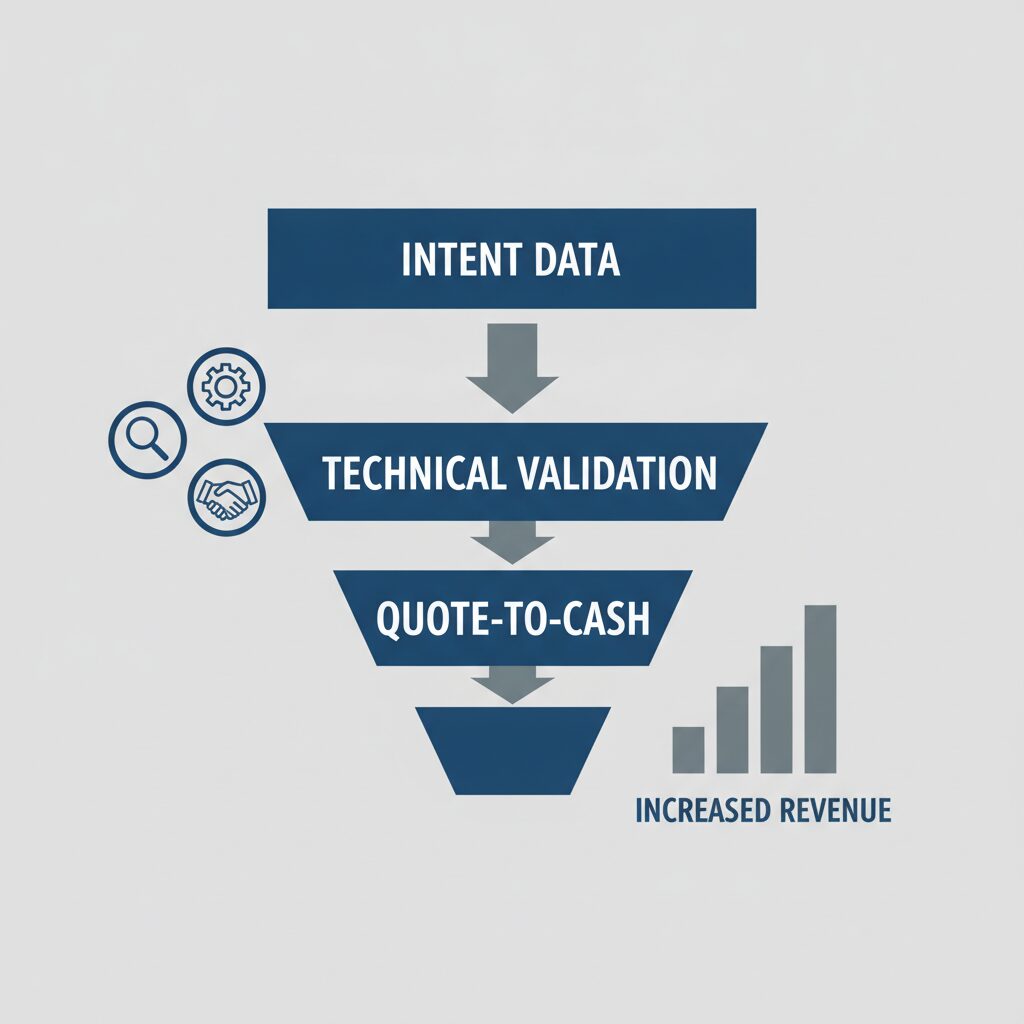
The biggest bottleneck is the gap between initial interest and technical validation. Most firms make the mistake of using a generic “Contact Us” form. For a technical buyer, that’s a wall. They don’t want to “hop on a discovery call” just to find out if your machine fits their floor plan. They want specifications, CAD files, and compatibility data upfront.
This is where most firms fail: they list features instead of outcomes. A feature is a spec; a value is a result. Listing “high-torque capacity” is a feature. Explaining how that capacity shaves 14% off downtime during peak production cycles is a value. Market data shows that assets quantifying risk reduction convert at more than triple the rate of those that simply list specs.
Finally, you have to fix the “quote-to-cash” leak. The gap between a Request for Quote (RFQ) and the actual proposal is where leads go to die. If your internal process takes five days to crunch numbers, you’ve already lost to a leaner competitor. Using B2B automation to trigger instant preliminary quotes based on pre-defined parameters can cut this cycle by 60%, capturing the buyer while their intent is at its peak.
Precision Lead Generation via Predictive Data
Industrial lead gen is usually too broad. Firms bid on high-volume keywords and then act surprised when the leads are unqualified. This is a waste of capital. To win, you need a “zero-waste” approach to PPC.
High-precision PPC requires aggressive negative keyword lists and intent data. Let’s be honest: if you sell industrial-grade turbines, you don’t want the student searching for “how turbines work.” You want the procurement officer searching for “industrial turbine procurement costs.” This shift in targeting can slash your Cost Per Lead (CPL) by 40% while drastically increasing the quality of the conversations your sales team has.
For enterprise contracts, Account-Based Marketing (ABM) is the only tool that makes sense. Instead of casting a wide net, you identify the top 50 accounts that would fundamentally move the needle on your annual revenue. You then build custom campaigns for those specific entities—such as LinkedIn Matched Audiences targeting only the lead engineers at a specific automotive plant.
Intent data allows you to time the strike. When a target account starts searching for “alternative suppliers for [your product],” that’s a flare in the sky. By the time they fill out a form, they’ve already made 70% of their decision. Your goal is to be the primary source of truth during the first 30% of that journey.
Removing Manual Friction with Automation
Manual lead qualification is a drain on your most expensive resources. Your lead engineer should not be acting as a glorified secretary, filtering through emails to find a qualified lead. This is a waste of cognitive capital.
AI-powered intake agents solve this by handling the first line of questioning. An intelligent form can verify budget, timeline, and technical requirements in real-time. If the lead is a mismatch, the system nurtures them with automated content. If they are a fit, the system books a meeting directly on the engineer’s calendar. No back-and-forth, no delays.
The “black hole” of the CRM is the most common failure mode in manufacturing. A lead is entered, then sits for three days because someone forgot to assign it. Automation kills this gap. A new lead should trigger an instant notification to the account manager and a personalized email to the prospect.
Because industrial purchases often take six to eighteen months, you need a multi-channel sequence. A single ad won’t close a million-dollar deal. You need a deliberate cadence: a white paper on operational efficiency, a case study on ROI, and a targeted invite to a technical webinar. This keeps you top-of-mind without becoming a nuisance.
The Only Metrics That Matter
Clicks and impressions are vanity metrics. They don’t show up on a balance sheet. In the industrial sector, the only KPIs that matter are those tied directly to revenue and efficiency.
Stop tracking “leads” and start tracking “Qualified Pipeline Value.” This is the total potential revenue of all leads that have passed technical qualification. When you track pipeline value, you can see the direct causal link between your marketing spend and your future bank balance.
You also need to calculate your true Customer Acquisition Cost (CAC). Most firms only count the ad spend, which is a mistake. True CAC includes the software, the qualifier’s salary, and the sales engineer’s time. If your LTV (Lifetime Value) to CAC ratio is below 3:1, your growth model is unsustainable. You aren’t scaling; you’re just buying expensive revenue.
A zero-waste PPC approach paired with a real-time dashboard allows you to pivot in hours. If a campaign is driving high-volume but low-value leads, you kill it immediately. That is the essence of a strategic growth engine.
Frequently Asked Questions
How does AI change industrial lead generation compared to traditional methods?
AI shifts the focus from demographics to behavior. Instead of targeting “Companies in the Midwest,” you target “Companies currently searching for specific technical replacements,” which means you reach buyers when they are actually in the market.

What is the average length of an industrial sales funnel in 2026?
High-ticket cycles typically range from six to eighteen months. The key is using automation to stay relevant throughout that entire window so you don’t disappear from the buyer’s mind.
How do you measure ROI for high-ticket manufacturing equipment marketing?
Ignore the “likes” and look at the LTV to CAC ratio. Track the total pipeline value generated per channel to see which specific investments are driving the most profitable contracts.
Which B2B automation tools are best for industrial SMEs?
Focus on integrated CRM systems with built-in AI qualification agents. The goal is a seamless flow of data from the first ad click to the final sales handoff.
How can manufacturers implement radical transparency in their marketing spend?
Fire the static reports. Move to a live dashboard where every dollar spent is linked to a trackable lead and a projected contract value.
Can small manufacturing firms compete with enterprises using AI?
Absolutely. AI allows small firms to target niche segments with surgical precision. A small firm that responds in ten minutes will almost always beat a giant that takes ten days.
What is the most common mistake in industrial B2B funnels?
Forcing a sales call too early. Technical buyers want to verify the specs and the risk before they ever want to talk to a human.
How does ABM differ from traditional lead gen for industry?
Traditional lead gen is a net; ABM is a spear. You identify the high-value targets first and build a custom experience to attract them, rather than hoping the right person finds your ad.
Stop settling for opaque reports
Industrial growth is no longer a matter of who you know. It’s a matter of how you use data to find those who need you. By integrating your tech stack and killing fragmented processes, you eliminate the guesswork. The companies that will dominate the next decade are those that treat marketing as a precision engineering problem.
Schedule a growth audit to see how a real-time dashboard can transform your ROI. Get a clear view of your pipeline with no hidden fees and zero excuses.
Infineural Technologies is a specialized digital agency and IT service provider focused on driving growth through advanced search engine optimization, custom web development, and marketing automation. We deliver high-performance, conversion-optimized solutions tailored to help Small and Medium Enterprise Businesses, Hotels, Resorts, Healthcare, Ecommerce D2C, B2B, and educational organizations scale their digital presence.
- Search Engine & Generative Engine Optimization Specialists
- Google Ads Management & Performance Marketing Experts
- Advanced WordPress & Custom Web Application Developers
- B2B, D2C & Enterprise Conversion Rate Optimization (CRO) Leaders
- Digital Growth Partners for Hospitality, Healthcare, and Education
This article was drafted with AI assistance and thoroughly reviewed, edited, and fact-checked by our editorial team before publishing.