
Stop wasting budget on leaky funnels. Build a customer retention strategy that optimizes LTV and drives retention-led growth with radical transparency.
The Acquisition Trap
Many founders confuse activity with strategy. They treat growth as a volume problem, pouring capital into the top of the funnel and obsessing over cost-per-click. But this isn’t a strategy; it’s a gamble. If your churn rate is high, you aren’t building a scalable business. You are simply funding a revolving door, paying for the privilege of watching customers leave.

It is a well-worn rule that acquiring a new customer costs significantly more—often five times more—than keeping one. When you focus solely on the “top of the funnel,” you create a structural leak that destroys your ROI. Real growth is a result of a retention-led growth model. In plain English: your existing customer base must become your primary engine for new revenue, not an afterthought.
To stop the bleed, you need to see your data without the filter of optimistic reporting. You cannot fix a problem you only discover a month after it happened. By tying growth marketing to a tight, real-time feedback loop, you stop guessing why people leave and start seeing the exact moment they lose interest.
The logic of customer retention
Strategy is not a list of goals or a vision statement. It is a way of dealing with a specific, critical challenge. The challenge here is the mathematical imbalance between what you pay to get a customer and what that customer actually pays you over their lifetime.
The LTV to CAC ratio: The only metric that matters
The LTV to CAC ratio is the litmus test for your business model’s viability. LTV (Lifetime Value) is the total revenue a customer generates before they quit. CAC (Customer Acquisition Cost) is the total spend required to get them to sign up.
Based on 2026 industry benchmarks, a 3:1 ratio is the baseline for a healthy company. If your ratio is 1:1, you are effectively trading dollars for dollars—spending your entire margin just to stand still. If it’s 5:1, you’re likely playing it too safe and leaving growth on the table. I’ve seen too many companies track these as separate KPIs. That’s a mistake. They are two sides of the same coin; you cannot optimize one while ignoring the other.
Moving from wasteful PPC to cohort-based spending
Most companies burn their budget on zero-waste PPC strategies that attract the wrong crowd. They optimize for the click, which is a vanity metric. This results in a surge of low-quality leads who churn within 30 days, leaving you with a high volume of users and a shrinking bank account.
The shift happens when you let retention data dictate your ad spend. If the data shows that LinkedIn users have a 40% higher LTV than Meta users, you move the budget immediately. You stop buying “traffic” and start buying high-LTV cohorts. This is how you scale without the desperate need for an ever-increasing ad budget.
Using signals to kill churn
Churn is a lagging indicator. By the time a customer hits “cancel,” the relationship ended weeks ago. The goal isn’t to react to the cancellation; it’s to identify the behavioral red flags that precede it.
Spotting the “Quiet Exit” in real time
We use data to move from reactive support to proactive intervention. We implement real-time reporting dashboards that track actual usage, not just logins. A sudden dip in feature adoption is a scream for help, even if the customer is still paying.
For example, in a B2B SaaS environment, a 30% decline in session duration over 14 days is usually a death knell. When the system detects this, it flags the account instantly. This is what I call “unfiltered transparency.” You see the failure coming while you still have the window to fix it.
Interventions that actually work
Knowing a customer is at risk is useless if your only response is a generic “We miss you!” email. That is fluff, and customers see right through it. The intervention must solve a specific problem.
If a user stops using your reporting tool, the system shouldn’t send a newsletter; it should trigger a 60-second video showing a new way to use that specific tool to save two hours a week. You provide a tangible win before you ask for their loyalty. This moves the conversation from “please stay” to “here is how to succeed.”
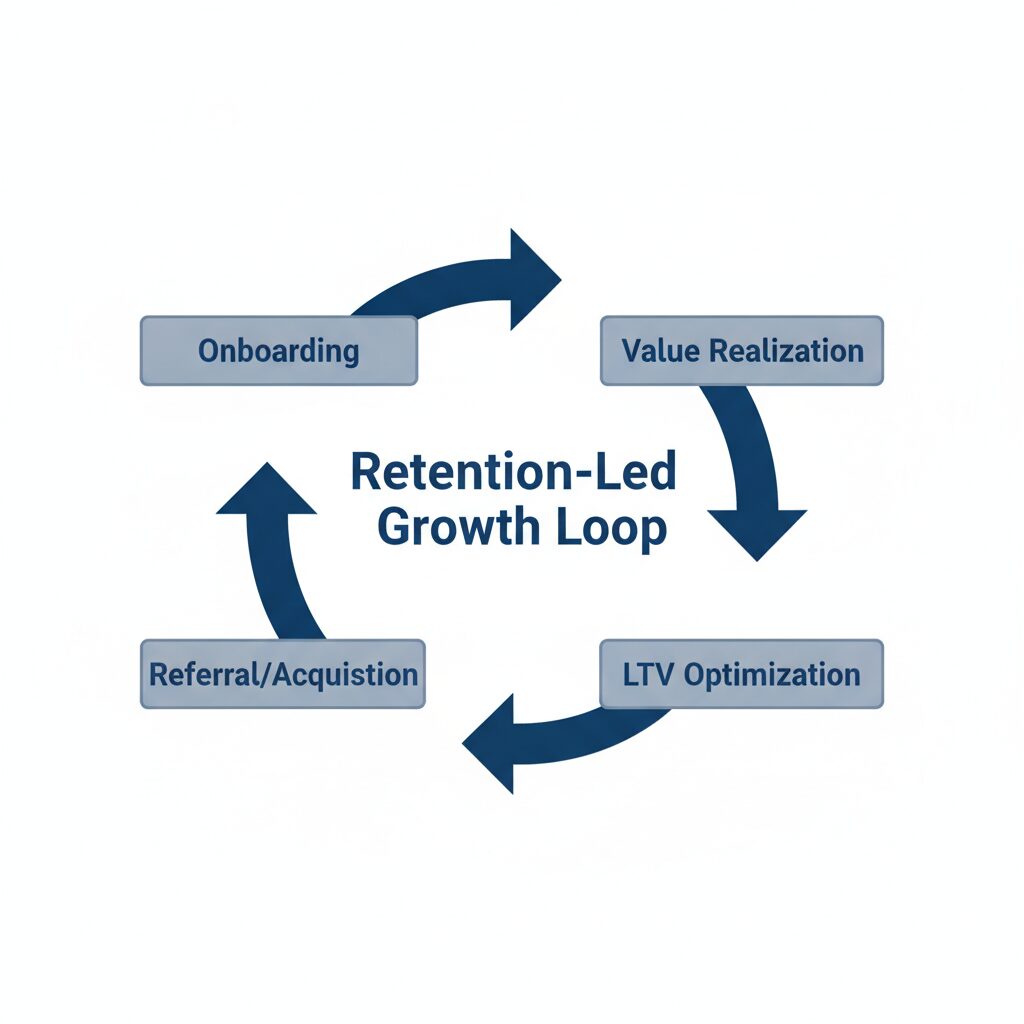
Scaling through retention
Retention isn’t a defensive play. It’s an offensive one. When you master the art of keeping people, your existing customers become your cheapest and most effective acquisition channel.
The 90-Day Danger Zone: Onboarding as a weapon
The first 90 days are where most businesses fail. This is where the gap between the sales pitch and the actual product experience becomes a canyon. Most onboarding is just a feature checklist. That’s a waste of time.
Effective onboarding focuses on the Time to First Value (TTFV). You need to get the customer to their first “aha moment” as fast as humanly possible. If your software automates reports, the win isn’t “completing the profile”—the win is the first report generated. Any step in your onboarding that doesn’t lead directly to that win is friction. Cut it.
The continuous feedback loop
Quarterly surveys are useless. By the time you read the results, the customers who hated the product are already gone. You need a loop where feedback is tied to a specific action.
When a user cancels, don’t just ask “Why?” Look at what they did in the 48 hours before they quit. Combine the qualitative “why” with the quantitative “what.” When you feed this back into the product roadmap, you stop guessing which features to build and start solving the exact problems that cause churn.
LTV optimization: The expansion phase
Once the leak is plugged, you stop worrying about survival and start focusing on expansion. LTV optimization is about increasing the value of a customer without blowing up your cost of service.
Intelligent upsells as a service
Upselling is usually treated as a sales tactic to hit a quota. In a retention model, it’s a service. An intelligent upsell happens when a user hits a bottleneck in their current tier. At that moment, moving to a higher tier isn’t an expense; it’s the solution to their problem.
We track usage thresholds. When a user hits 80% of their limit, the system suggests an upgrade based on their specific patterns. This converts better because the offer is timed to a real need. This is the essence of AI-powered growth marketing: right offer, right person, right moment.
Loyalty that creates psychological lock-in
Most loyalty programs fail because they offer discounts. A 10% coupon is a weak incentive. Real loyalty is built on access, status, or exclusivity.
Create tiers based on how much the customer contributes to your ecosystem. Give your highest-LTV users early access to beta features or a direct line to the product team. This creates a psychological lock-in. They aren’t just using a tool anymore; they are part of an inner circle. When a customer feels like an insider, they stop shopping around for a cheaper price.
Frequently Asked Questions
What is the ideal LTV to CAC ratio for a SaaS startup?
Aim for 3:1. If you’re below that, your acquisition is too expensive or your customers are leaving too fast. If you’re way above it, you’re likely under-spending and letting competitors steal market share.
How do you calculate net revenue retention (NRR)?
Take your starting MRR, add expansion revenue (upsells), and subtract churned revenue. It tells you if your business can grow even if you don’t acquire a single new customer.
What are the fastest ways to reduce churn for SMBs?
Shorten the Time to First Value during onboarding. If a user doesn’t see a win in the first 7 days, they’re likely gone. Use predictive alerts to catch usage drops before the cancellation email hits.
How does retention-led growth differ from product-led growth?
Product-led growth uses the product to get users in the door. Retention-led growth uses the existing user base to ensure the business doesn’t collapse under the weight of its own acquisition costs.
Which tools are best for LTV optimization?
Customer Data Platforms (CDPs) with predictive analytics are the gold standard for tracking behavioral shifts. Use automation tools like n8n to trigger the intervention the second a red flag appears.
How often should I review my churn data?
In real time. A quarterly review is an autopsy; a real-time dashboard is a diagnostic tool. You want the latter.
Does a higher LTV always mean a better business?
Only if the cost to maintain that customer doesn’t scale linearly. If it takes a full-time account manager to keep one high-LTV client, your margins are still in danger.
Can AI replace account managers?
AI handles the signals and the simple fixes. But for your highest-value accounts, nothing replaces a human who can navigate a complex corporate relationship.
Stop the leak and start growing
Retention isn’t a “customer support” issue. It is your most powerful growth engine. When you stop obsessing over the top of the funnel and start maximizing the value of every single user, you build a business that scales on its own terms.
Stop the guesswork. Build a system of total transparency.
Start your retention engine today with a free growth audit from Infineural—no credit card required.
Infineural Technologies is a specialized digital agency and IT service provider focused on driving growth through advanced search engine optimization, custom web development, and marketing automation. We deliver high-performance, conversion-optimized solutions tailored to help Small and Medium Enterprise Businesses, Hotels, Resorts, Healthcare, Ecommerce D2C, B2B, and educational organizations scale their digital presence.
- Search Engine & Generative Engine Optimization Specialists
- Google Ads Management & Performance Marketing Experts
- Advanced WordPress & Custom Web Application Developers
- B2B, D2C & Enterprise Conversion Rate Optimization (CRO) Leaders
- Digital Growth Partners for Hospitality, Healthcare, and Education
This article was drafted with AI assistance and thoroughly reviewed, edited, and fact-checked by our editorial team before publishing.