
Stop losing leads. Use AI customer lifecycle marketing to automate nurturing and optimize your journey for maximum ROI and radical transparency.
Stop the revenue leakage in your growth engine
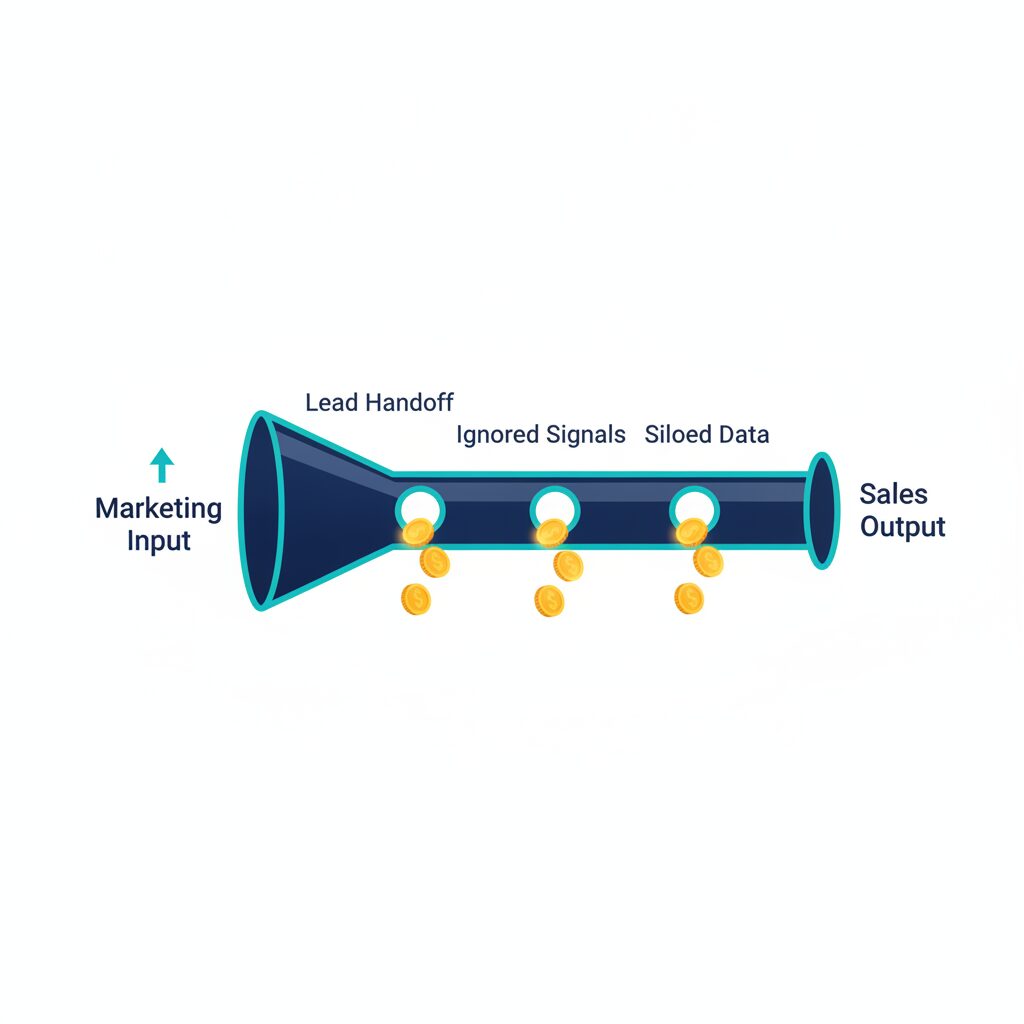
Most startups bleed roughly 30% of their potential revenue through fragmented handoffs and ignored leads. I call this lifecycle revenue leakage. It is not a marketing failure; it is a structural one. It happens when your marketing tools, sales team, and customer success software operate as separate islands. You spend the capital to acquire the lead, only to watch the value evaporate during the transition between stages.

To stop this, you have to replace guesswork with a growth system that tracks every touchpoint in real time. The goal isn’t just “automation”—it is the creation of a seamless path from the first click to a loyal advocate without a single manual hand-off. This isn’t about buying more software. It’s about forcing the tools you already own to talk to each other.
Identifying and fixing lifecycle revenue leakage
Where the money disappears in traditional funnels
Revenue dies in the gaps. A lead downloads a whitepaper, but your sales rep doesn’t follow up for 48 hours. By then, the lead has already forgotten why they cared. Or a customer hits a major usage milestone, but no one suggests an upgrade. In our work at Infineural, we consistently find that the most violent drop-off occurs during the handoff from marketing to sales.
Most agencies treat these as separate campaigns. They obsess over ad spend but ignore the conversion decay that happens the second a user clicks. When you rely on fragmented agency management, you get three different dashboards and zero accountability. You cannot see where the lead dropped off, which means you are essentially flying blind while spending your budget.
Using predictive analytics to spot churn before it happens
Reacting to churn after a customer cancels is not a strategy; it is an autopsy. A real strategy focuses on the diagnosis. Predictive analytics lets you identify churn signals—a sudden drop in login frequency or a spike in “how-to” support tickets—weeks before the user actually decides to leave.
Industry data suggests that companies using predictive AI for customer health scoring can reduce churn by up to 18% compared to reactive teams. The system flags the account for a customer success manager automatically. This allows for an intervention while the customer is still salvageable, rather than a desperate “please come back” email after they have already signed with a competitor.
The cost of fragmented agency management
When you hire one agency for SEO, another for PPC, and a third for social, you are paying for data silos. Each agency optimizes for their own specific KPI, not your bank account. The PPC agency will brag about a low cost-per-lead, even if those leads are low-quality noise that your sales team can’t close.
This is why so many integrated B2B marketing efforts fail. You lose the “thread” of the customer journey. You can’t see that a lead who saw a LinkedIn ad and read two blog posts is 5x more likely to close than a cold lead. Without that visibility, you are guessing which channels actually drive profit.
Scaling growth with automated lead nurturing
Behavioral triggers vs. scheduled sequences
Scheduled email sequences are dead. They are rigid and tone-deaf, sending the same message to every lead regardless of intent. Behavioral triggers are the opposite. They respond to what the user is doing right now.
Imagine a lead visits your pricing page three times in 24 hours. That is a screaming signal of high intent. Instead of waiting for a “Day 4” automated email, a behavioral trigger can immediately send a personalized case study via WhatsApp or alert a rep to call them. It creates a tight loop between interest and action. We break this down further in our AI WhatsApp automation guide.
Dynamic content personalization at scale
Real personalization isn’t just inserting a first name into a subject line. That’s basic. True personalization changes the offer based on the user’s profile. AI can analyze industry, company size, and past clicks to serve a completely different landing page to a solo founder than to a VP of Operations at a global enterprise.
In one of our tests, this shift in dynamic content pushed click-through rates from 2.1% to 4.8% in just two months. The system matched the value proposition to the persona, which means the lead felt the product was built specifically for their problem. This removes the mental friction that usually kills a conversion.
Lead scoring models that actually predict sales
Most lead scoring is a shot in the dark. A manager decides a whitepaper download is “worth 10 points” because it feels right. AI-driven lead scoring removes the feeling and looks at the data to see which behaviors actually result in a closed-won deal.
You might discover that leads who watch a demo video and visit the ‘About Us’ page are 40% more likely to convert, regardless of their job title. The system then prioritizes those leads. Your sales team stops chasing every single inquiry and starts focusing only on high-probability wins. This is the foundation of a winning RevOps strategy.
Customer journey optimization AI for higher LTV
Mapping the non-linear path to purchase
The “funnel” is a myth. Customers don’t move in a straight line; they loop, jump, and disappear. They see an ad, read a review, vanish for ten days, and then return via a direct Google search.
AI maps these non-linear paths by stitching together identity data across sessions and devices. When you see the actual path, you find the real bottlenecks. If 60% of your users drop off at the credit card entry page, your marketing isn’t the problem—your checkout UX is. You can’t fix what you can’t map.
AI-driven cross-sell and up-sell timing
An up-sell at the wrong time feels like a cash grab. An up-sell at the right time feels like a solution. AI analyzes usage patterns to find the exact moment a user has squeezed every bit of value out of their current plan.
Reports indicate that AI-timed offers can increase expansion revenue by roughly 22% over fixed-date renewals. The system triggers the offer when a user hits a specific limit—say, 80% of their monthly data. It transforms a sales pitch into a helpful suggestion to avoid service interruption.
Automating the feedback loop for product improvement
Most customer feedback is buried in a graveyard of support tickets and ignored emails. AI performs sentiment analysis across thousands of interactions to find the recurring screams for help or missing features. It links the customer’s pain directly to your product roadmap.
When you automate this, you stop guessing what to build. You build what the data proves is missing. This reduces churn and spikes the lifetime value (LTV) because the product evolves as the user evolves.
Building your AI marketing stack under one roof
Integrating CRM, Ads, and Automation
Radical transparency requires a unified stack. Your CRM cannot be a static database; it must be the central brain. When a lead changes status to “Customer” in the CRM, your ad platforms should automatically stop showing them “acquisition” ads.
There is nothing more embarrassing (or wasteful) than paying for a trial ad to someone who already pays for your premium plan. Integration allows you to track the actual ROI of every dollar spent, from the first click to the third renewal. For B2B teams, we use LinkedIn matched audiences to keep this precise.
Setting up your real-time dashboard for ROI tracking
Stop reading monthly reports. A report that tells you what happened 30 days ago is a history book, not a management tool. You need a real-time dashboard showing lifecycle metrics: Customer Acquisition Cost (CAC), LTV, and the current rate of leakage.
A proper dashboard shows the flow of leads between stages as it happens. If your conversion rate from ‘Lead’ to ‘Qualified Lead’ drops on Tuesday, you should know by Wednesday. This allows you to pivot your strategy in 24 hours rather than waiting for a quarterly review to realize you’ve lost a month of revenue.
Eliminating zero-waste PPC through lifecycle data
Most PPC is wasteful because it treats all keywords the same. You pay the same premium for a “just browsing” lead as you do for someone ready to buy today.
Zero-waste PPC uses lifecycle data to bid aggressively on high-intent users while maintaining a low-cost “awareness” presence for others. By feeding CRM data back into the ad platform, the AI learns which profiles actually turn into high-LTV customers. The focus shifts from “cheap leads” to “profitable accounts.” Check out our guide on zero-waste PPC strategies to see how this works.
Frequently Asked Questions
How does AI customer lifecycle marketing differ from standard email automation?
Standard automation is a conveyor belt; it moves everyone at the same speed regardless of behavior. AI lifecycle marketing is a GPS; it reroutes the experience in real time based on the user’s actual actions and predictive scores.
What is the most common cause of lifecycle revenue leakage in SMBs?
It is almost always fragmented handoffs. When marketing “tosses” a lead over the wall to sales without a synchronized data flow, leads get forgotten and signals get missed.
How long does it take to see ROI from customer journey optimization AI?
Most businesses see a jump in conversion rates within 60 to 90 days. The biggest wins usually come from plugging the most obvious “holes” in the handoff process first.
Which AI tools are best for automated lead nurturing for B2B startups?
Combine a modern CRM with an orchestration layer like n8n or HubSpot. The priority should be tools that support behavioral triggers rather than just time-based sequences.
Can AI replace the need for a dedicated customer success manager?
No. AI can’t build a relationship, but it can kill the grunt work. It tells the manager exactly who to call and why, making one CSM as effective as three.
How do I calculate the cost of my revenue leakage?
Take the number of leads lost at each stage, multiply that by your average lead-to-customer conversion rate, and then multiply by your average LTV. That number is the revenue you are leaving on the table every single month.
Does AI lifecycle marketing work for small budgets?
Actually, it is better for small budgets. It focuses on maximizing the traffic you already have rather than throwing more money at expensive ads.
What is the first step to integrating an AI marketing stack?
Audit your data flow. Find exactly where the information stops moving between teams. Once you find the silo, you can build the automation to break it.
Fragmented marketing is a liability. Radical transparency allows you to scale your revenue without scaling your headcount. Stop the leakage and start treating your customer lifecycle as a single, automated engine. Ready to build a zero-waste growth system? Book a strategy call to see our real-time dashboard in action. No commitment required.
Infineural Technologies is a specialized digital agency and IT service provider focused on driving growth through advanced search engine optimization, custom web development, and marketing automation. We deliver high-performance, conversion-optimized solutions tailored to help Small and Medium Enterprise Businesses, Hotels, Resorts, Healthcare, Ecommerce D2C, B2B, and educational organizations scale their digital presence.
- Search Engine & Generative Engine Optimization Specialists
- Google Ads Management & Performance Marketing Experts
- Advanced WordPress & Custom Web Application Developers
- B2B, D2C & Enterprise Conversion Rate Optimization (CRO) Leaders
- Digital Growth Partners for Hospitality, Healthcare, and Education