
Stop relying on bloated sales cycles. Implement an AI product-led growth strategy to automate acquisition and maximize ROI with radical transparency.
The Structural Failure of Sales-Led Growth
Traditional sales-led growth is built on a high-friction sequence: the lead capture, the discovery call, the demo, and the grueling contract negotiation. It is a slow process. In today’s market, this speed gap is a liability. You’ve created a bottleneck where the actual value of your product is trapped behind a human gatekeeper. The customer wants the solution, but you’re forcing them to talk to a person first.

An AI product-led growth strategy solves this by removing the gate. It shifts the burden of proof from the salesperson’s slide deck to the product itself. By using AI to automate the delivery of value, the product becomes the primary engine for both acquisition and expansion. I’ve seen this time and again: the product stops being something you sell and starts being the thing that sells itself.
At Infineural, we see companies fail because they treat AI as a shiny feature rather than a growth engine. That is a mistake. True PLG (Product-Led Growth) means the product handles the heavy lifting of conversion. You stop guessing which leads are “qualified” based on a CRM note and start tracking actual usage data in a real-time dashboard. This means your sales team only talks to people who already know the product works.
The PLG Framework for B2B SaaS in the AI Era
Solving the Trust Gap
The critical challenge here is the redistribution of trust. In a sales-led model, the customer is asked to trust the pitch. In a product-led model, the customer trusts the experience. Your strategic goal is to shrink the time between the first click and the first moment of realized value. If that gap is too wide, you lose them.
When you kill the mandatory demo call, you kill the friction. The user enters the product, hits a win, and decides to pay based on evidence. It is a simple equation: evidence beats promises. But this requires a product that can guide a user to a win without a human holding their hand.
The AI-Powered Growth Flywheel
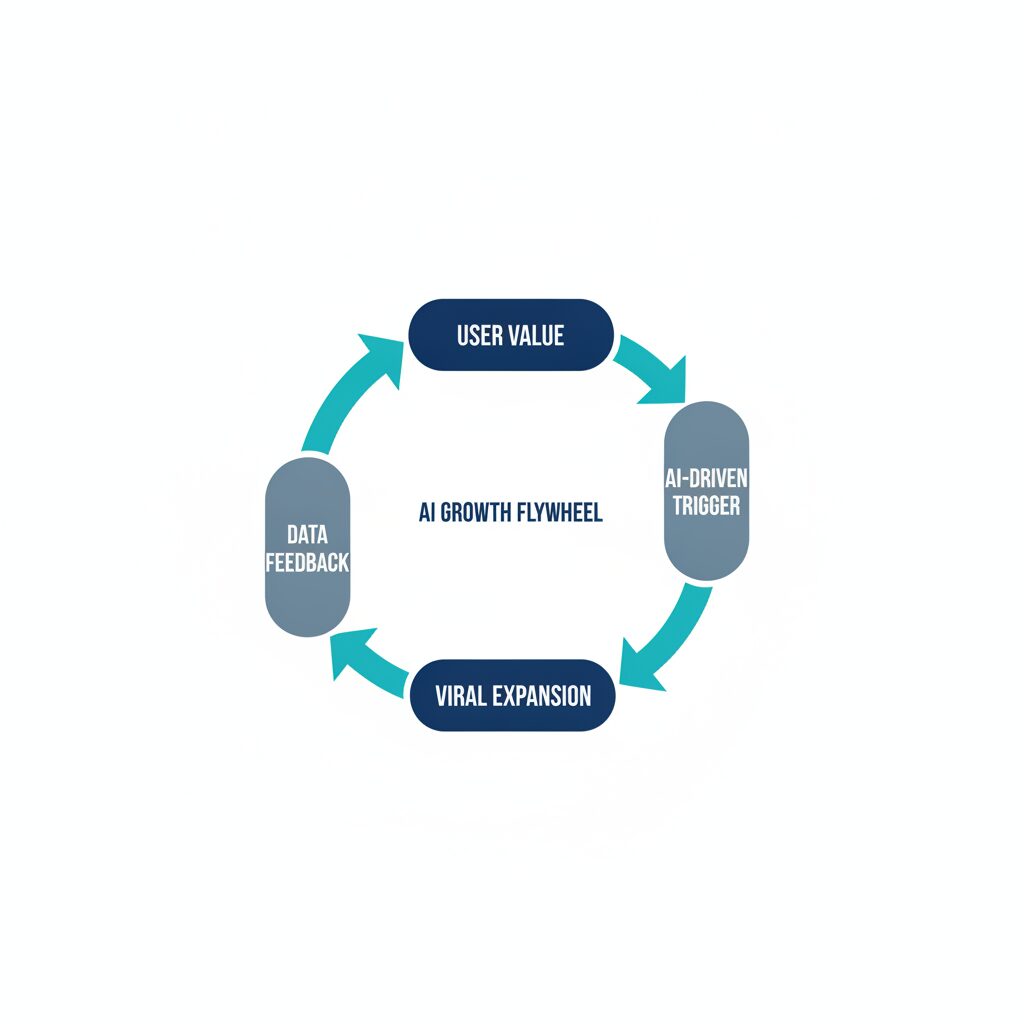
Growth is a loop, not a funnel. A funnel leaks; a loop compounds. An AI-driven flywheel uses real-time product data to trigger automated growth actions. Look at this example: when an AI detects a user has mastered a specific tool, it can automatically suggest a collaborative feature that requires inviting a teammate to get the full benefit.
Based on our projections for 2026, B2B companies using these AI-driven triggers see a 22% increase in expansion revenue compared to those still sending static “check-in” email sequences. The logic is linear: User Value → AI-Driven Suggestion → Viral Expansion → More Data → Higher User Value.
Identifying Your North Star (And Ignoring Vanity)
Most founders track vanity metrics. Sign-ups and daily active users (DAU) feel good in a board meeting, but they are useless for growth. You need a North Star metric that represents the core value delivered. For an AI writing tool, “logins” mean nothing. “Documents published” means everything.
The North Star must be a leading indicator of retention. If a user hits this metric, they stay. If they don’t, they churn. The failure mode here is tracking activity instead of outcomes. Stop measuring how much time they spend in the app and start measuring how much value they actually extracted.
AI Onboarding: Cutting Time-to-Value
Predictive Onboarding Paths
Static onboarding tours are a waste of time. Users click “Next” as fast as possible just to make the pop-ups go away. AI allows for predictive onboarding, where the interface adapts based on the user’s initial behavior. This means the user doesn’t have to learn your tool; the tool learns the user.
If a user signs up and immediately uploads a 50MB dataset, the AI should skip the “Welcome” basics and jump straight to the data analysis tools. We have seen this specific shift reduce the time-to-value (TTV) from 72 hours to under two hours in several B2B deployments.
Eliminating the “Cognitive Load”
Friction is any moment where a user has to stop and think. That hesitation is where churn lives. AI eliminates this by predicting the next logical step. Instead of forcing a user to navigate a complex settings menu, the AI suggests a configuration based on their industry and company size.
This is the core of AI-powered growth. You aren’t just giving them a tool; you are providing the path of least resistance. When the product does the thinking, the user feels the relief of a problem solved.
Engineering the ‘Aha!’ Moment
The ‘Aha!’ moment is the exact second a user realizes your product actually solves their problem. In a traditional setup, this happens after hours of clicking around. AI accelerates this by generating a tangible output the moment they sign up.
Take an AI SEO tool. It shouldn’t ask the user to “set up a project” or “integrate a search console” first. It should ask for a URL and immediately present three high-impact wins. The user sees the value before they even finish the onboarding process. That is how you hook a customer.
Engineering Viral Loops for AI Apps
Inherent Virality via High-Value Outputs
The best AI apps build virality into the output itself. When the product generates something inherently valuable to others, the user becomes your distribution channel. This isn’t about boring referral codes. It is about value-based sharing.
Imagine a B2B AI tool that generates a professional audit report. When the user shares that report with their boss or a client, the report is the lead magnet. The recipient sees the quality of the work and naturally wants the tool that created it. The output is the advertisement.
Collaboration as an Acquisition Channel
B2B software wins when it becomes the communication standard. By building AI-powered collaborative workflows, you weave the product into the user’s professional network. This is a growth loop strategy that compounds.
When an AI summarizes a meeting and tags four colleagues in the action items, those colleagues are pulled into the product by necessity. They didn’t click an ad. They didn’t read a whitepaper. They entered because their job now requires it.
Building Moats with Network Effects
Network effects happen when the product gets more valuable as more people use it. AI strengthens this by learning from the collective data of the entire user base to provide better insights for the individual. This creates a moat that is nearly impossible to cross.
In B2B, this looks like industry benchmarks. When an AI can tell a user, “Your conversion rate is 12% lower than the average for mid-sized fintech firms,” the user is incentivized to stay and optimize. The data of the crowd benefits the individual.
Scaling via Radical Transparency
The Real-Time Dashboard Requirement
You cannot manage what you cannot see. The fragmented agency model is a relic; getting a PDF report once a month is too slow. You need a live view of your acquisition cost, churn rate, and expansion revenue. If you are waiting for a monthly meeting to find out a channel is dead, you’ve already lost money.
Radical transparency means admitting when a flow is broken. If your AI onboarding is leaking 40% of users at step three, you need to see that spike in real-time. This allows for rapid iteration and kills the waste associated with traditional agency reporting.
Zero-Waste PPC: Usage-Based Targeting
Most PPC campaigns are a money pit because they optimize for the “lead,” not the “user.” Zero-waste PPC involves feeding actual product usage data back into the ad platform.
Instead of targeting “people interested in SaaS,” you target the specific behavior patterns of your highest-LTV (Lifetime Value) users. If the data shows that users who integrate with Slack stay 3x longer, your ads should target Slack power users. You stop paying for “interest” and start paying for “fit.”
Integrating Marketing and Tech
When marketing and product development are separated, the user experience breaks. One team promises a “seamless AI experience” in an ad, and the other team delivers a clunky onboarding flow. The brand promise and the product reality must be the same thing.
The ROI of this integration is a lower Customer Acquisition Cost (CAC) and higher retention. You stop paying for leads that your product isn’t designed to convert. You build a machine where marketing feeds the product, and the product fuels the marketing.
Common Failures in AI PLG
The ‘Feature Trap’
Many teams fall into the feature trap. They add AI because it is a trend, not because it solves a problem. They build complex AI agents that users don’t know how to trigger. This actually adds friction. It makes the product harder to use.
The goal isn’t to have the most AI features. The goal is to deliver the result as fast as possible. If a simple automation does the job better than a complex LLM (Large Language Model), use the automation. The user cares about the result, not the tech stack.
The Loss of the Human Touch
Automation is a tool, not a strategy. The biggest failure mode is removing all human contact from the enterprise journey. While PLG handles the acquisition, high-ticket B2B deals still involve organizational politics and complex approvals. AI cannot navigate a boardroom.
The winning balance is “Product-Led, Sales-Assisted.” Use AI to qualify the user and prove the value. Once the user is hooked, bring in a human expert to close the enterprise contract. The product does the selling; the human does the relationship building.
Frequently Asked Questions
What is the difference between traditional PLG and AI-powered PLG?
Traditional PLG uses static flows to guide users. AI-powered PLG uses real-time data to change the product experience on the fly for every individual user.
How do you measure the success of an AI PLG strategy?
Track the reduction in Time-to-Value (TTV) and the increase in your expansion rate. Success is a higher percentage of users hitting the North Star metric without needing a human guide.
Can high-ticket B2B tools actually use PLG?
Yes, through a “land and expand” strategy. The product enters via a single user or small team, proves its value, and grows organically before the corporate contract is ever signed.
What are the best AI tools for optimizing onboarding?
Look for Digital Adoption Platforms (DAPs) that integrate directly with your product analytics. The most effective tools are those that trigger messages based on behavioral events, not timers.
How do viral loops differ for B2B AI apps vs B2C?
B2C loops usually rely on status or entertainment. B2B loops rely on professional utility. You grow by sharing a high-value, actionable output that makes the user look good to their boss.
Does AI PLG eliminate the need for a sales team?
It eliminates the need for sales to do the grunt work: lead qualification and basic demos. This frees your sales team to focus on strategic accounts and high-value closing.
What is the biggest risk of an AI-first growth strategy?
Over-automation. If you automate a bad user experience, you just accelerate your churn. AI must optimize for the user’s pain, not for a metric on a dashboard.
How often should PLG metrics be reviewed?
In real-time. You use weekly reviews for strategic pivots, but the data must be live so you can plug onboarding leaks the moment they happen.
Growth is a math problem, not a guessing game. By integrating AI into your product-led strategy, you remove the layers of traditional agencies and build a self-sustaining acquisition machine. Stop settling for opaque monthly reports and start tracking your ROI in real-time. Ready to build your growth engine? Start scaling your revenue today with a zero-waste, integrated strategy—no hidden fees, no guesswork.
Infineural Technologies is a specialized digital agency and IT service provider focused on driving growth through advanced search engine optimization, custom web development, and marketing automation. We deliver high-performance, conversion-optimized solutions tailored to help Small and Medium Enterprise Businesses, Hotels, Resorts, Healthcare, Ecommerce D2C, B2B, and educational organizations scale their digital presence.
- Search Engine & Generative Engine Optimization Specialists
- Google Ads Management & Performance Marketing Experts
- Advanced WordPress & Custom Web Application Developers
- B2B, D2C & Enterprise Conversion Rate Optimization (CRO) Leaders
- Digital Growth Partners for Hospitality, Healthcare, and Education


