Which search engine offers total anonymity? We tested 7 private search engines that hide your IP and encrypt queries in 2026. See the #1 ranked choice here.
Stop Letting Big Tech Track Your Every Move
You are being watched. Every time you search for a new pair of shoes or a medical symptom, Google takes a note. They build a profile on you. Then, they sell your attention to the highest bidder. Does that sound fair? I didn’t think so.

Most people think Incognito mode hides them. It doesn’t. Your ISP still sees everything. Google still knows it is you. If you want real privacy, you need to change your tools. True anonymity requires a search engine that refuses to log your IP address.
At Infineural Technologies, we have tested dozens of platforms to see which ones actually protect your identity. We looked at how they handle data and where their servers live. The truth? Not every ‘private’ engine is actually private. But some are doing it right. If you want to see how these compare to mainstream options, check out our Top Search Engines List: 12 Best Platforms for Traffic (2026) for the full picture.
Quick Comparison: Best Private Search Engines at a Glance
When searching for total anonymity, the jurisdiction where a company is headquartered matters as much as their code. Here is how the top contenders stack up in 2026.
| Search Engine | Jurisdiction | Index Source | Onion Mirror? |
|---|---|---|---|
| DuckDuckGo | USA (5-Eyes) | Bing / Own | Yes |
| Startpage | Netherlands (9-Eyes) | No | |
| Brave Search | USA (5-Eyes) | Independent | No |
| Mojeek | UK (5-Eyes) | Independent | No |
| Swisscows | Switzerland (Privacy Haven) | Bing / Own | No |
| SearXNG | Decentralized | Meta-search | Yes |
While many of these are based in ‘Eyes’ alliance countries, their strict ‘no-logs’ policies are designed to ensure that even if a subpoena is issued, there is no data to hand over. However, for those seeking the highest tier of protection, Swisscows and decentralized options like SearXNG offer an extra layer of legal insulation.
How These Engines Guarantee Total Anonymity: The Tech Behind the Curtain
To rank these platforms, we looked at three specific technical criteria that separate ‘private’ engines from truly ‘anonymous’ ones:
- IP Masking & Proxying: The best private search engines, like Startpage, use a proxy system. When you search, the engine sends the request to Google or Bing on your behalf. The destination sees the engine’s IP address, not yours.
- Metadata Stripping: Every search query carries ‘leakage’—your browser type, screen resolution, and OS. Anonymity-focused engines strip this metadata so your ‘digital fingerprint’ cannot be used to track you across different sites.
- Non-Custodial Data Policies: It is not enough to say ‘we don’t sell data.’ The top 3 engines in our list utilize a ‘non-custodial’ approach, meaning they never generate the data in the first place. If a government agency demands their logs, there is literally nothing to hand over.
If you are interested in how these privacy-first approaches compare to the broader market, see our guide on 50 Best Search Engines to Diversify Your Traffic.

1. DuckDuckGo: The Most Popular Choice for Anonymous Search Results
You have probably heard of DuckDuckGo. They are the biggest name in this space. And for good reason. They do not store your personal info. They do not follow you with ads. They keep it simple.
But here is the catch. They still use some Bing data to power their results. Is that a dealbreaker? Not for most. They offer a great mobile app and a clean interface. It feels just like Google, without the creepy tracking. Just remember that while they hide your searches, they do not hide your activity from the websites you eventually click on. For that, you need a VPN.
2. Startpage: Achieve Total Anonymity with Google-Level Search Quality
Do you love Google’s results but hate their privacy policy? Startpage is your answer. They pay Google to use their search technology. But then, they strip away all the tracking. They act as a buffer between you and Big Tech.
Startpage never records your IP address or your search history. They even have an ‘Anonymous View’ feature. This lets you visit websites through a proxy. It means the site you visit thinks Startpage is visiting them, not you. It is a massive win for anyone serious about staying hidden. But it can be a bit slower because of that extra layer of security.
3. Brave Search: Total Independence
Brave is doing something different. Most small search engines just repackage results from Google or Bing. Brave built their own index. Why does this matter? It means they are not dependent on the big guys. They control the whole process.
And they do it without tracking you. In our experience at Infineural Technologies, Brave Search is the fastest-growing alternative for a reason. It is integrated directly into the Brave Browser. If you want an ecosystem that respects your data, this is the one to beat. But since their index is newer, you might occasionally miss some very niche results.
4. Mojeek: The No-Tracking Crawler
Mojeek is based in the UK. Like Brave, they have their own index of billions of pages. They do not rely on anyone else. Their philosophy is simple: no tracking, no bias, and no nonsense. They do not even try to guess what you want based on your past behavior.
This leads to very neutral results. You get what you searched for, not what an algorithm thinks you should see. It is refreshing. But be warned. Because they don’t track you, the results can sometimes feel less ‘personalized’ than what you are used to. Is that a bad thing? I don’t think so. It is just honest search.
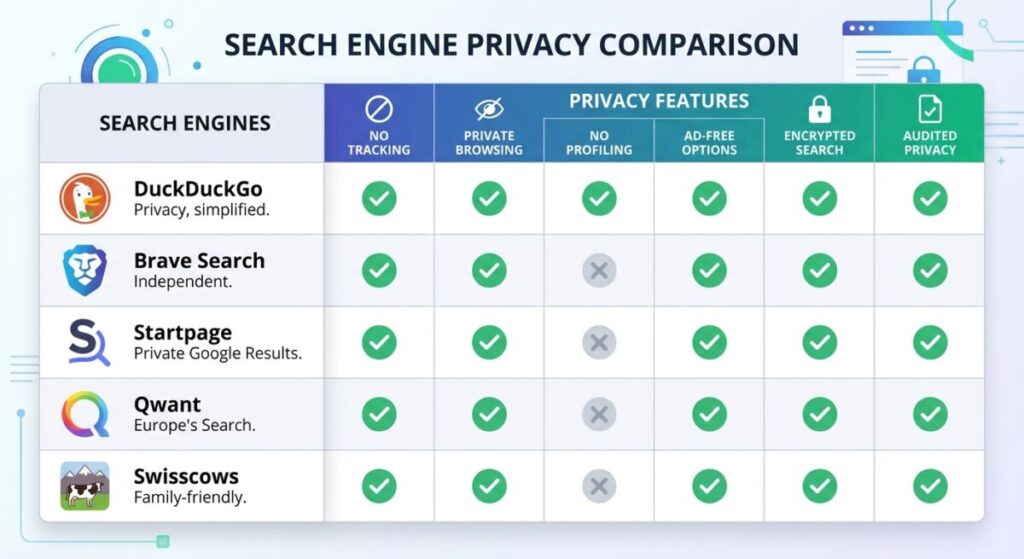
5. Swisscows: The Privacy Haven for Family-Safe Anonymity
When it comes to total anonymity, jurisdiction is everything. Swisscows is based in Switzerland, a country known for some of the world’s strictest privacy laws. Unlike engines based in the US or EU, Swisscows exists outside of the reach of most global data-sharing alliances.
What makes Swisscows a top contender for 2026 is its semantic search technology. It doesn’t just look for keywords; it understands the context of your query without needing to know who you are. They have their own servers and do not use third-party cloud infrastructure, ensuring that your data never touches a server owned by Big Tech. Furthermore, they are strictly family-friendly, automatically filtering out violent or pornographic content, making it the safest choice for households seeking privacy.

6. SearXNG: The Ultimate Decentralized Meta-Search Engine
For the privacy purist, SearXNG is the gold standard. It is a decentralized, open-source meta-search engine. This means it aggregates results from over 70 different search services (including Google, Bing, and DuckDuckGo) but strips away all identifying markers before the request ever leaves your device.
Because it is decentralized, you can actually host your own ‘instance’ of SearXNG. This provides a level of total anonymity that a centralized company simply cannot match. In 2026, as AI-driven tracking becomes more invasive, the ability to pull results from multiple sources through a private, self-hosted gateway is the ultimate ‘cloaking device’ for your digital footprint.
7. Qwant: The European Powerhouse for Neutral Results
Based in France, Qwant is the first European search engine to have its own indexing engine that refuses to use tracking cookies or profile its users. Their philosophy is built on two pillars: no tracking and no filter bubble. While Google shows you what it thinks you want to see based on your history, Qwant shows you the same results as everyone else, ensuring a neutral and unbiased view of the web.
- Zero Tracking: No cookies, no fingerprinting, and no IP logging.
- Panoramic View: Segments results into web, news, and social media on a single page.
- Qwant Junior: A dedicated, secure search environment for children.
5. Swisscows: Semantic and Safe
Swisscows is based in Switzerland. That is a big deal for privacy. Swiss privacy laws are some of the toughest in the world. They do not store any data. None. Zero.
They use semantic search technology. This means they try to understand the meaning behind your query. It works surprisingly well. The best part? They are strictly family-friendly. They filter out violent or pornographic content automatically. If you have kids at home, this is probably the best private search engine for your family.

6. Search Encrypt: Privacy by Design
Search Encrypt uses local encryption to keep your searches private. Before your search even leaves your computer, it is encrypted. Only then is it sent to their servers. This ensures that even if someone intercepted the data, they couldn’t read it.
Your search history also expires. After a period of inactivity, your local search history is wiped clean. It is great for shared computers. But the interface can feel a bit dated compared to Brave or DuckDuckGo. But if you care about encryption, it is a solid choice.

7. SearXNG: The Ultimate Open-Source Meta-Search Engine
For the privacy hardcore, SearXNG is the gold standard. It isn’t a single website; it is a free software ‘metasearch engine’ that aggregates results from over 70 different search services. It does not track you, it does not profile you, and it offers total transparency because the code is open-source.
The real power of SearXNG lies in its decentralization. You can use a public instance, or for total anonymity, you can host your own on a private server. This ensures that no third party—not even the SearXNG developers—ever sees your queries. It even supports Tor, making it nearly impossible to trace your search habits back to your physical location.
Why SearXNG is for Power Users:
- No Central Authority: No single company owns your data.
- Aggregated Results: Combines the power of Google, Bing, and DuckDuckGo without their tracking.
- Zero Cookies: By default, it operates without saving any local data to your browser.
7. Gibiru: Unfiltered and Anonymous
Gibiru has been around for a long time. They pride themselves on providing ‘unfiltered’ results. Most search engines censor or downrank certain topics. Gibiru claims to show you everything. They use a modified Google algorithm but strip out all the tracking cookies.
They also have a mobile app that acts as a private browser. It is fast and simple. If you feel like your current search engine is hiding information from you, Gibiru is worth a look. Just be ready for a very basic design. They focus on function over form.
How to Choose the Right One for You
So, which one should you use? It depends on what you value most. Do you want the best results? Go with Startpage. Do you want a whole new index away from Big Tech? Use Brave or Mojeek. Do you want the easiest transition? DuckDuckGo is your best bet.
The important thing is that you start. Staying on Google means giving away your digital soul. You are the product. It is time to stop that. Switch your default search engine today. It takes 30 seconds. And it changes your whole digital life. But don’t stop there. Pair these engines with a good VPN for the best results.
Common Questions About Private Search
Is DuckDuckGo owned by Google?
No, DuckDuckGo is an independent company based in Pennsylvania. They have no ownership ties to Google and compete directly with them.
Can my ISP see what I search on Startpage?
Your ISP can see that you are visiting Startpage. However, they cannot see the specific terms you search because the connection is encrypted via HTTPS.
Are private search engines less accurate?
Not necessarily. Engines like Startpage provide the same results as Google, while others like Brave have very high-quality independent indexes.
Do these engines save my IP address?
The best private search engines, like the ones listed here, do not log your IP address. This is the foundation of their privacy promise.
Is ‘Incognito Mode’ the same as a private search engine?
No, Incognito Mode only prevents your browser from saving your history locally. It does not stop search engines or websites from tracking you online.
Why do private search engines have ads?
Private engines often use keyword-based ads rather than behavioral ads. This means if you search for ‘cars,’ you see a car ad, but they don’t track you after that.
Does using a private search engine hide my location?
It prevents the search engine from tracking your location via your IP. However, your browser might still share location data if you have given it permission.
What is the most private search engine in the world?
Many experts point to Startpage or Swisscows because of their strict data policies and the privacy-friendly jurisdictions where they are based.
Take Control of Your Data Today
Privacy is not a luxury. It is a right. But in 2026, you have to fight for it. By switching to one of the best private search engines for total anonymity, you are taking the first step. You are telling Big Tech that your data is not for sale.
At Infineural Technologies, we believe in a transparent and fair internet. Whether you are a casual browser or a business owner looking for better tools, the choices you make today matter. Ready to level up your digital presence? Let’s talk about how we can help you grow without sacrificing your values.
Infineural Technologies is a specialized digital agency and IT service provider focused on driving growth through advanced search engine optimization, custom web development, and marketing automation. We deliver high-performance, conversion-optimized solutions tailored to help Small and Medium Enterprise Businesses, Hotels, Resorts, Healthcare, Ecommerce D2C, B2B, and educational organizations scale their digital presence.
- Search Engine & Generative Engine Optimization Specialists
- Google Ads Management & Performance Marketing Experts
- Advanced WordPress & Custom Web Application Developers
- B2B, D2C & Enterprise Conversion Rate Optimization (CRO) Leaders
- Digital Growth Partners for Hospitality, Healthcare, and Education