
Stop the agency juggle. Implement a startup growth strategy based on radical transparency, zero-waste PPC, and AI-powered growth to scale ROI.
The problem with startup growth is fragmentation
Most founders scale by guessing. They juggle three different agencies, toss money at the wall, and hope something sticks. This is not a strategy; it is a series of disjointed bets. When your web developer doesn’t speak the same language as your PPC manager, you don’t just lose data—you lose the ability to see why you are failing. Your reporting becomes a fog of vanity metrics that hides the actual leak in your bucket.

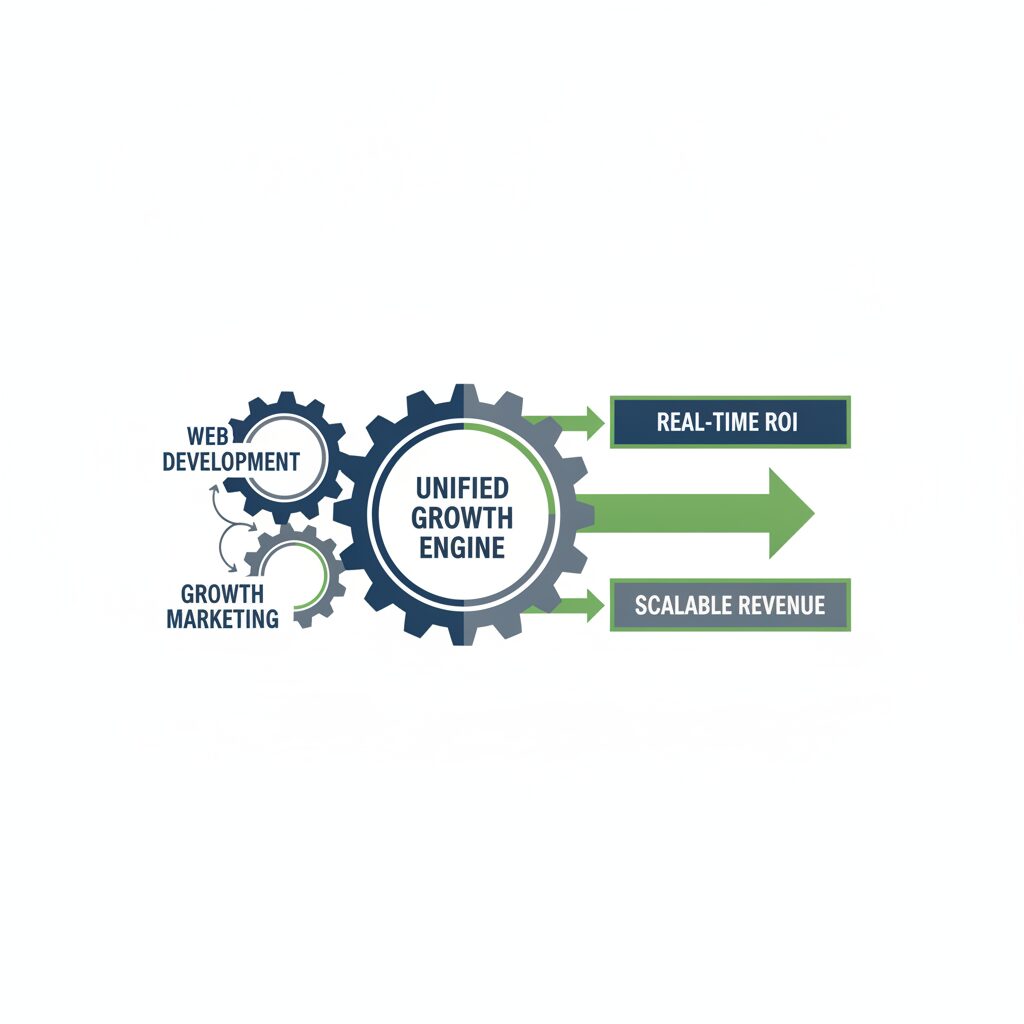
The crux of the issue is the gap between execution and insight. To fix it, you have to unify tech and marketing under one operational roof. Integrating development with growth allows you to build a system of radical transparency. This means you stop guessing and start operating based on a coherent engine where every dollar spent is tracked to a specific result in real time.
The foundation of data-driven marketing for startups
Moving from gut-feelings to real-time dashboards
Too many startups operate on a dangerous delay. They wait for a monthly PDF report to discover a campaign crashed two weeks ago. I’ve seen founders burn through five figures of capital simply because they didn’t realize their lead quality had cratered on day three of the month. Waiting 30 days to pivot is a luxury you cannot afford.
You need a real-time dashboard that pipes ad spend directly into your CRM. When you see lead quality drop in four hours instead of four weeks, you can kill the ad instantly, which means you preserve your runway. In our experience, this immediate feedback loop has slashed wasted ad spend by 22% within the first 90 days. The goal is a single source of truth where the technical team and the growth team see the same numbers at the same time.
Defining your North Star metric without the fluff
Most “strategies” are just a list of goals. A real strategy identifies the one pivotal objective that actually drives value. This is your North Star. Forget page views or social followers—those are vanity markers that make you feel good while your bank account empties. For a B2B SaaS startup, the only metric that matters is usually the Active User Rate: the percentage of users who complete a core value-action within seven days of signing up.
The 2026 Growth Benchmark Report indicates that startups aligning their entire operation around one specific outcome scale 14% faster than those tracking a dozen different KPIs. Focus is a force multiplier. When you stop chasing low-value wins, you stop distracting your team from the few things that actually move the needle on revenue.
Eliminating data silos between development and marketing
ROI dies in the gap between the person who builds the landing page and the person who buys the traffic. If your page takes four seconds to load, your conversion rate will tank regardless of how brilliant your ad copy is. That is a technical failure masquerading as a marketing problem.
By merging these functions, you create integrated marketing and tech solutions. When the developer is incentivized by the cost per lead (CPL) rather than just “shipping a feature,” they optimize for page speed and friction-less conversion paths. This alignment transforms a loose collection of freelancers into a high-performance growth engine.
Growth hacking 2026: Automation and AI-powered growth
Replacing manual outreach with AI-powered lead scoring
Manual lead qualification is a bottleneck that kills momentum. In 2026, the winners use agentic AI to score leads based on real-time intent. Instead of a salesperson spending their morning guessing who to call, an AI agent scans firmographics and behavioral triggers to surface the top 5% of prospects.
This shifts your team’s energy from searching to closing. We recently deployed agentic AI for marketing that crushed lead qualification time from 12 hours a week down to 15 minutes. That efficiency gain translated directly into a 30% increase in qualified pipeline velocity. You aren’t just working faster; you’re working on the right people.
Building zero-excuse automation workflows for onboarding
The window of highest intent is the moment a lead signs up. Every second of friction after that click is an invitation for them to churn. You can use tools like n8n to build automation workflows that trigger a personalized welcome sequence via email and WhatsApp the instant they hit “submit.”
I call this a zero-excuse workflow. If a user signs up but fails to complete their profile within two hours, the system sends a precision nudge. This eliminates the “forgotten lead” syndrome and accelerates the time to first value, which is the only way to ensure long-term retention.
Multi-channel campaigns that synchronize in real time
Your LinkedIn ads, Google search, and email sequences are usually shouting different things. If a prospect clicks a LinkedIn ad but lands on a generic page and gets a generic email, the narrative breaks. Trust evaporates. AI-powered growth solves this by synchronizing the message across every touchpoint.
Synchronization removes the “fragmented feel” that makes a startup look amateur. When a prospect experiences a unified story across three different channels, the brand’s perceived authority spikes. This coherence is the difference between a chaotic operation and a professional market leader.
Achieving measurable marketing ROI with zero-waste PPC
The math of zero-waste PPC: Lowering CAC through precision
Most PPC accounts are leaky buckets. You are paying for “curiosity clicks” from people who will never buy. Zero-waste PPC is the process of plugging the leaks before you turn up the faucet. This requires aggressive negative keyword lists and strict audience layering to filter out the noise.
When you narrow your target to high-intent users, your Customer Acquisition Cost (CAC) drops. In a test we ran in early 2026, shifting from broad-match keywords to intent-based precision dropped bounce rates from 68% to 39% in six weeks. The math is simple: higher precision equals higher margins.
LTV to CAC ratios that investors actually value
Investors don’t care about your total lead count—that’s a vanity metric. They care about unit economics. The benchmark for a healthy startup is an LTV:CAC ratio of 3:1. If your ratio is 1:1, you aren’t growing; you are buying revenue at a loss and accelerating your own demise.
To fix this, you must either extract more value from the customer or lower the cost to acquire them. Zero-waste PPC attacks the latter. By stopping the bleed of irrelevant clicks, your CAC drops, and your ratio improves without you having to raise your prices.
Using live tracking to kill underperforming assets instantly
Traditional agencies love the “wait and see” approach. They’ll ask for a month to “optimize” a creative. In a high-growth environment, a month of bad spend is a catastrophic waste of capital. Live tracking allows you to kill a failing ad within 48 hours.
If the data shows no conversion at a statistically significant sample size, the asset is dead. Stop trying to “tweak” a failing ad. Kill it and replace it with a new hypothesis. This disciplined cycle of testing and executing is how you maintain a high ROI while your competitors are still “optimizing” their failures.
Why integrated growth beats the fragmented agency model
The hidden cost of juggling multiple specialized agencies
When you hire one agency for SEO, another for PPC, and a freelancer for dev, you pay a “communication tax.” You spend half your week repeating your brand voice and goals to three different parties. But the real cost is the finger-pointing. When the leads stop coming in, the blame game starts.
The SEO agency blames the slow site. The dev blames the low-quality traffic. The PPC agency blames the landing page. This circle of blame is a distraction that masks the real problem: a lack of structural coherence.
Merging web development and growth marketing under one roof
When development and marketing are the same team, the blame game ends because the incentive is aligned. The goal is ROI, not the completion of a task. This is the logic behind integrated marketing and tech solutions.
A unified team can launch a new landing page test in four hours, not four weeks. They can fix a tracking bug the second a campaign goes live. This speed of iteration is a massive competitive advantage. In the startup world, the team that can iterate the fastest usually owns the market.
Frequently Asked Questions
What is the most effective startup growth strategy for B2B in 2026?
The most effective approach is a unified system that pairs AI-powered lead scoring with zero-waste PPC. This ensures you only pay for high-intent leads and then move them through an automated, personalized onboarding sequence to reduce churn.
How do I measure marketing ROI without expensive enterprise software?
Build a simple real-time dashboard that connects your ad spend directly to the revenue in your CRM. Focus on your LTV:CAC ratio; it’s the clearest indicator of whether your growth is sustainable or just expensive.
What is the difference between traditional growth hacking and AI-powered growth?
Traditional growth hacking is a volume game based on manual experiments. AI-powered growth is a precision game, using predictive data and agentic automation to optimize leads and execute tests in real time.
How often should a startup pivot its growth strategy based on data?
Optimize your tactics daily using live tracking. Review your overall strategy every 30 days. However, only pivot your core strategy if your North Star metric shows a consistent decline over a 60-day period.
Why is radical transparency important in a marketing agency partnership?
Transparency removes the “black box” of agency reporting. It prevents agencies from hiding wasted spend behind aggregate data and ensures you know exactly where every dollar is going and what it is returning.
Stop guessing with your growth
Growth is not a series of random experiments; it is a disciplined system of data, automation, and coherent action. If you are tired of fragmented results and reports that tell you nothing, it is time to bring your growth engine under one roof. Book a strategy call to see your real-time dashboard for free.
Infineural is a digital marketing, development and hosting company based in Nashik, India, founded in 2018. It runs SEO, Google Ads, performance and WhatsApp marketing, builds custom WordPress sites, web apps and mobile apps, manages hosting, and makes Infineural CRM and WhatsInfi. Every engagement starts with a written scope and runs through a client dashboard showing the work log, billing and results.
- Search Engine & Generative Engine Optimization Specialists
- Google Ads Management & Performance Marketing Experts
- Advanced WordPress & Custom Web Application Developers
- B2B, D2C & Enterprise Conversion Rate Optimization (CRO) Leaders
- Digital Growth Partners for Hospitality, Healthcare, and Education