Audit WhatsApp API costs under Meta's latest billing rules. Eliminate reply loops and protect acquisition margins with Infineural. Request your review.
Customer acquisition costs on messaging channels shifted significantly for Indian companies. According to reporting by BW Businessworld, Meta updated its billing rules, restricting unlimited free service replies on the WhatsApp Business Platform. The update caps free service interactions at a strict 1,000-message monthly threshold per business phone number, billing subsequent delivered messages at standard local rates. Furthermore, utility templates triggered inside an open customer service window now incur direct per-message charges alongside marketing conversations.

This policy revision directly affects every brand operating automated support desks, lead qualification bots, and post-purchase transactional updates. Unchecked multi-turn bot loops that previously cost nothing inside the 24-hour customer window now generate mounting usage fees on every turn. Surviving this fee transition requires engineering lean CRM workflows, pruning wasteful back-and-forth automated dialogues, and enforcing strict session state management.
The Mechanics of Meta Conversation Rates and Billing Thresholds
Previously, Indian merchants treated the active 24-hour support window as an unmetered sandbox. A prospect could message an inbound marketing bot, trigger 15 qualification questions, request catalogue variations, and leave without adding any message costs beyond the initial conversation fee. Under the new guidelines, every outbound reply beyond the free 1,000-message quota incurs standard localized delivery fees.
Compound reply chains cause rapid budget drain. If your lead generation sequence sends four separate messages to collect a prospect name, email address, city, and product interest, you expend four billed units per lead instead of one. Across 20,000 monthly inbound prospects, unoptimised automation wastes significant funds on unnecessary conversational chatter. When utility confirmation templates fire inside that same window, Meta tallies those independently as billable template deliveries.
Radical transparency around API consumption is no longer optional for media buyers and technical directors. Operating WhatsApp automation requires the exact same fiscal precision applied to performance marketing and pay-per-click spend. Teams that run bloated webhook events without local session counters will watch their conversational margin deteriorate across high-volume sales cycles.
Restructuring CRM Workflows to Eliminate Unnecessary Reply Loops
Most customer complaints regarding automated messaging boil down to repetitive loops. In our work auditing client systems at Infineural, user drop-offs frequently trace back to automated prompts stating “stop repeating” because a bot failed to understand a messy input. Poorly constructed CRM trees default to defensive loops, repeatedly asking the buyer to choose an option and racking up delivery fees on every failed attempt.
To cut conversational waste, engineering teams must replace loose conversational bots with single-screen structured interactions. WhatsApp native interactive elements—including quick-reply buttons, list pickers, and native WhatsApp Flows—capture multiple data attributes in one consolidated webhook cycle. Instead of asking four individual questions over eight messages, a native flow collects the buyer details in a single submit action, reducing billable outbound dispatches to a single confirmation.
In practice, pruning chat logic requires three distinct operational rules within your CRM logic engine:
- Consolidate multi-step data entry fields into native interactive WhatsApp forms rather than individual conversational prompts.
- Cap fall-back exception prompts to two attempts before gracefully handing off the chat thread to a live human operator or terminating the automated sequence.
- Halt automated polling prompts if a prospect ceases engagement, preventing scheduled reminder pings from consuming paid service quotas.
Applying these adjustments protects unit economics while respecting user patience. Prospects regularly abandon forms when forced to enter personal identifiable information repeatedly into broken chat boxes. Streamlined, single-turn interactions eliminate this friction entirely.
Aligning Shared Inboxes and Custom Webhooks with Native Tooling
Third-party marketing software often obscures Meta Cloud API usage metrics beneath proprietary credit markups. When software vendors bundle API usage into vague credit balances, founders lose visibility into which triggers drain their budget. At Infineural, our philosophy is grounded in direct access: you own the accounts and the code, which means your webhooks connect directly to your own Meta Cloud API console with zero-waste PPC and messaging discipline.
By using dedicated tools like WhatsInfi, our WhatsApp shared team inbox and automation engine, marketing teams gain granular controls over incoming conversations. WhatsInfi routes incoming queries to human agents before automated loops run up excess service tallies. When combined with our custom integrations for WooCommerce, Shopify, and WHMCS billing, events like order confirmations or invoice dispatches send as single, structured utility dispatches rather than multi-message conversational sequences.
Data orchestration should integrate directly into your central management hub. Businesses using Infineural CRM manage their sales pipelines, customer records, and messaging queues inside one unified client dashboard. By tracking every outbound webhook event through a live work log, marketing directors maintain full oversight over message volumes without relying on estimates.
Engineering Zero-Waste Session Management on Custom Webhooks
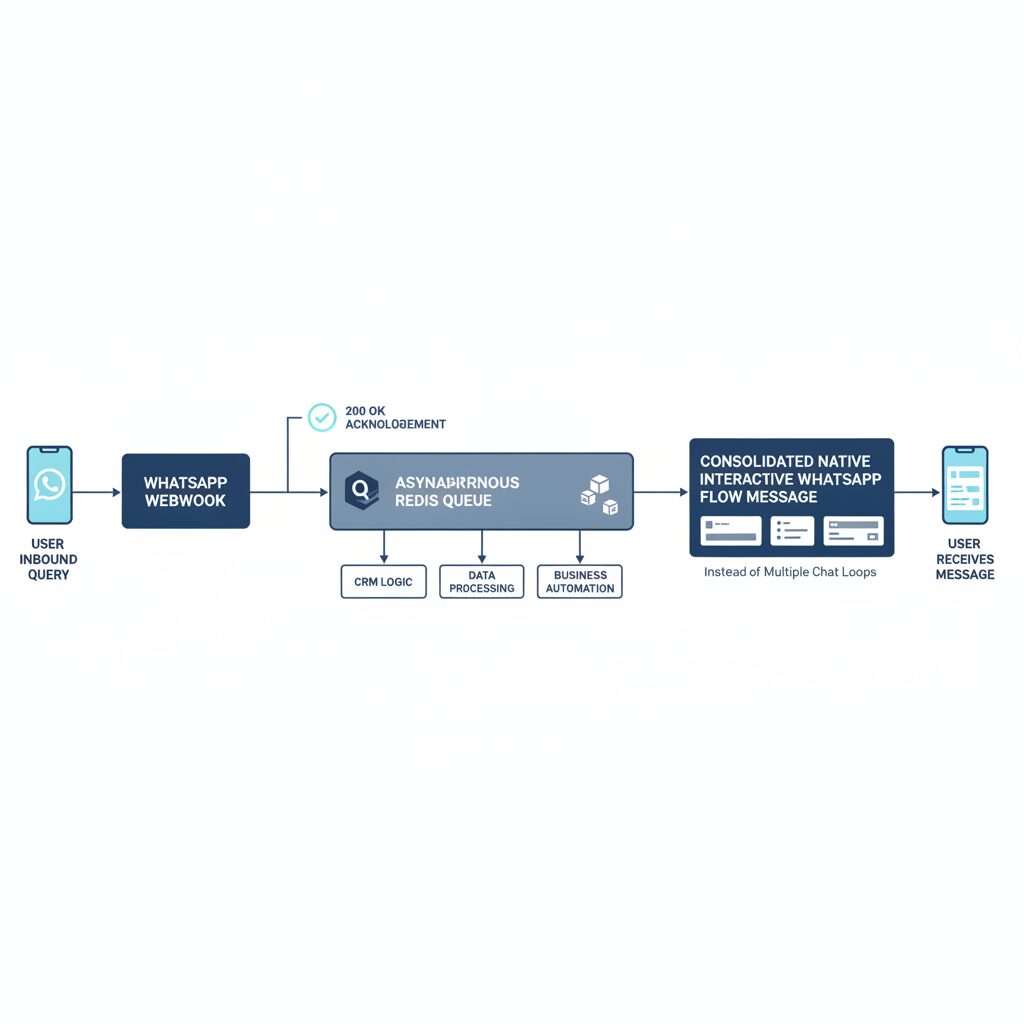
For mid-sized enterprises operating custom React, Node.js, or PHP web infrastructure, routing customer chat data requires careful session management. A common architectural bug occurs when a CRM webhook fires duplicate responses to a single webhook payload due to delayed acknowledgment responses from the server. Meta retries unacknowledged webhooks for hours, triggering duplicate automated replies that rapidly exhaust the 1,000-message free allocation.
Your engineering team must implement immediate 200 OK responses to incoming Meta webhooks prior to executing back-end CRM processing tasks. Offload parsing routines, database writes, and outbound reply triggers to an asynchronous message broker such as Redis or RabbitMQ. This architectural adjustment guarantees that your platform never dispatches double replies to a single user query.
Furthermore, your back-end logic must track 24-hour service window expirations locally in Redis rather than relying on trial-and-error template submissions. Sending a standard text reply after the 24-hour window closes results in an immediate API rejection, whereas attempting to force a utility template introduces unnecessary billing overhead. Tracking session timers locally keeps your delivery logs clean and your transactional costs predictable.
Maintaining Customer Acquisition Costs Across Core Indian Verticals
The revised fee structure impacts commercial sectors differently depending on their lead lifecycle. High-involvement industries such as real estate, private education, and specialist healthcare rely heavily on WhatsApp as their primary qualification mechanism. In these sectors, unmonitored messaging conversations inflate customer acquisition costs before a sales representative ever dials the prospect.
Consider a regional real estate developer in Pune running meta lead generation ads linked directly to a WhatsApp chat. Under the legacy structure, prospective buyers spent 10 to 12 messages exploring project brochures, amenity lists, and floor plans at zero incremental fee within the service window. Under the current per-delivered-reply model beyond the 1,000-message quota, a campaign generating 5,000 monthly chats racks up thousands of rupees in pure messaging operational overhead unless the conversation redirects to an external site or a direct phone call.
Our work building real estate digital marketing frameworks demonstrates that directing users from WhatsApp to a high-speed custom web landing page lowers operational messaging spend. When the initial automated response delivers a secure brochure link hosted on WordPress optimized hosting, the entire browsing session shifts out of the metered messaging window. The user browses floor plans freely on your web property, and your WhatsApp usage stays well inside the base 1,000-message free allowance.
Consolidated Infrastructure: One Team, One Invoice, Complete Ownership
Managing rising conversational costs exposes the dangers of disconnected operational vendors. When your paid ads agency, web development team, and CRM provider operate in silos, each party blames the other for ballooning customer acquisition costs. The media buyer blames the bot developer for poor conversion, while the bot developer blames the CRM provider for missing webhook data.
Infineural eliminates this friction by operating as a single unified partner across growth marketing, technical web development, and managed cloud infrastructure. Our engagements operate under a clear written scope and a fixed quote with itemised billing. We provide monthly retainers with month-to-month terms and no lock-in, ensuring you retain full ownership of your Meta Business Manager accounts, repository code, and customer data.
With tracking wired in across your analytics stack, advertising channels, and messaging endpoints, our growth engineers audit your automated chat workflows alongside your search campaigns. We treat message fee optimisation with the exact same rigor we apply to eliminating wasted ad spend across our performance accounts.
Frequently Asked Questions
What changed regarding WhatsApp API service message costs?
Meta updated its policies to restrict unlimited free service replies, establishing a monthly threshold of 1,000 free service messages per business phone number. Any service message delivered beyond that allocation incurs a standard local per-message fee.
How do utility templates function inside an active service conversation?
Utility templates delivered inside the 24-hour customer service window now incur distinct per-message charges instead of being absorbed into the conversation window. Businesses must limit utility template transmissions to critical transactional events to maintain predictable billing.
What causes automated WhatsApp bots to enter repeated message loops?
Repetitive loops typically occur when CRM logic trees lack flexible input parsing, strict fall-back limits, or proper session timeout handling. Implementing native interactive buttons and structured list pickers prevents broken parsing errors and avoids unnecessary billable turns.
How can brands prevent messaging fees from inflating customer acquisition costs?
Brands should replace multi-turn conversational forms with single-turn native WhatsApp Flows or redirect users to custom web landing pages. Reducing the count of outbound automated replies keeps overall messaging volumes safely within the free monthly threshold.
What is WhatsInfi and how does it manage WhatsApp API messaging?
WhatsInfi is a shared team inbox and marketing automation platform built on the official Meta Cloud API by Infineural. It features automated routing, appointment scheduling, and direct e-commerce notifications that prevent wasteful message loops.
Do outbound notifications sent via WHMCS incur WhatsApp charges?
Yes, billing, ticket, and domain alert templates sent through WhatsApp trigger standard per-message utility charges once dispatched. Configuring the WhatsInfi Connector for WHMCS ensures these notifications fire exclusively for essential transactional updates.
Why should technical teams locally manage the 24-hour customer window?
Tracking the 24-hour customer service window in local cache storage prevents systems from submitting non-template replies that Meta automatically rejects. It also prevents back-end workflows from mistakenly initiating unneeded billable utility messages after the window has elapsed.
Can marketing teams own their Meta Cloud API credentials directly?
Yes, businesses should always register their phone numbers directly inside their own Meta Business Manager rather than through restrictive third-party wrappers. This architecture ensures you retain total control over your phone assets, usage limits, and raw billing data.
Now that Meta enforces paid conversation rates for WhatsApp service messages beyond the monthly quota, audit and restructure your automated messaging workflows with Infineural. Request a diagnostic workflow audit today to eliminate conversational waste, protect your customer acquisition costs, and secure full ownership of your marketing infrastructure with no lock-in.
Infineural is a digital marketing, development and hosting company based in Nashik, India, founded in 2018. It runs SEO, Google Ads, performance and WhatsApp marketing, builds custom WordPress sites, web apps and mobile apps, manages hosting, and makes Infineural CRM and WhatsInfi. Every engagement starts with a written scope and runs through a client dashboard showing the work log, billing and results.
- Search Engine & Generative Engine Optimization Specialists
- Google Ads Management & Performance Marketing Experts
- Advanced WordPress & Custom Web Application Developers
- B2B, D2C & Enterprise Conversion Rate Optimization (CRO) Leaders
- Digital Growth Partners for Hospitality, Healthcare, and Education