
Discover the most popular search engines in Asia for international SEO in 2026. Learn how to rank on Google, Baidu, Naver, and Yahoo! Japan to scale growth.
The Short Answer: How to Win in Asia
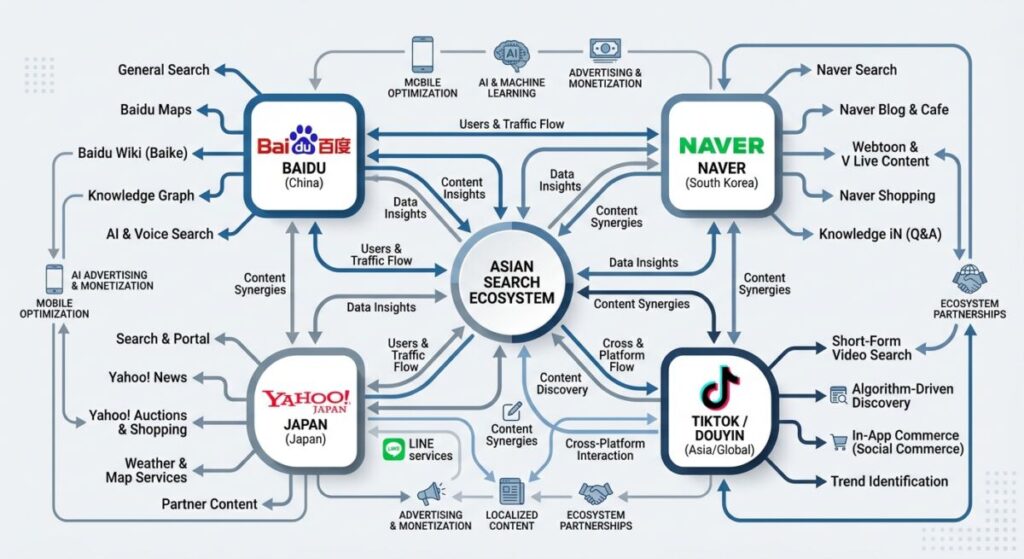
If you want to dominate the Asian market in 2026, you cannot rely on Google alone. While Google holds significant weight in Southeast Asia and India, it is a minor player in the world’s most populous nations. To succeed, you must optimize for Baidu in China, Naver in South Korea, and Yahoo! Japan in Japan. But here is the catch: 2026 is the year of Sovereign AI. Every major Asian search engine has now fully integrated its own proprietary Large Language Model (LLM), meaning your traditional backlink strategy is only half the battle. You need to optimize for answer engines, not just link lists.

In our work at Infineural Technologies, we have seen companies double their organic reach simply by shifting 20% of their budget toward localized platforms. It sounds simple. But the execution is where most people fail. You are dealing with different languages, different user behaviors, and vastly different technical requirements. Are you ready to stop guessing and start ranking?
China: Dominating Baidu for International SEO in Asia
China is a different beast. You probably know about the Great Firewall. But do you know how it actually affects your SEO? If your site is hosted outside of China, it will load slowly. And in 2026, speed is everything. We have found that page load speed impacts ranking more severely on Baidu than on almost any other platform. If your site takes more than three seconds to load, Baidu might not even index you.
Baidu remains the king of the most popular search engines in Asia for international SEO within the mainland. But Baidu in 2026 is not the Baidu of five years ago. It is now an AI-first platform driven by the ERNIE bot. When users search, they are often met with a generated answer before they ever see a blue link. To rank here, you need high-quality, simplified Chinese content that answers questions directly. But do not forget the legal side. You need an Internet Content Provider (ICP) license. Without it, you are basically invisible to the Chinese algorithm.
And do not ignore the mobile-first players. Shenma and Sogou are massive. Shenma is integrated into the UC Browser, which is the default for millions of mobile users in China. If you are not looking at these top search engines, you are missing out on a massive chunk of mobile traffic. Sogou is unique because it has access to WeChat data. That is a goldmine of social signals that Google can only dream of.
Technical Infrastructure: CDNs and Data Residency in 2026
International SEO in Asia is as much about hardware as it is about content. In 2026, ‘Sovereign AI’ laws mean that data residency is a ranking factor. If you are targeting China, South Korea, or Vietnam, where your data is stored matters. To be one of the most popular search engines in Asia for international SEO, platforms like Baidu and Naver prioritize sites that offer near-instantaneous load times through local nodes.
Edge Computing and Asian SEO
Standard CDNs are no longer sufficient. You need Edge Computing solutions that can execute localized AI scripts at the server level. This ensures that a user in Seoul sees different dynamically generated content than a user in Mumbai, based on local search trends and regulatory requirements. We have found that sites utilizing green, local servers not only rank better but also benefit from higher trust scores in the algorithm.
The ICP License and Beyond
While the ICP license remains mandatory for China, other Asian nations are introducing similar ‘Trust Badges’ for 2026. Ensuring your site carries the necessary local certifications is now a technical SEO requirement. Without these, search engines may flag your site as ‘untrusted,’ leading to a permanent suppression in rankings regardless of your backlink profile.
South Korea: Cracking Naver's Search Engine Algorithm
South Korea is obsessed with Naver. While Google has made gains, Naver still controls a huge portion of search intent. But here is the thing: Naver is not just a search engine. It is a portal. Think of it like Yahoo in the 90s but with 2026 technology. When you search on Naver, the results are divided into sections: Blogs, Cafes (communities), Knowledge iN (Q&A), and News.
If you want to rank on Naver, you need to participate in these communities. You cannot just publish a blog post and hope for the best. You need to be active in Naver Cafes. You need to answer questions on Knowledge iN. According to 2026 market data, over 60% of Korean users trust social recommendations over traditional search results. This means your SEO strategy must include a social component. You are not just building links; you are building a reputation within the Naver ecosystem.
But what about technical SEO? Naver has its own webmaster tool, and it is picky. It prefers content that is updated frequently. In our experience, fresh content on Naver outranks high-authority older content almost every time. It is a fast-paced environment. Can you keep up? You should also use obscure SEO tools to find keywords that Korean users actually type, which are often very different from direct English translations.
Google and Yahoo! Japan: Winning Southeast Asia and Japan
While regional players like Baidu and Naver are critical for their respective countries, Google remains one of the most popular search engines in Asia for international SEO, commanding over 80% of the market share in India and Southeast Asia in 2026.
However, optimizing for Google in these regions requires a highly localized approach. You must account for mobile-first user behaviors, variable network latencies, and the rapid rollout of regional AI Overviews. Additionally, to penetrate the Japanese market, understanding Yahoo! Japan is non-negotiable. Even though Yahoo! Japan relies on Google’s core algorithm on the backend, its SERP layout, featured news segments, and user behavior are distinctively integrated into the local Yahoo portal ecosystem.
- Southeast Asia Strategy: Prioritize mobile loading speeds, hyper-local dialect targeting, and Generative Engine Optimization (GEO) tactics to appear in AI summaries.
- Japan Strategy: Optimize for Yahoo! Chiebukuro (Yahoo! Answers) and leverage local PR to dominate the portal’s integrated news feeds.
For brands seeking continent-wide visibility, balancing Google’s massive reach with tailored regional platforms is the ultimate key to international SEO success.

Japan: The Dual Power of Google and Yahoo! Japan
Japan is unique. It is one of the few places where Yahoo! is still a major player. However, there is a secret: Yahoo! Japan uses Google’s search algorithm. So, if you rank on Google, you rank on Yahoo! Japan, right? Not exactly. While the core algorithm is the same, the SERP features are completely different. Yahoo! Japan has its own ad platform and its own way of displaying news and shopping results.
To win in Japan, you need to master the three Japanese writing systems: Kanji, Hiragana, and Katakana. If you only optimize for one, you are missing two-thirds of the potential traffic. Japanese users also value trust and detail. They want to see long-form content with lots of data. They want to know who is behind the website. In 2026, the E-E-A-T (Experience, Expertise, Authoritativeness, and Trustworthiness) signals you use for Google are vital for Japan. But you have to localize those signals. A US-based testimonial does not carry much weight in Tokyo.
Southeast Asia: The Battle of Localized AI and Super-Apps
While Google remains the dominant force in Southeast Asia (SEA), 2026 has seen a massive shift toward localized ‘Search-within-Apps.’ In markets like Vietnam and Indonesia, traditional SEO is no longer enough. You must account for platforms like Cốc Cốc, which has carved out a significant niche by focusing on the nuances of the Vietnamese language and local shopping habits.
Vietnam’s Cốc Cốc and the AI Ad-Blocker Era
In Vietnam, Cốc Cốc remains one of the most popular search engines in Asia for international SEO because of its integrated browser features. By 2026, it has fully integrated a localized LLM that helps users bypass traditional ad clutter. To rank here, your technical SEO must prioritize browser compatibility and localized schema markup that identifies product availability in specific Vietnamese provinces.
Indonesia and the Rise of Social Search
Indonesia is the world’s fourth most populous nation, and in 2026, search intent has migrated toward social commerce platforms. However, Google still acts as the discovery layer. The key to winning in Indonesia is ‘Hyper-Local SEO.’ This involves optimizing for regional dialects and ensuring your mobile performance is flawless, as 98% of Indonesian users access the web via smartphones. If you aren’t using a regional CDN, your bounce rate will kill your rankings before you even start.
Southeast Asia: The Rise of Social and Super-App Search
In countries like Vietnam, Indonesia, and the Philippines, Google is dominant. But the way people search is changing. In 2026, TikTok has become a primary search engine for Gen Z in Southeast Asia. If you are selling a product or a lifestyle, you need a TikTok SEO strategy alongside your traditional one. Users are looking for visual proof, not just text.
Then there is Zalo in Vietnam. It started as a messaging app, but now it is a search hub. In Indonesia, people search directly within Gojek or Grab for services. This is decentralized SEO. You have to be where the users are. In these markets, localized language is non-negotiable. Even if people speak English, they search in their native tongue for local solutions. Are you speaking their language? Or are you just shouting into the void?
The Technical Foundations of Asian SEO
You can have the best content in the world, but if your technical setup is wrong, you will fail. First, let’s talk about hosting. If you want to rank in China, host in China or Hong Kong. If you want to rank in Singapore, host in Singapore. Latency is a silent killer of rankings. We have seen sites jump three pages in the SERPs just by moving to a local CDN.
Second, mobile optimization is not an option; it is the entire game. Most users in Asia skipped the desktop era entirely. They went straight to smartphones. Your site must be lightning-fast on a 4G connection in a crowded city. Use compressed images, clean code, and avoid heavy scripts that bog down the experience. But do not just take my word for it. Test your site using local tools. Google Search Console is great, but Baidu Webmaster Tools will tell you things Google never could.
Why Most Companies Fail at International SEO in Asia
The biggest mistake? Treating Asia as a monolith. Asia is a collection of vastly different cultures, languages, and technical infrastructures. You cannot use a ‘one size fits all’ approach. You see, most brands just translate their English site and wonder why the phone isn’t ringing. It is because they didn’t localize the intent.
In the West, a search for ‘best coffee’ might be looking for a review site. In Japan, that same search might be looking for the history of the bean. In China, it might be looking for a delivery app. You have to understand the ‘why’ behind the search. And that requires local expertise. At Infineural Technologies, we always tell our clients: ‘Don’t just translate. Transcreate.’ Create content that feels like it was born in the local market.
Ready to Conquer the Asian Search Market?

The opportunity in Asia is massive. But the competition is fierce. If you are still using 2024 strategies in a 2026 world, you are already behind. You need a partner who understands the technical, cultural, and AI-driven shifts happening in the East. At Infineural Technologies, we specialize in bridging the gap between Western brands and Asian audiences. Don’t let language barriers and technical hurdles stop your growth. Reach out to us today, and let’s build a strategy that actually moves the needle.
The India Factor: Multilingual SGE and the 2026 AI Shift
India is no longer a ‘Google-only’ market in the traditional sense. In 2026, Google’s Search Generative Experience (SGE) has matured, particularly for regional languages. If your international SEO strategy for Asia doesn’t include Hindi, Tamil, and Bengali, you are ignoring over 600 million potential users. The ‘Search’ button is being replaced by ‘Ask,’ and your content needs to be the definitive answer.

Optimizing for Voice and Vernacular Search
Indian users are increasingly using voice search in their native languages. This requires a shift from keyword-stuffing to natural language processing (NLP). Your content should be structured in a Q&A format to feed into the AI Overviews that now dominate the top of the SERPs. Furthermore, with the government’s push for ONDC (Open Network for Digital Commerce), search results are now more integrated with local inventory than ever before.
The Impact of Sovereign AI on Indian Rankings
India has invested heavily in ‘Bhashini,’ an AI-led language translation platform. In 2026, search engines are using these datasets to rank content that is culturally relevant, not just translated. To compete, brands must move beyond literal translation and invest in ‘transcreation’ that respects local idioms and consumer sentiment.
FAQ: Frequently Asked Questions
Which search engine is most popular in China in 2026?
Baidu remains the leader, but mobile-specific engines like Shenma and AI-driven social search are gaining ground rapidly. You must optimize for ERNIE bot’s generative answers to stay relevant.
Do I need a local office to rank on Naver?
While not strictly required for organic search, having a local presence or a South Korean phone number makes it much easier to verify accounts for Naver Blog and Cafe. This significantly boosts your trust signals.
Is Google used in Japan?
Yes, Google is the most used search engine in Japan, but Yahoo! Japan holds a massive market share and offers different localized features. Optimizing for Google’s algorithm covers both, but your content must be culturally localized.
How does the ICP license affect Chinese SEO?
Without an ICP license, your website cannot be hosted on mainland Chinese servers. This leads to slower loading times and potential blocking by the Great Firewall, which ruins your ranking potential on Baidu.
What is the best way to rank in Southeast Asia?
Focus on mobile-first content and localized languages. While Google is the main engine, integrating social search strategies for TikTok and Zalo is essential for 2026.
Does Yandex matter for Asian SEO?
Yes, specifically in Central Asian countries and for businesses targeting Russian-speaking populations in the region. Yandex uses a different weighting for backlinks compared to Google.
Is voice search common in Asia?
Absolutely, voice search via mobile devices and smart speakers is highly prevalent in China and Korea. Content should be optimized for natural, conversational long-tail keywords.
Can I use AI to translate my content for Asian SEO?
You can use AI for a first draft, but a native speaker must review it. Subtle nuances in tone and vocabulary can make or break your brand’s authority in markets like Japan and Korea.
What is the most popular search engine in Asia 2026?
While Google leads in Southeast Asia and India, Baidu is the most popular search engine in China, and Naver dominates South Korea. In 2026, the ‘most popular’ engine depends on the specific country’s AI regulations and local language support.
How do I optimize for Baidu from outside China?
To optimize for Baidu, you must obtain an ICP license, host your site on a Chinese server or a high-performance CDN, and use Simplified Chinese content. In 2026, optimizing for the ERNIE Bot AI results is also critical for visibility.
Is Google still dominant in Southeast Asia?
Yes, Google holds over 90% market share in most of Southeast Asia, but it faces increasing competition from local ‘Super-Apps’ and specialized engines like Cốc Cốc in Vietnam which offer localized AI features.
What is Sovereign AI in Asian SEO?
Sovereign AI refers to nation-specific Large Language Models (LLMs) developed to respect local laws and cultures. For SEO, this means your content must align with local AI training data to appear in generated ‘Answer Engine’ results.
Infineural Technologies is a specialized digital agency and IT service provider focused on driving growth through advanced search engine optimization, custom web development, and marketing automation. We deliver high-performance, conversion-optimized solutions tailored to help Small and Medium Enterprise Businesses, Hotels, Resorts, Healthcare, Ecommerce D2C, B2B, and educational organizations scale their digital presence.
- Search Engine & Generative Engine Optimization Specialists
- Google Ads Management & Performance Marketing Experts
- Advanced WordPress & Custom Web Application Developers
- B2B, D2C & Enterprise Conversion Rate Optimization (CRO) Leaders
- Digital Growth Partners for Hospitality, Healthcare, and Education