
The Short Answer: How to Win in China Search 2026
You want to reach Chinese consumers. You know Google isn’t the answer there. In 2026, the strategy for international businesses boils down to one word: fragmentation. While Baidu remains the dominant player for traditional search, the real growth for global brands lies in ecosystem-specific search engines like WeChat and Douyin. To succeed, you need a mix of traditional SEO and ‘In-App’ optimization.
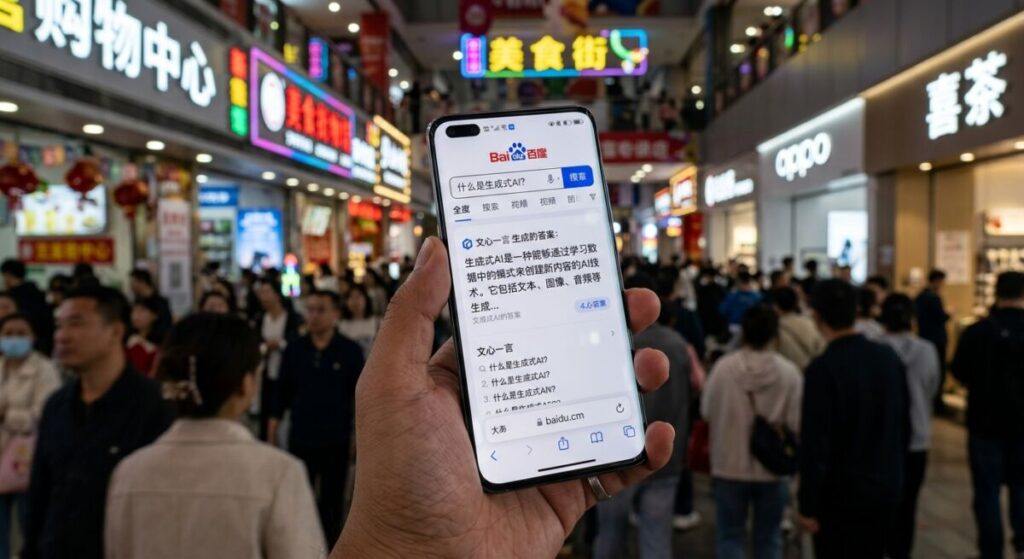
In our work at Infineural Technologies, we have seen that successful market entry requires more than just translating your site. You need to understand that search in China is now heavily driven by Artificial Intelligence (AI) agents. Users don’t just type keywords anymore; they ask their AI assistants to find products. If your brand isn’t visible within these AI-driven ecosystems, you are invisible to the world’s largest consumer base.
Baidu: Still the King of the Hill in 2026
Is Baidu still relevant? Absolutely. It holds over 60% of the market share as of April 2026. But it is not the same Baidu you knew three years ago. With the rollout of Ernie Bot 5.0, search results are now a blend of traditional links and generative AI answers. Why does this matter to you? Because standard keyword stuffing is dead. You need to provide high-quality, long-form content that answers specific user queries to appear in the ‘AI Snapshot’ at the top of the results.
And here is the kicker. Baidu prioritizes sites hosted within mainland China. If your site is hosted in the US or Europe, your loading speeds will crawl. According to 2026 speed benchmarks, a three-second delay can drop your ranking by 40 positions. You need an Internet Content Provider (ICP) filing and local hosting to even stand a chance. If you are looking for a global perspective on search, you should check out our Top Search Engines List: 12 Best Platforms for Traffic (2026) to see how Baidu compares to Western giants.
Sogou: The Secret Weapon for Social Integration
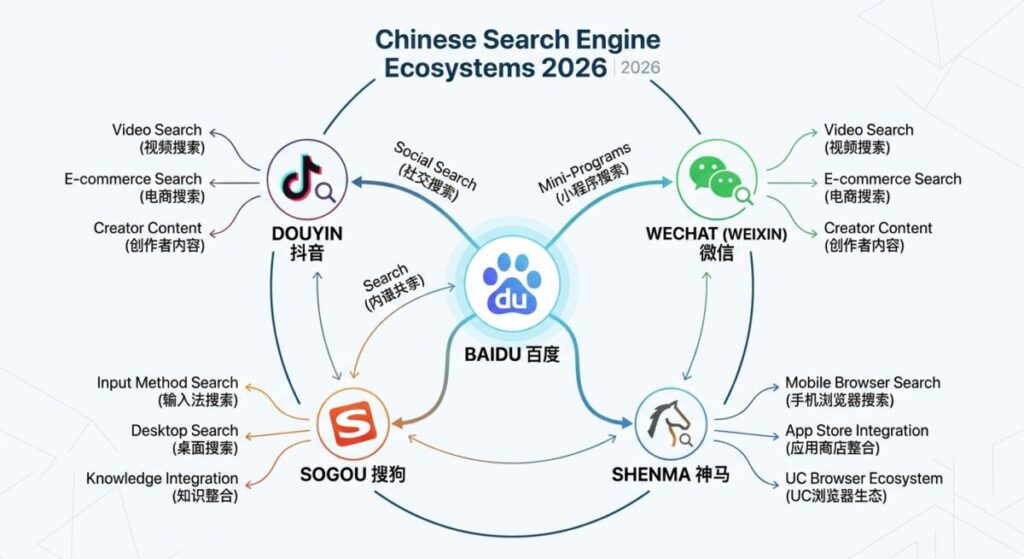
Sogou is the second-largest player, and it has a massive advantage: Tencent. Because Tencent owns a significant stake in Sogou, this engine is the only one that can fully index content from WeChat. Think about that. WeChat has over 1.4 billion monthly active users in 2026. If you want your WeChat articles to show up in a general web search, Sogou is your gateway.
But wait, there is more. Sogou has integrated advanced voice search features that are popular among China’s aging population and younger Gen Alpha users. They aren’t typing. They are talking to their devices. Are you optimizing for conversational Mandarin? If not, you are leaving money on the table. We have found that brands using natural, question-based headings see 25% higher click-through rates on Sogou compared to traditional headlines.
Shenma: The Mobile-Only Powerhouse
You might not have heard of Shenma, but your customers have. It is a mobile-only search engine born from a collaboration between Alibaba and UCWeb. Since it comes pre-installed on the UC Browser—one of China’s most popular mobile browsers—it captures a huge chunk of the shopping-intent traffic. When people want to buy, they use Shenma.
It acts more like a shopping directory than a standard search engine. If you are an e-commerce brand, this is where you spend your ad yuan. But it is competitive. You need to ensure your mobile site is flawless. No clunky menus. No slow images. Just a fast, seamless path to checkout. Have you tested your site on a 5G connection in Shanghai lately? That is the standard you are up against.
The Rise of ‘In-App’ Search: WeChat and Douyin
Here is something most ‘experts’ won’t tell you. Traditional search engines are losing ground to apps. In 2026, a huge portion of Chinese users start their search inside WeChat or Douyin (the Chinese version of TikTok). They search for brands, reviews, and ‘how-to’ guides without ever opening a browser. This is what we call ‘Closed-Loop Search.’
Douyin’s search algorithm is particularly aggressive. It uses visual recognition to suggest products. If a user watches a video of someone wearing a specific style of watch, the search bar suggests similar brands. For international businesses, this means your video content is now your SEO content. It is a total shift in how we think about discovery. If you’re interested in how other regions handle this, you can read about the Most Popular Search Engines in Asia for International SEO 2026.
Haosou (360 Search): The Enterprise Choice
If you are in the B2B space, pay attention to Haosou. It is owned by Qihoo 360, a major cybersecurity company. Because it is the default search engine for many corporate computers and government offices in China, its user base is more professional and affluent. They have higher disposable income and are looking for reliable, ‘safe’ international brands.
Trust is everything here. Haosou users value security certificates and official brand verification. We recommend that international businesses go through the ‘Official Website’ verification process on 360 Search. It adds a small blue ‘V’ icon next to your listing. It sounds small. But in a market where ‘fake’ sites are a constant worry, that little icon can double your conversion rate. It is about authority.
Technical Barriers You Can’t Ignore in 2026
You can’t just ‘do’ SEO in China. You have to play by their rules. First, the Great Firewall is real and it is stricter than ever in 2026. If you use Google Fonts, YouTube embeds, or Facebook ‘Like’ buttons, your site will break. It won’t just be slow; it will fail to load entirely. You need to strip your code of all blocked Western dependencies.
Second, language matters. Machine translation won’t cut it. Chinese users can spot ‘AI-translated’ text from a mile away, and it screams ‘untrustworthy.’ You need localized content that uses current slang and cultural references. For instance, the way users search for ‘sustainable fashion’ in Beijing is totally different from how they search for it in London. You need local expertise to bridge that gap.
The Role of AI-Powered Search Engines
The market is shifting toward specialized AI tools. While Baidu has Ernie, new players are emerging that focus solely on research and data. For brands in the medical or academic space, this is a niche you can’t ignore. According to a 2025 study by the China Digital Institute, 30% of professional searches have migrated to specialized AI platforms. You should explore the 7 Top AI Powered Search Engines for Research (2026 Guide) to understand this trend better.
Don’t forget about privacy either. While the Chinese market is different, there is a growing segment of users concerned about data tracking. Some are moving toward niche engines that offer more control. For a comparison of how this looks globally, see our guide on DuckDuckGo vs Startpage for 2026.
FAQ: Navigating the Chinese Search Market
Which search engine is best for B2B businesses in China?
Baidu is essential for broad reach, but Haosou (360 Search) is often better for targeting corporate decision-makers. Its integration with enterprise security software makes it the default for many office environments.
Do I need a local Chinese phone number for SEO?
Yes, most Chinese search engines require a local phone number to register for webmaster tools or advertising accounts. It is nearly impossible to manage your presence effectively without local contact details.
How important is WeChat search for international brands?
In 2026, it is vital because WeChat is an all-in-one ecosystem where users spend hours daily. If your content isn’t searchable within WeChat, you are missing out on the primary way users discover new brands.
Is Bing available in China?
Yes, Bing is one of the few Western search engines accessible in China, but its market share is small. It is mostly used by developers and people looking for English-language results.
What is an ICP Filing and why do I need it?
An Internet Content Provider filing is a state-issued license that allows a website to host on a mainland Chinese server. Without it, you cannot host locally, which leads to slow speeds and poor search rankings.
Can I use my Western social media strategy in China?
No, because platforms like Instagram and X are blocked. You must adapt your strategy for Douyin, Xiaohongshu, and WeChat to gain visibility in their respective search functions.
What is the biggest mistake brands make in China SEO?
The biggest mistake is ignoring mobile optimization and loading speeds. China is a mobile-first society, and a slow-loading site will be penalized heavily by all major Chinese search engines.
How does AI change search rankings in China for 2026?
AI agents now aggregate information from multiple sources to provide a single answer. To rank, your content must be structured as authoritative data that these AI agents can easily parse and cite.
Stop Guessing and Start Growing in China
The Chinese market is too big to ignore, but it is too complex to wing it. You need a strategy that accounts for the unique algorithms of Baidu, the social power of WeChat, and the mobile dominance of Shenma. At Infineural Technologies, we specialize in navigating these technical and cultural hurdles. We don’t just translate; we transform your digital presence for the 2026 market. Ready to see your brand thrive in China? Let’s build your international SEO roadmap today.