
The Bottom Line: Why the Difference Matters Today
You want to find information fast. Most people just head to Google. But did you know you might be missing out on 40% of the web by sticking to one algorithm? Traditional search engines like Google or Bing build their own indexes. They use ‘spiders’ to crawl the web and store that data on their own servers. It is a massive, expensive operation.

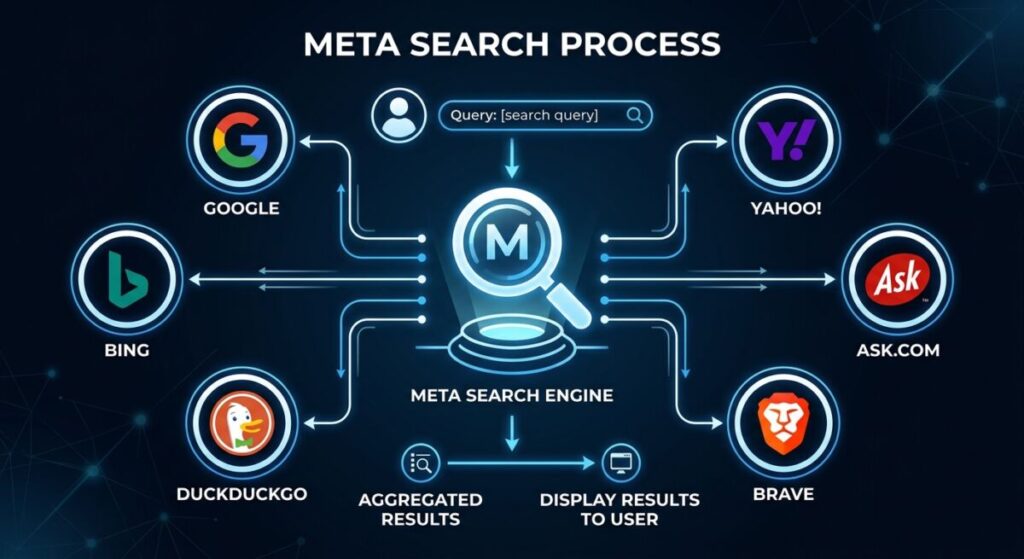
Meta search engines are different. They don’t crawl the web. Instead, they act as a middleman. When you type a query into a meta search engine, it sends that request to several traditional engines at once. It collects their results, cleans them up, and gives you a unified list. In our work at Infineural Technologies, we have found that meta search engines are often the best way to bypass the ‘filter bubbles’ created by big tech in 2026.
The Crawler vs. The Aggregator
Think of a traditional search engine as a chef who grows their own vegetables. They plant the seeds (crawling), harvest the crop (indexing), and cook the meal (ranking). They own the whole process. This gives them total control over the results. But it also means you only taste what that one chef thinks is good. If you are looking for more variety, check out our Top Search Engines List: 12 Best Platforms for Traffic (2026) to see the full variety available.
A meta search engine is more like a food delivery app. It doesn’t cook anything. It just looks at what five different restaurants are making and brings the best dishes to your door. It saves you time because you don’t have to visit five different sites. But it depends entirely on the quality of the ‘restaurants’ it pulls from. If Google and Bing are both having a bad day, the meta search engine will too.
Is one better than the other? Not necessarily. It depends on what you need. Traditional engines are great for deep, localized searches. Meta engines are better for broad overviews or when you want to see how different algorithms rank the same topic. Do you want to see the consensus or just one opinion?
How Traditional Search Engines Build an Index
Traditional engines spend billions of dollars on infrastructure. They need thousands of servers to store a copy of the internet. This process is called indexing. When you search on a traditional engine, you aren’t searching the ‘live’ web. You are searching their library of the web. This is why it takes time for new pages to show up. You have to wait for the spider to visit you. If you’re a site owner, you should submit your website to alternative search engines for free to speed this up.
In 2026, these spiders are smarter than ever. They don’t just look at keywords. They look at user intent, page speed, and even the ‘green’ credentials of your server. In fact, there are 7 surprising SEO benefits of hosting on a green server that many experts still ignore. These engines use complex math to decide who wins the top spot. It is a closed-door process that keeps SEO pros up at night.
The Inner Workings of a Meta Search Engine
Meta search engines use something called ‘Rank Fusion.’ Since they get results from multiple sources, they have to decide which one to show first. If Google says a page is #1 but Bing says it is #10, where does the meta engine put it? They use algorithms like the Borda Count to find a mathematical average. This often results in a more ‘neutral’ list of results.
They also have to handle deduplication. You don’t want to see the same Wikipedia article five times just because five different engines found it. Meta engines strip out the repeats. This gives you a cleaner, more condensed view of the internet. Many researchers prefer this. If you are doing deep work, you might want to look at top search engines for academic research beyond Google Scholar to see how meta-analysis helps.
But there is a catch. Meta search engines often lack the advanced features of traditional ones. You might not get the ‘rich snippets’ or the interactive maps you see on Google. They are built for speed and breadth, not necessarily for ‘instant answers’ like the modern AI-driven traditional engines we see in March 2026.
Privacy: The Hidden Driver of Meta Search in 2026
Why are people flocking to meta search engines lately? One word: Privacy. Traditional engines make money by tracking you. They build a profile of your interests and sell it to advertisers. Meta engines like Startpage or DuckDuckGo (in its meta capacity) act as a shield. They send your query to the big engines anonymously. The big engines see the query, but they don’t see *you*.
This is a big deal in 2026. Data privacy is no longer a niche concern. It is a mainstream demand. If you’re wondering which one to use, we did a deep dive on DuckDuckGo vs Startpage for privacy-conscious users. Using a meta engine is often the easiest way to get ‘Google-quality’ results without the ‘Google-quality’ tracking. It’s a win-win for most users.
But keep in mind, ‘free’ meta engines still need to pay the bills. They usually do this through contextual ads. These ads are based on what you searched for *right now*, not what you searched for three weeks ago. It is a much more ethical way to monetize. And honestly? The ads are usually less annoying.
Speed and Efficiency: A Real-World Comparison
Is a meta search engine slower? Technically, yes. It has to wait for multiple other engines to respond before it can show you the results. In 2026, we’re talking about milliseconds, but it’s there. Traditional engines are faster because they are pulling from their own local database. They don’t have to wait for anyone else.
However, the ‘efficiency’ of a meta search engine is higher. If you have to search three different sites to find a rare piece of information, that takes minutes. A meta engine does it in seconds. We see this often when clients are looking for rare data. If you’re searching for something specific, like best video search engines for finding rare content, a meta approach is almost always better.
Don’t let the millisecond delay fool you. The time you save by not hopping between tabs is much more valuable. For power users, meta search is the ultimate productivity hack. It simplifies the discovery process and cuts through the noise of biased algorithms.
The Role of AI in 2026 Search
By March 2026, AI has changed everything. Traditional engines are now ‘answer engines.’ They don’t just give you links; they give you paragraphs of text. This is great for simple questions, but it can be dangerous for complex ones. AI can hallucinate. It can be biased. It can present one perspective as the absolute truth.
Meta search engines provide a necessary check. By showing you results from multiple AI models and traditional indexes, they allow you to spot discrepancies. If three different engines give three different answers, you know you need to dig deeper. This ‘triangulation’ is the only way to stay informed in an AI-heavy world. We always tell our clients at Infineural Technologies: never trust a single source of truth online.
And let’s talk about SEO. If you want to rank in 2026, you can’t just optimize for one engine. You need to look at the broader picture. Meta engines show you the ‘consensus’ of the web. If you’re appearing in meta results, it means multiple algorithms have vetted your content. That is a very strong signal of authority. Want to know more? Check out these 11 hidden ranking factors for niche websites.
Which One Should You Choose?
So, which should you use? It’s not an either-or choice. Most savvy users in 2026 use both. Use traditional engines for local searches, shopping, and quick facts. Their integration with your local environment is hard to beat. If you need a plumber in your zip code, Google is your best bet.
Use meta search engines for research, privacy-sensitive topics, and when you feel like you’re stuck in an algorithmic bubble. If you feel like you’re seeing the same five websites over and over, switch to a meta engine. It will break the cycle. It will show you the parts of the web that the big algorithms might be hiding.
The web is too big for one engine to map perfectly. Even in 2026, with all our advanced AI, we still need variety. Diversity in search is just as important as diversity in news. Don’t let a single algorithm decide what you know. Experiment. Try new tools. You might be surprised at what you find.
Frequently Asked Questions
What is the main difference between a meta search engine and a traditional one?
Traditional engines crawl and index the web themselves, while meta engines aggregate results from multiple traditional engines.
Are meta search engines safer for privacy?
Yes, most meta engines act as a proxy, hiding your IP address and personal data from the major engines they query.
Does a meta search engine have its own database?
No, meta search engines do not store their own index of web pages; they rely on the indexes of other providers.
Why are traditional search engines faster?
They pull data from their own local servers rather than waiting for third-party APIs to respond with results.
Can I use meta search engines for SEO research?
Absolutely, they are excellent for seeing how different algorithms rank your site compared to your competitors.
Is Dogpile still a meta search engine in 2026?
Yes, Dogpile remains one of the oldest and most well-known meta search engines, still aggregating from Google and Yahoo.
Do meta search engines show different results than Google?
Yes, because they blend Google’s results with those from Bing, Yandex, and others, the final ranking order is unique.
Are meta search engines free to use?
Almost all meta search engines are free, supported by contextual advertising rather than invasive data tracking.
Take Control of Your Search Strategy
Understanding the difference between these tools is just the first step. In the fast-moving world of 2026, you need a search strategy that is as dynamic as the web itself. Whether you are looking to increase your site’s visibility or just find better information, diversification is key. At Infineural Technologies, we help brands navigate this complex world. We don’t just follow the trends; we anticipate them. Ready to see how your brand stacks up across the entire search ecosystem? Let’s build something better together. Reach out to us today to start your journey toward search mastery.