
The Real Difference Between Mainstream and Secret SEO Tools
Do you want to know a secret? Most SEOs are lazy. They log into a big-name tool, export a report, and think they have the whole story. But if you are using the same data as your competitors, how do you expect to beat them? You cannot. In 2026, the gap between standard data and actual insights is wider than ever.

Mainstream software like Ahrefs or Semrush is great for the basics. They give you a broad view of the market. But "secret" tools—specialized, often single-purpose utilities—give you the surgical precision needed to win. At Infineural Technologies, we have seen that the real growth happens when you stop following the crowd. It is about finding the data that others do not even know exists.
The bottom line? Mainstream tools are for maintenance, while secret tools are for growth. If you want to stay safe, stick to the big names. If you want to dominate your niche in 2026, you need to look where others are not looking. And that means moving beyond the shiny dashboards of the industry giants.
Why Big Brands Are Moving Away From All-In-One Platforms in 2026
Look at the biggest players in search today. They are not just checking keyword volumes. They are analyzing server logs in real-time. They are using AI to predict algorithm shifts before they happen. But mainstream tools are often slow to update. They have to serve millions of users, so they play it safe. They give you averaged data. And averages do not win races.
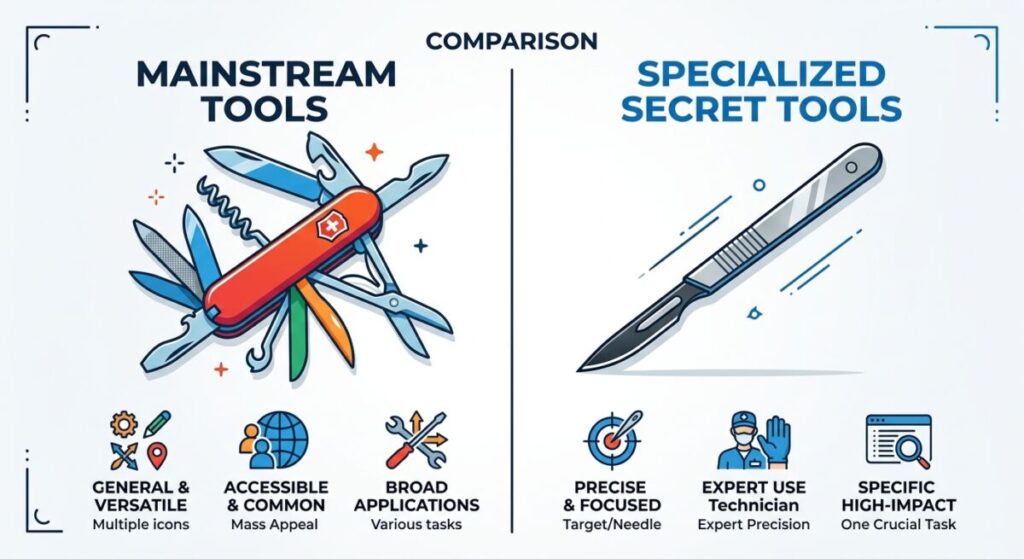
Secret SEO tools are different. They are often built by developers for their own use before being released to a small circle. They focus on one thing and do it better than anyone else. Think about it. Would you rather have a Swiss Army knife or a specialized scalpel when you are performing surgery on your site rankings? The scalpel wins every time. But you have to know how to use it.
And here is the kicker. Many of these "secret" tools are actually more affordable. You are not paying for a massive marketing budget or a fancy office in Silicon Valley. You are paying for raw data and high-performance code. But there is a catch. These tools usually have a steeper learning curve. You need to understand the fundamentals of search to make them work for you.
Inside the Secret SEO Toolbox: What the Pros Use Right Now
So, what are these tools? We are talking about custom scrapers, specialized cloud-based log analyzers, and niche entities-mapping software. These tools do not just tell you that a keyword is "hard." They tell you exactly which nodes in the knowledge graph you are missing. This is next-level stuff. You might even find some of these methods mentioned in our guide on 15 top interesting unknown facts SEO experts use to rank.
One of the biggest trends we see in March 2026 is the rise of "API-first" analysis. Instead of using a web interface, top-tier SEOs are pulling data directly from multiple sources and cleaning it themselves. Why? Because it removes the bias of the software provider. Every mainstream tool has its own way of calculating "Keyword Difficulty." But those formulas are often outdated or oversimplified.
But wait, does this mean you should delete your Semrush account? Not necessarily. Mainstream tools are still the best for quick site audits and basic rank tracking. They provide the "what." Secret tools provide the "why" and the "how." You need both to build a complete picture of your search performance in 2026.
The Mainstream Trap: Why Common Data Leads to Common Results
Here is a hard truth. If 10,000 people are looking at the same "easy" keyword list in a mainstream tool, that keyword is no longer easy. The competition increases instantly. This is the mainstream trap. By the time a keyword shows up as a "trend" in a major platform, the early adopters have already moved on. They have already captured the traffic.
How do you avoid this? You use tools that find "hidden" patterns. For example, some secret tools analyze user sentiment across decentralized platforms to predict search demand. Others look at patent filings from major search engines to see where the technology is heading. This is how you stay ahead of the curve. You do not wait for the data to come to you; you go and find it.
In our work at Infineural Technologies, we often find that the best opportunities are found in the "noise" that mainstream tools filter out. That low-volume keyword that Ahrefs says is "zero" might actually be driving thousands of dollars in revenue for a competitor. But you would never know if you only looked at the big-box software. And that is a huge mistake.
How to Spot a Secret SEO Tool Worth Your Time
Not every obscure tool is a goldmine. Some are just poorly built. So, how do you tell the difference? First, look at the data source. Does the tool have its own crawler, or is it just reselling data from a mainstream provider? If it is just a wrapper for a big-name API, it is not a secret tool. It is just a skin.
Second, check the frequency of updates. Search changes fast. If a tool hasn't been updated since 2025, it is probably useless in the 2026 market. You want tools that are actively being refined. Look for developers who are active in the community. They are usually the ones building the most innovative solutions.
But don't just take their word for it. Test it. Run a small experiment. Compare the findings of the new tool against your "source of truth." Does it show you something new? Does it find errors that your mainstream auditor missed? If the answer is yes, you have found a winner. It is that simple.
Integrating Niche Tools Into Your 2026 Strategy
You do not need fifty different tools. You just need the right ones. Start with your foundation—a solid mainstream platform for your daily checks. Then, add one or two specialized tools to solve specific problems. Maybe you need a better way to track hidden keyword opportunities or a tool that specializes in international SEO for the Asian market.
And remember, the tool is only as good as the person using it. You need to invest time in learning how to interpret the data. In 2026, the most successful SEOs are part-analyst and part-strategist. They do not just report numbers; they tell stories with data. They use these secret tools to build a narrative that proves their value to the business.
But what if you are on a budget? Many of these specialized tools offer "freemium" models or pay-per-use credits. This allows you to get high-end data without a massive monthly commitment. It is a great way to level the playing field against bigger competitors with deeper pockets. Use that to your advantage.
The Future of SEO Software: What is Next?
As we move through 2026, we expect to see even more fragmentation in the SEO tool market. The "all-in-one" model is struggling to keep up with the complexity of modern search. We are seeing tools that only focus on video SEO, or only on voice search optimization, or only on AI-driven content analysis. This is the future.
And it is an exciting time. We have more access to data than ever before. But with that comes the responsibility to use it wisely. Do not get distracted by "vanity metrics." Focus on the data that actually moves the needle for your business. Whether it comes from a mainstream giant or a secret startup, the goal is the same: results.
So, are you ready to look beyond the dashboard? Are you ready to find the secrets that your competitors are missing? The data is out there. You just have to be willing to find it. And once you do, you will never look at SEO the same way again.
Frequently Asked Questions
What are secret SEO tools? They are specialized, niche software applications that provide deep data insights that mainstream all-in-one platforms often miss. These tools usually focus on specific technical aspects like log analysis, entity mapping, or real-time API scraping.
Are secret SEO tools better than Ahrefs or Semrush? They are not necessarily better, but they are more focused and provide different data. Use mainstream tools for a broad overview and secret tools for specific, high-level tactical advantages.
How do I find these obscure SEO tools in 2026? Look in developer forums, follow technical SEO experts on social media, and attend niche search marketing conferences. Many of the best tools are shared through word-of-mouth in expert communities.
Are secret tools safe to use? Most are perfectly safe, but you should always vet the provider before giving them access to your Google Search Console or server logs. Stick to tools with positive reputations among technical SEO professionals.
Do secret tools cost more than mainstream software? Often they are cheaper because they have lower overhead and marketing costs. Many operate on a pay-as-you-go model rather than a high-priced monthly subscription.
Is it hard to learn how to use specialized SEO software? Yes, they often have a steeper learning curve because they lack the "user-friendly" interfaces of big-name brands. However, the depth of data they provide is worth the effort to learn.
Can I replace my mainstream SEO tool entirely? It is possible for very advanced users, but most businesses benefit from a hybrid approach. Keep your mainstream tool for reporting and use secret tools for your actual optimization work.
Why is everyone talking about API-first SEO in 2026? Because pulling raw data directly from APIs allows for more custom, unbiased analysis. It lets you combine data from multiple sources to find insights that no single tool can provide on its own.
Ready to take your search strategy to the next level? At Infineural Technologies, we specialize in finding the edges that others miss. Contact us today to see how we can help you outpace your competition with a custom, data-driven SEO strategy built for the 2026 market.