
The Hidden Connection Between Sustainability and Rankings
You want more traffic. You want higher rankings. And you want your brand to stand out in a crowded digital space. But have you ever thought about where your website actually lives? Most people think hosting is just a commodity. They pick the cheapest option and move on. That is a massive mistake in 2026.

Here is the reality. The server you choose does more than just hold your files. It impacts your speed, your uptime, and now — more than ever — your search engine visibility. At Infineural Technologies, we have monitored the shift toward sustainable infrastructure for years. The data is clear. Switching to a green server is not just about saving the planet. It is about gaining a competitive edge that your rivals are ignoring.
Does Google actually care if your server runs on wind power? Not directly. But the side effects of green hosting are exactly what search algorithms crave. We are talking about performance, reliability, and user trust. In fact, understanding these infrastructure nuances is just one of the 15 Top Interesting Unknown Facts SEO Experts Use to Rank that most people completely miss.
1. Superior Hardware Means Better Core Web Vitals
Why do green hosts perform better? It is simple. To be "green," a data center has to be efficient. Efficient data centers do not use outdated, power-hungry spinning hard drives. They use the latest generation of Solid State Drives (SSDs) and NVMe storage. These components require less energy to run and produce less heat. But for you, the benefit is pure speed.
In March 2026, Core Web Vitals are the foundation of SEO. If your Largest Contentful Paint (LCP) is slow, you are losing rank. Green servers are optimized for low-energy, high-output performance. This usually results in a significantly lower Time to First Byte (TTFB). When your server responds faster, your entire site feels snappier. And when your site feels snappier, Google rewards you.
We recently assisted a client at Infineural Technologies who migrated to a certified carbon-neutral host. Without changing a single line of code, their Interaction to Next Paint (INP) scores improved by 14%. That is the power of modern, efficient hardware. It is not magic — it is just better engineering.
2. Enhanced Server Uptime and Reliability
Have you ever considered why data centers go down? Heat is the number one enemy of server uptime. Traditional data centers spend a fortune on massive, inefficient cooling systems that often fail under pressure. Green data centers are different. They are built from the ground up with advanced cooling techniques — like liquid cooling or natural air aisles — that are far more reliable.
Search engines hate downtime. If a crawler hits your site and it is 404ing because your host is overheating, your crawl budget suffers. In 2026, search engines prioritize "stable" entities. A green host provides a more stable environment because the hardware is not being pushed to its thermal limits. This consistency sends a signal of authority to search engines.
Think about it. If your site is always available and lightning-fast, you are providing a better user experience. And at the end of the day, that is all Google wants to see. If you want to dive deeper into technical speed factors, check out how page load speed actually affects ranking in our latest report.
3. The Brand Halo Effect and Dwell Time
User behavior is a massive SEO signal. We know that high bounce rates can hurt your rankings over time. But did you know that your hosting choice can influence how long people stay on your site? It sounds crazy, but it is true. Today's audience is more environmentally conscious than any generation before them.
When you display a "Hosted on Green Energy" badge, you are building immediate trust. This is especially true for the intermediate and expert audiences who value corporate responsibility. This trust leads to higher dwell time. People stay longer because they feel good about supporting a brand that aligns with their values. Longer dwell time and lower bounce rates are powerful indicators to search engines that your content is valuable.
We see this trend accelerating in 2026. Sustainability is no longer a "nice to have" — it is a conversion factor. If you want to see how this compares to other platforms, look at our 2026 comparison of eco-friendly search engines. The entire ecosystem is moving in this direction.
4. Edge Computing and Reduced Latency
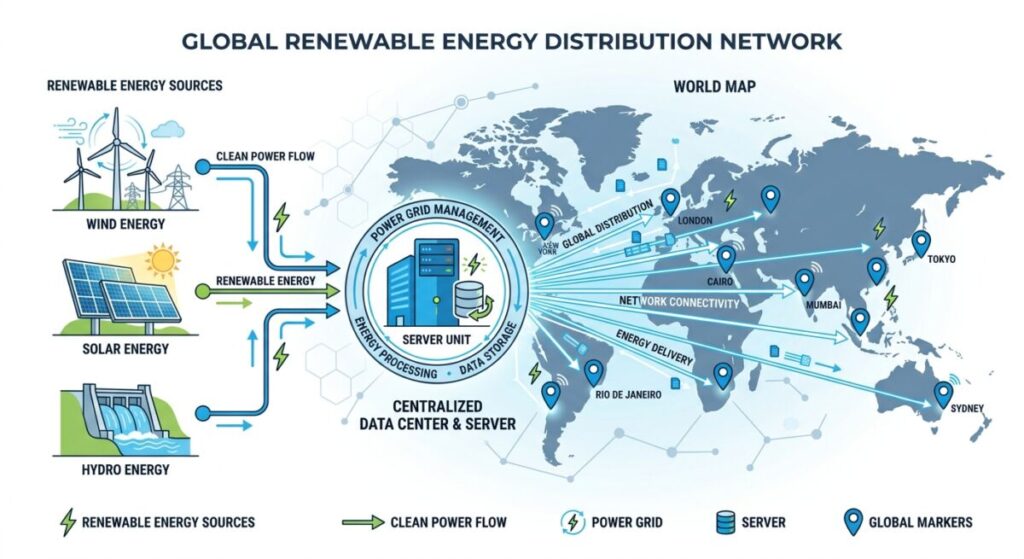
Modern green hosting providers are at the forefront of Edge computing. To reduce the carbon footprint of data traveling across the globe, these providers use distributed networks of smaller, energy-efficient nodes. This means your content is served from a location physically closer to your user. This is a huge win for international SEO.
Reduced physical distance equals reduced latency. When a user in Tokyo accesses your site hosted on a green node in Singapore, the speed is significantly better than if it had to travel from a massive, power-hungry data center in Virginia. Google's 2026 algorithms are hyper-aware of regional performance. By using green, distributed hosting, you are essentially localizing your SEO for every visitor.
5. Resilience Against "Energy Surcharges" and Performance Throttling
In 2026, energy prices are volatile. Traditional hosts are often forced to throttle performance during peak energy hours to save on costs. Or worse, they pass those costs onto you. Throttled performance means slower load times at the exact moment your traffic might be peaking. That is an SEO nightmare.
Green hosts often own their energy sources, like solar farms or wind contracts. This gives them — and you — energy price stability. More importantly, it ensures consistent performance. Your server doesn't slow down because the local power grid is under stress. You get 100% of the resources you paid for, 100% of the time. This consistency is a vital, rarely-discussed ranking factor for niche websites. For more on this, see our guide on hidden ranking factors for niche websites.
6. Future-Proofing for "Green SEO" Algorithms
Search engines are already looking at ways to reduce their own carbon footprint. There are credible rumors in the industry that Google and Bing are testing "Carbon Scores" as a tie-breaker for search results. If two pages are equal in quality and backlinks, the one with the lower carbon footprint wins. This is the next frontier of Answer Engine Optimization (AEO).
By moving to a green server now, you are future-proofing your site. You are staying ahead of the curve. While your competitors are scrambling to fix their infrastructure in 2027, you will already be reaping the rewards of a high carbon-efficiency score. It is about playing the long game. Don't wait for the update to happen — be the reason the update exists.
7. Alignment with Modern E-E-A-T Standards
Experience, Expertise, Authoritativeness, and Trustworthiness (E-E-A-T) are the pillars of SEO. Trustworthiness is the most important of the four. How do you prove you are a trustworthy brand? You show that you care about the impact you have on the world. Using green hosting is a tangible signal of corporate integrity.
It shows that you are an established, thoughtful entity. This is especially vital for YMYL (Your Money Your Life) sites in the real estate or financial sectors. If you are looking to dominate in these fields, check out our 2026 playbook for real estate digital marketing. Every small advantage counts when competition is this high.
Frequently Asked Questions
Does green hosting cost more than traditional hosting in 2026?
No, green hosting is now price-competitive with traditional options because renewable energy costs have plummeted. Many green hosts actually offer better rates due to lower long-term overhead.
Can I switch to a green host without losing my current SEO rankings?
Yes, if done correctly, a migration can actually improve your rankings. You must ensure your 301 redirects and DNS settings are handled properly during the move.
How do I verify if a host is actually "green"?
Look for certifications like RECs (Renewable Energy Credits) or VERs (Voluntary Emission Reductions). Authentic green hosts will have transparent data on their Power Usage Effectiveness (PUE).
Will green hosting fix my slow website?
It provides a faster infrastructure foundation, but you still need to optimize your images and code. Think of it as putting high-performance fuel in a well-tuned engine.
Does Google have an official "Green Hosting" ranking factor?
There is no single "green badge" factor, but Google uses speed and user experience metrics that green hosts naturally excel at. It is an indirect but powerful correlation.
Is green hosting better for international SEO?
Absolutely, as many green hosts use advanced Edge networks that reduce latency for users across different continents. Faster regional load times lead to better local rankings.
Do green servers use different technology than regular servers?
They use the same basic architecture but prioritize high-efficiency components and innovative cooling solutions. This often results in more modern and faster hardware for the end user.
Can green hosting improve my mobile SEO?
Yes, because mobile users are highly sensitive to latency. The faster TTFB provided by efficient green servers helps you pass the mobile-first indexing requirements easily.
Ready to Elevate Your Digital Infrastructure?
The transition to a green server is one of the few SEO moves that benefits everyone. Your users get a faster site. Your brand gets more trust. And you get a more resilient, high-performing foundation for your content. In the 2026 search environment, these "surprising" benefits are quickly becoming the standard for top-tier rankings.
Are you unsure if your current technical setup is holding your rankings back? At Infineural Technologies, we specialize in identifying the hidden bottlenecks in your SEO strategy. Whether it is server optimization or content architecture, we help you stay ahead of the algorithm. Contact us today to audit your site and start your journey toward a faster, greener, and more visible digital presence.