Stop Relying on Google Scholar for Everything
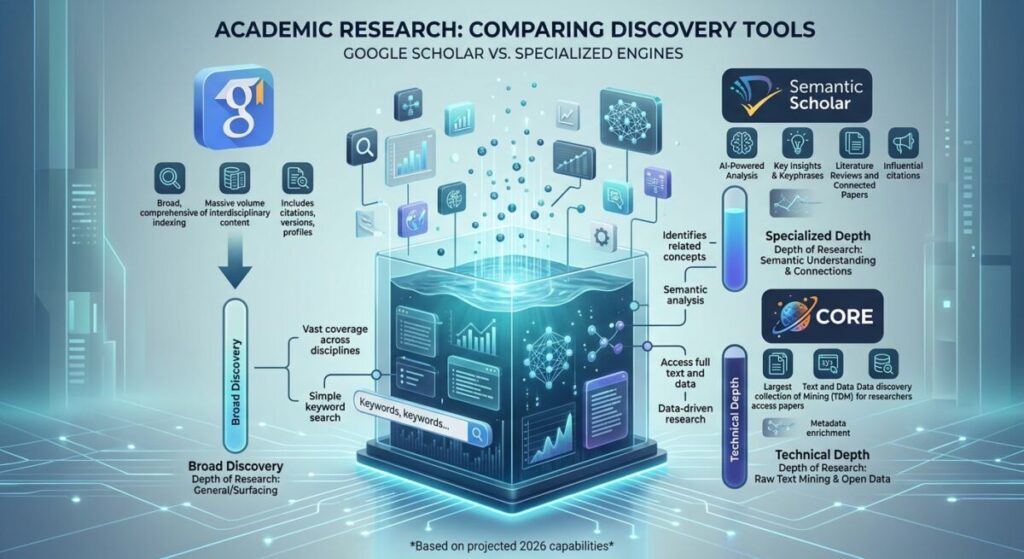
Seriously. It is a great tool, but it is not the only game in town anymore. In 2026, the academic world moves too fast for one single index. You need specialized tools that actually understand context. Google Scholar is often too broad—it pulls in everything from high-level peer-reviewed papers to random PDF uploads from college freshman. That is a problem when you need precision. At Infineural Technologies, we have found that high-level content requires high-level sourcing. If you want to stand out, you need better data than your competitors.

Why does this matter? Because your citations are your foundation. If the foundation is weak, the whole house falls. And let us be honest—Google Scholar misses a lot of the deep web stuff. If you are doing serious research, you need to look elsewhere. You need engines that use semantic AI to find connections between papers. You need tools that filter by methodology. This guide will show you exactly what to use.
The Shift to Semantic Search in 2026
Search has changed. It is no longer just about matching keywords. It is about intent. Modern academic engines now use Large Language Models (LLMs) to read papers for you. They do not just give you a list of titles; they give you answers. But you have to know which ones to trust. We have tested dozens of platforms this year to see which ones actually deliver. Most of them are just hype. A few of them are absolute gold mines for data. If you are looking for the top search engines list for 2026, you will see how the broad market is shifting toward these specialized niches.
1. Semantic Scholar: The AI Powerhouse
Do you want an engine that actually understands what a paper is about? Semantic Scholar is my top pick. It uses artificial intelligence to identify the most important papers in a field. It does not just look at how many times a paper was cited. It looks at *how* it was cited. Was it a passing mention? Or was the entire study built on that previous research? That is a huge difference. In our work at Infineural Technologies, we use these influence scores to find the real thought leaders in any industry. It saves hours of digging through fluff.
And the best part? It is free. The interface is clean. It does not feel like a library catalog from 1995. It feels like a modern tool for modern researchers. If you are not using it, you are working too hard. Semantic Scholar helps you find the "seminal" works that everyone else is ignoring. It is the secret weapon for anyone who needs to prove a point with data that actually holds up under scrutiny.
2. Consensus: The Answer Engine
This is where things get interesting. Consensus is an AI search engine that only searches through peer-reviewed research. You ask it a question. It gives you a consensus of what the science says. For example, you might ask, "Does caffeine improve cognitive function in adults?" Instead of a list of links, it gives you a summary of the findings across hundreds of papers. According to data from early 2026, Consensus has indexed over 210 million academic papers. That is massive coverage.
But do not just take its word for it. Always click through to the primary source. But the speed? It is unmatched. You can get a high-level overview of a complex topic in seconds. This is how you build authority fast. It removes the guesswork from academic research. You are no longer hunting for a needle in a haystack; the engine is handing you the needle.
3. CORE: The Open Access King
If you hate paywalls, you will love CORE. It is the world’s largest aggregator of open-access research papers. We are talking about millions of full-text articles that you can read for free. No subscriptions. No "requesting a copy from the author." Just pure data. CORE links directly to the repositories of universities and research institutions globally. It is an essential stop if you are looking for global perspectives that might not make it into the big American journals.
Why settle for a snippet when you can have the whole study? CORE makes sure you have the full context. And in 2026, context is everything. If you are trying to search privately while accessing these papers, CORE is a great place to start your journey. It is transparent and wide-reaching.
4. Elicit: The Research Assistant
Elicit is not just a search engine. It is a workflow tool. It helps you automate the tedious parts of research. You can upload your own PDFs, and it will summarize them. It will find other papers that are similar to the ones you already like. It is like having a PhD student working for you 24/7. We have found that Elicit is particularly good at extracting specific data points from tables within papers. That is a task that used to take hours of manual labor.
But here is the catch. You still need to be the expert. AI can summarize, but it can't think for you. Use Elicit to gather the raw materials, but do the building yourself. Elicit is the ultimate force multiplier for content creators and serious students alike. It turns a week of research into an afternoon of work.
5. Dimensions.ai: The Big Data Giant
Dimensions is what happens when you turn academic search into a massive data visualization tool. It goes beyond just papers. It includes grants, patents, and clinical trials. This gives you a much broader view of the "lifecycle" of an idea. You can see who is funding the research. You can see how that research turned into a product. That is the kind of insight that wins arguments and builds world-class content.
In March 2026, Dimensions updated its interface to include even more real-time tracking of research trends. It is a bit more complex than Google Scholar. But the depth is worth the learning curve. If you want to know where the money is going in any field, this is where you look. Knowledge is power, but knowing who paid for that knowledge is even more powerful.
6. BASE (Bielefeld Academic Search Engine)
BASE is operated by Bielefeld University Library in Germany. It is one of the most voluminous search engines in the world. They are extremely picky about what they index. You are not going to find junk here. About 60% of the indexed documents in BASE are open access. This makes it a fantastic alternative to the more commercialized engines. It provides very specific filtering options that Google Scholar simply lacks. You can filter by document type, author, or even the specific repository it came from.
Is it pretty? No. Is it effective? Absolutely. Sometimes you do not need a flashy AI interface. Sometimes you just need a powerful index that respects the hierarchy of academic data. BASE is for the purists. It is for when you need to be 100% sure you are looking at a verified academic source.
7. WolframAlpha: For the Hard Numbers
Okay, this one is a bit different. WolframAlpha is a computational intelligence engine. It does not give you a list of documents. It gives you computed answers. If you need to know the exact statistical distribution of a population or the chemical properties of a compound, this is your tool. It uses a massive internal database of "curated" data. In our research at Infineural Technologies, we use WolframAlpha to double-check the math in third-party studies.
Don't trust every chart you see on social media. Run the numbers yourself. WolframAlpha makes that possible. It is the "fact-checker" for the scientific world. If the data is computable, WolframAlpha can find it. It is a must-have in your research stack if you want to be taken seriously as an expert.
8. Science.gov: The Official Source
Do you want to know what the U.S. government is researching? Science.gov is a gateway to over 60 databases and 2,200 scientific websites. It covers research from NASA, the NIH, and the Department of Energy. This is often the most current data available on topics like climate change, space exploration, and public health. Because it is government-funded, the data is usually very high quality and free to access.
But be warned—government websites can be clunky. You have to be patient. But the rewards are worth it. You are getting information directly from the source. Science.gov provides an level of authority that is hard to match with private search engines. It is the gold standard for official scientific data in 2026.
9. ResearchGate: The Social Network for Scientists
Think of ResearchGate as LinkedIn for academics. It is where researchers post their work, share data, and collaborate. The "search" aspect is great because you can often find "pre-prints"—papers that have not even been published in a journal yet. This gives you a massive head start on everyone else. You can also see the discussions happening around a paper. This is where you find the "interesting unknown facts" that experts use to rank their ideas above the noise. Check out our list of unknown facts SEO experts use for more on this kind of data mining.
But remember, ResearchGate is a social platform. Not everything there is peer-reviewed. Use it to find the *people* behind the research. Send them a message. Ask for their data. You would be surprised how many scientists are happy to share their work if you just ask nicely.
10. JSTOR: The Reliable Archive
JSTOR is the old reliable of the academic world. It is a digital library of academic journals, books, and primary sources. It is particularly strong in the humanities and social sciences. While many newer engines focus on "the latest" research, JSTOR is where you go for the historical context. You can find papers dating back decades or even centuries. In 2026, JSTOR has expanded its "Register & Read" program, allowing individuals to access more content for free than ever before.
Why does history matter? Because trends are cyclical. If you want to predict where an industry is going, you have to know where it has been. JSTOR provides the depth that AI-driven snippets lack. It is the place for deep, contemplative research that builds true expertise.
How to Build Your 2026 Research Stack
Don't just pick one. Use a combination. Start with Consensus to get the general "vibe" of the scientific community. Then, move to Semantic Scholar to find the most influential papers. Finally, use CORE or BASE to find the full-text versions so you can read the methodology yourself. This is how you produce content that is "AI-resistant." Why? Because you are doing the work that a basic prompt can't replicate.
And if you are struggling with your own site's performance while doing this research, you might need to optimize your WordPress site to handle the heavy lifting. Fast research is great, but a fast website is what keeps your readers around once they see your amazing data.
FAQ: Academic Research in 2026
Is Google Scholar still relevant in 2026? Yes, it is still a massive index, but it lacks the advanced AI filtering and semantic understanding of newer tools. Use it as a starting point, not your only source.
Which academic engine is best for free full-text papers? CORE and BASE are your best bets, as they focus specifically on aggregating open-access research from around the world.
Can I trust AI-generated summaries of research? You should use them for speed, but always verify the actual data in the original paper before citing it. AI can still "hallucinate" specific numbers.
What is the best engine for finding patents and grants? Dimensions.ai is the leader in this space, offering a broad view of the entire research and development lifecycle.
Are there search engines for non-English academic papers? BASE is excellent for this, as it pulls from thousands of international repositories beyond just the major English journals.
How do I find research that hasn't been published yet? ResearchGate and SSRN are the primary places where researchers share pre-prints and works-in-progress.
Is JSTOR free to use now? JSTOR offers a significant amount of free content through their "Register & Read" program, though some content still requires institutional access.
How can I stay updated on new research in my niche? Set up alerts in Semantic Scholar or use Elicit to follow specific topics; they will notify you when new, relevant papers are indexed.
Take Your Content to the Next Level
Research is the difference between a blog post that gets ignored and a piece of content that builds an empire. If you want to dominate your niche in 2026, you cannot afford to be lazy. You need the best data, the best sources, and the best strategy. At Infineural Technologies, we help brands turn complex data into compelling stories that rank. Ready to stop guessing and start growing? Let us build your authority together.