The Dark Mode Phenomenon: Why It Matters Now
Ever wonder why you find yourself scrolling through your favorite apps at 2 AM without even realizing it? It is not just the content. It is the color. Or rather, the lack of it. By March 2026, dark mode has moved from a trendy toggle to a default expectation for over 85% of mobile users. But here is the big question. Does this shift actually change how people interact with your site? And more importantly, does Google care?

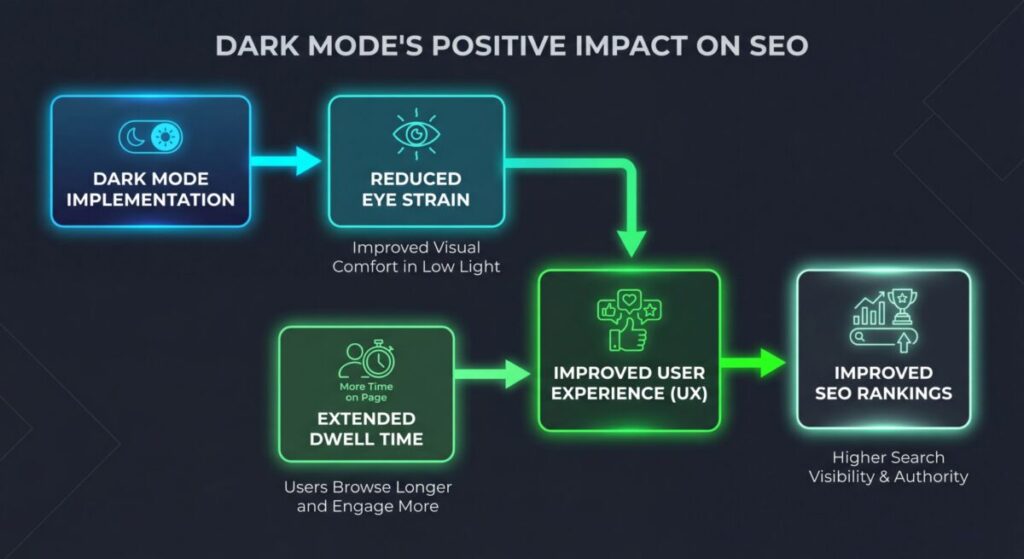
Look, I have spent years analyzing how small design tweaks move the needle on search rankings. Most people think dark mode is just about saving battery life or looking cool. They are wrong. There is a deep, psychological connection between dark interfaces and user retention. When you get it right, your dwell time skyrockets. When you get it wrong, your bounce rate kills your rankings. In our work at Infineural Technologies, we have seen that dark mode implementation is now a significant factor in how users perceive brand authority.
But before we get into the technical weeds, you need to understand the baseline. If you want to see how this fits into the bigger picture of search, check out these 15 Top Interesting Unknown Facts SEO Experts Use to Rank. It covers the foundation of what we are discussing today. Dark mode is just one piece of a much larger puzzle involving user psychology and technical execution.
How Dark Mode Hijacks User Behavior
Why do people love dark mode so much? It is simple. Eye strain is real. In 2026, the average person spends over nine hours a day looking at screens. Bright white backgrounds are like staring into a lightbulb. It is exhausting. Dark mode flips the script. It uses light text on a dark background, which reduces the overall luminance of the screen. But here is the kicker. This reduction in light does more than just save your eyes. It changes how you process information.
Studies show that users in dark mode tend to scan content more slowly. Why? Because the contrast between the text and the background is softer. On a white background, your eyes are constantly fighting the glare. This leads to "skimming" behavior. But on a dark background, the eyes relax. This relaxation leads to higher comprehension and longer session durations. And we all know what happens when session durations go up. Google notices. They see that users are actually consuming your content rather than bouncing after three seconds.
Think about the last time you read a long-form article. Was it easier on a bright white screen or a soft charcoal one? Most people choose the latter. But you have to be careful. If the contrast is too low, you end up with the opposite effect. Users will squint, get frustrated, and leave. You need to hit that sweet spot of accessibility. This is why understanding 11 Hidden Ranking Factors for Niche Websites is so vital. It is these small, user-centric details that define winners in 2026.
The Direct Connection to SEO and Core Web Vitals
You might be asking, "Neil, how does a color scheme actually affect my SEO?" It is not a direct ranking factor like a backlink, but its impact on your Core Web Vitals (CWV) is massive. Let us talk about Largest Contentful Paint (LCP). In 2026, LCP is still the king of speed metrics. Many developers make a huge mistake. They use heavy JavaScript to detect user system preferences and then swap CSS files. This causes a delay. It causes a flash of unstyled content. That flash ruins your user experience and hurts your LCP score.
But there is a better way. By using the `prefers-color-scheme` CSS media query, you can deliver the right theme instantly. No JavaScript required. This keeps your site fast. And speed is everything. We know that page load speed actually affects ranking in ways most people do not even realize. If your dark mode implementation slows down your site by even 200 milliseconds, you are losing money. It is that simple.
And then there is the OLED factor. By 2026, nearly every high-end smartphone uses an OLED screen. These screens don’t just display black; they turn off the pixels entirely. This means dark mode literally saves battery life for your users. If your site is "battery-friendly," users are more likely to stay on it while they are on the go. They won’t feel that anxiety of watching their battery percentage drop while reading your 3,000-word guide. That leads to more shares, more bookmarks, and more return visits.
Psychology of Dark Mode: Trust and Perception
Does color affect trust? Absolutely. In the digital marketing world, we have known for a long time that blue builds trust and red creates urgency. But what about dark themes? In 2026, dark mode is associated with premium brands. Think about it. Netflix, Spotify, Steam—they all use dark interfaces by default. It feels high-end. It feels modern. When a user lands on a site that has a beautifully executed dark mode, they subconsciously associate it with quality.
But wait. You can’t just slap a black background on everything. You have to think about visual hierarchy. In light mode, we use shadows to create depth. In dark mode, shadows don’t work the same way. You have to use "elevation" through different shades of gray. The closer an element is to the user, the lighter the gray should be. This creates a sense of space. If your site feels flat or cluttered in dark mode, users will feel claustrophobic. And a claustrophobic user is a user who clicks the back button.
I always tell my clients at Infineural Technologies that SEO is about more than just keywords. It is about the emotional response your site triggers. If your dark mode makes a user feel like they are using a cutting-edge tool, they will stay. They will interact with your Call to Action (CTA). They will convert. And those conversion signals are exactly what Google uses to determine if you deserve that top spot in the Search Engine Results Pages (SERPs).
Technical Implementation: Doing It the Right Way
So, how do you actually build this without breaking your site? First, forget about toggles that require a page reload. That is old school. Your site should automatically detect the user’s system setting. But you should also provide a manual override. Why? Because some people prefer light mode even at night. Giving users control is a massive usability win. And usability is a core tenet of modern SEO.
Use CSS variables. This is the secret sauce. Instead of hard-coding colors like `#ffffff` or `#000000`, use variables like `–bg-color` and `–text-color`. This makes it incredibly easy to manage your themes. It also reduces the size of your CSS file. Smaller files mean faster load times. Faster load times mean better rankings. It is a virtuous cycle.
Also, pay attention to your images. A bright, vibrant photo that looks great on a white background might be blinding on a dark one. Consider using a CSS filter to slightly dim images when dark mode is active. This keeps the visual experience consistent. It prevents that "visual shock" that happens when a user scrolls from a dark text block to a bright white image. Small details like this separate the amateurs from the pros.
The 2026 SEO Forecast: Dark Mode and Generative Search
As we look at the search landscape in March 2026, Generative Engine Optimization (GEO) is the new frontier. AI-powered search engines are looking for content that provides the best user experience. They aren’t just reading your text; they are simulating the user journey. If an AI agent sees that users spend significantly more time on your site’s dark version than a competitor’s light version, it will prioritize you. Why? Because the AI’s goal is to satisfy the user.
We are seeing a trend where "Accessibility-First" design is becoming a primary ranking signal. Dark mode is a huge part of that. It caters to users with light sensitivity and visual impairments. By making your site accessible to everyone, you are widening your net. You are capturing traffic that your competitors are ignoring. That is how you win in a crowded market. You don’t just do what everyone else is doing. You do it better.
And don’t forget about social signals. Dark mode screenshots are much more common on platforms like X (formerly Twitter) and LinkedIn in 2026. They look cleaner. They stand out in a feed. If your site looks great in a dark mode screenshot, you are more likely to get those organic mentions. And organic mentions lead to brand searches. Brand searches are the ultimate SEO gold mine.
Common Mistakes to Avoid
Don’t fall into the trap of using pure black (`#000000`). It is too harsh. Most experts recommend a dark gray or a very dark navy blue. Pure black can cause "halation," where the white text appears to glow or bleed into the background for some users. This makes reading difficult. Always test your contrast ratios. The Web Content Accessibility Guidelines (WCAG) suggest a ratio of at least 4.5:1 for normal text. In 2026, I recommend aiming for 7:1 just to be safe.
Another mistake? Neglecting your logo. If your logo has a dark background or dark text, it might disappear in dark mode. You need a version of your logo that works for both themes. Or better yet, use an SVG logo where you can change the fill colors with CSS. This keeps your branding sharp regardless of what theme the user chooses. Branding is trust. Trust is SEO.
Lastly, don’t ignore your ads. If you are using Google AdSense or affiliate banners, make sure they don’t look like sore thumbs in dark mode. Many ad networks now offer dark-themed units. Use them. A bright white ad on a dark page is the fastest way to get someone to close the tab. It feels like an intrusion rather than a recommendation. If you want to keep your dwell time high, the ads must blend in.
Frequently Asked Questions
Does dark mode directly improve Google rankings?
No, it is not a direct signal, but it improves dwell time and Core Web Vitals, which are major ranking factors. By enhancing the user experience, you indirectly signal to Google that your site is high-quality.
Is dark mode better for battery life?
Yes, on OLED and AMOLED screens, dark mode significantly reduces power consumption because black pixels are essentially turned off. This allows users to stay on your site longer without worrying about their battery.
Should I make dark mode the default for my website?
The best approach is to respect the user’s system settings using CSS media queries. This ensures the site matches the user’s current preference automatically.
What is the best background color for dark mode?
Avoid pure black and instead use dark grays like #121212 or #181818. These colors provide better contrast without causing the "halation" effect that makes text hard to read.
How does dark mode affect conversion rates?
When done correctly, it can increase conversions by reducing eye fatigue and creating a more "premium" feel. However, poor contrast can frustrate users and lead to lower conversion rates.
Does dark mode help with accessibility?
Yes, for users with photophobia or certain visual impairments, dark mode is much easier to navigate. Following WCAG contrast guidelines is essential for a truly accessible site.
Can dark mode affect my site’s bounce rate?
Absolutely, as a site that doesn’t offer a comfortable viewing experience in low-light environments often sees a higher bounce rate. Providing a dark option keeps users engaged longer during evening hours.
What are the technical requirements for dark mode in 2026?
Use the CSS `prefers-color-scheme` media query and CSS variables to handle theme switching efficiently. This method ensures fast load times and a seamless user experience without heavy JavaScript.
Final Thoughts: The Future is Dark (And That Is Good)
Dark mode is not a fad. It is a fundamental shift in how we consume digital content. As we move further into 2026, the websites that win will be the ones that prioritize the physical and psychological comfort of their users. By implementing a high-quality dark mode, you are doing more than just following a trend. You are optimizing for humans. And when you optimize for humans, Google rewards you.
Ready to take your SEO to the next level? Don’t leave your user experience to chance. At Infineural Technologies, we specialize in building high-performance, SEO-optimized digital experiences that convert. Whether you need a full site audit or a custom dark mode strategy, we are here to help. Reach out to us today and let us help you dominate the SERPs in 2026.