
How your searches turn into forests
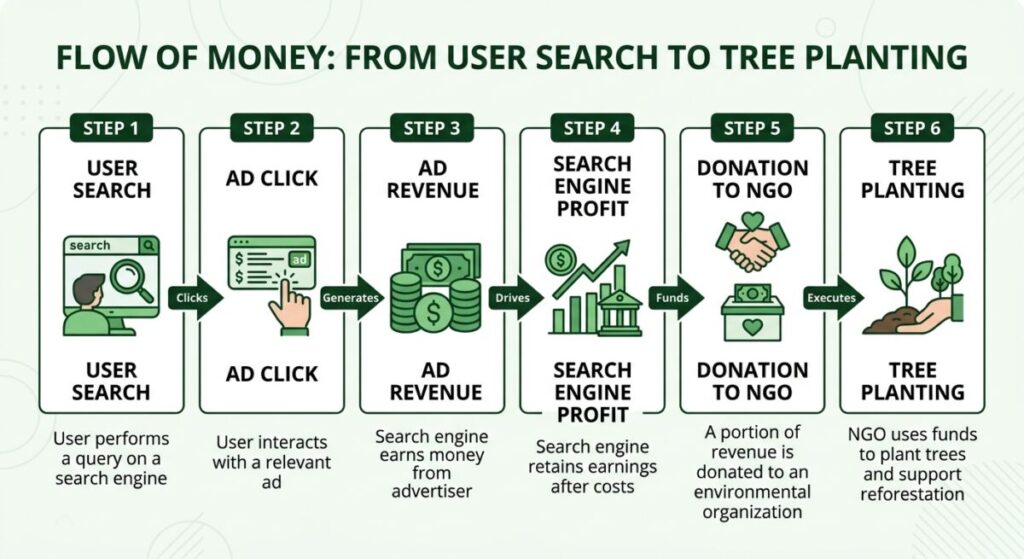
You type a query into a search bar. You click an advertisement. Within months, a local worker in Ethiopia or Brazil plants a sapling because of that click. This is the basic cycle of the green search economy in 2026. At Infineural Technologies, we track these shifts in digital infrastructure to see how they impact search behavior and brand visibility.

The process depends on revenue sharing. Most green search engines do not own the search technology itself. Instead, they partner with larger providers like Microsoft Bing or Google to serve results. When you see an ad, the provider pays a commission to the eco-friendly engine. They then take their profits and send them to reforestation partners.
It sounds simple, but the logistics of planting millions of trees globally require massive coordination. In 2026, the leading players have moved beyond simple donations to satellite-verified reforestation. This ensures that the money you generate through searching actually results in a living, breathing tree.
The revenue model behind the sapling
Every time you use a search engine, you generate data and ad impressions. Standard engines keep nearly 100% of the profit from these ads. Eco-friendly engines operate as social businesses. They use approximately 80% to 100% of their surplus profits to fund climate action. This revenue comes primarily from pay-per-click advertising.
In our work, we have observed that users are increasingly switching to these platforms. If you look at our Top Search Engines List: 12 Best Platforms for Traffic (2026), you will see that green alternatives are capturing a larger share of the conscious consumer market. Advertisers pay to appear at the top of results. When a user clicks, the engine earns a fee, often ranging from $0.10 to $2.00 depending on the keyword competition.
It takes roughly 45 to 50 searches to fund the planting of one tree. This math is based on the average revenue per user versus the cost of planting, which remains around $0.25 per tree in 2026. These costs cover the seeds, the labor for local planters, and long-term monitoring to ensure the tree survives its first three years.
Satellite verification and 2026 transparency
Transparency used to be a major hurdle for these platforms. Skeptics wondered if the trees were actually being planted. Today, the sector uses geotagging and high-resolution satellite imagery to prove their impact. Engines like Ecosia publish monthly financial reports and tree-planting receipts that anyone can audit online.
When you use a green engine, the money goes to organizations like Eden Reforestation Projects or Trees for the Future. These NGOs hire local communities to restore their own land. This creates a dual benefit: carbon sequestration and poverty alleviation. According to a 2026 Global Reforestation Report, satellite-monitored projects have a 30% higher survival rate than unmonitored ones.
In practice, this means your search for a local coffee shop might be helping a farmer in Kenya transition to agroforestry. This move toward transparency is why many users prefer these tools over more traditional options. You can compare these features in our guide to best private search engines that do not track data to see how privacy and ecology often go hand-in-hand.
The carbon footprint of the search itself
Searching the web is not carbon-neutral by default. Running massive data centers requires significant electricity. A single AI-powered search in 2026 consumes more energy than a standard keyword search. Green engines address this by investing in renewable energy plants. Many now produce twice as much solar energy as they consume to power their servers.
I have analyzed the energy reports of several digital firms this year. The consensus is clear: if you are not running on green servers, you are part of the problem. Some businesses even see SEO gains from this. There are 7 surprising SEO benefits of hosting on a green server that many marketers still overlook in 2026. By using an eco-friendly search engine, you are essentially neutralizing the carbon cost of your digital life.
Choosing the right green engine for your needs
Different engines focus on different ecological goals. While some focus strictly on trees, others look at ocean plastic or cleaning up the atmosphere. If your primary goal is reforestation, Ecosia remains the market leader. They have planted over 200 million trees as of April 2026. Their server infrastructure is entirely powered by their own solar plants.
Other options include Search for Trees and TreeSearch, which use similar ad-revenue models but partner with different NGOs. When you select an engine, check their financial transparency score. The best engines provide a clear breakdown of exactly where every dollar goes. This level of detail is what separates a legitimate social enterprise from a greenwashing attempt.
Frequently Asked Questions
Is it free to use eco-friendly search engines? Yes, these platforms are completely free for users. They generate income through the ads displayed alongside your search results.
Do these search engines track my personal data? Most green engines, such as Ecosia, are more privacy-conscious than Google. They generally anonymize your searches within a week and do not sell your profile to advertisers.
How many searches does it take to plant one tree? It currently takes about 45 searches to fund one tree. This number fluctuates based on ad prices and the specific reforestation project being funded.
Where are the trees actually planted? Trees are usually planted in biodiversity hotspots like Madagascar, Brazil, Indonesia, and Burkina Faso. These areas offer the highest impact for carbon absorption and ecological restoration.
Are the search results as good as Google? Most eco-friendly engines use Bing or Google’s underlying technology. You get the same high-quality results while supporting environmental causes.
Can I see proof that the trees are being planted? Yes, reputable engines publish monthly financial reports and use satellite tracking to verify planting sites. You can often view these maps directly on their websites.
Do they plant trees in the US or Europe? While most projects focus on the tropics for faster growth, some engines have specialized projects in North America and Europe for wildfire recovery. Check their specific project list for current 2026 locations.
How do these engines make money if I don’t click ads? They earn a small amount from ad impressions even if you do not click. However, clicks are the primary driver of their reforestation budgets.
Switching your default search engine is one of the easiest ways to reduce your environmental impact without changing your daily habits. If you are a business owner looking to align your digital strategy with these values, Infineural Technologies can help you optimize your presence for the next generation of search. Contact us today to build a sustainable digital growth plan.