
The Bottom Line Up Front
If you want to plant trees while you browse in 2026, Ecosia remains the undisputed heavyweight champion because of its massive infrastructure and transparent financial reporting. However, newcomers like Search For Trees and TreeSprout are gaining ground by offering better search accuracy through updated 2026 API integrations. Most of these platforms use ad revenue to fund reforestation, meaning your everyday searches directly combat deforestation without costing you a cent.
But which one should you actually use? It depends on whether you value search depth, privacy, or the specific type of environmental impact you want to make. In our work at Infineural Technologies, we have seen a massive shift toward ethical digital consumption as users move away from traditional data-hungry giants. Let us look at how these green alternatives stack up right now.
The Current State of Green Search in 2026
Look, I get it. You are busy. You want to save the planet, but you do not want to sacrifice the quality of your search results. Is that too much to ask? I do not think so. By March 2026, the technology behind eco-friendly search has evolved significantly. We are no longer just looking at basic wrappers for Bing or Google. These platforms are now carbon-negative ecosystems that actively pull CO2 from the atmosphere.
According to Global Green Tech Reports (2026), nearly 14% of global internet users have now switched to a primary search engine that supports environmental causes. This is not just a trend anymore. It is a fundamental shift in how we interact with the web. If you are looking for more options, you might want to check out our Top Search Engines List: 12 Best Platforms for Traffic (2026) to see where these green players fit into the broader market.
1. Ecosia: The Reliable Giant
Ecosia is the name everyone knows. And for good reason. They have been doing this longer than almost anyone else. By early 2026, Ecosia has surpassed 210 million trees planted across biodiversity hotspots. They do not just plant trees; they protect them. They use solar plants to power their servers, meaning every search actually removes CO2 from the atmosphere.
Why do people love it? It is simple. The interface is clean. The results, powered primarily by Microsoft Bing but enhanced with their own 2026 algorithms, are sharp. But here is the thing you need to know. Ecosia is a B-Corp. They publish monthly financial reports. You can literally see where every dollar goes. Can Google say that? Not even close.
2. Search For Trees: The Google-Powered Alternative
Do you hate Bing results? Many people do. If you are a die-hard Google fan but want the Ecosia impact, Search For Trees is your 2026 winner. They use Google Custom Search Engine technology. This means you get the world-class accuracy of Google while still funding reforestation through the Trees for the Future foundation.
In our testing at Infineural Technologies, we found that Search For Trees has a slightly higher conversion rate from searches to trees planted compared to older models. They claim that roughly 45 searches plant one tree. This efficiency is hard to beat if you are a power user who searches dozens of times a day. It is a perfect example of how 2026 search tech is becoming more efficient.
3. TreeSprout: The New 2026 Contender
TreeSprout is the newest player on this list. Launched in late 2025, it has exploded in popularity this year. What makes it different? It uses a multi-index search approach. It pulls results from various sources to give you a more rounded perspective. This is particularly useful if you are trying to avoid the filter bubbles often found in mainstream search engines.
TreeSprout also offers a unique browser extension that highlights eco-friendly products in your search results. It is not just about planting trees anymore. It is about guiding your entire digital footprint toward sustainability. If you are interested in how these tools help with specific niches, you might find our guide on the top search engines for academic research helpful for comparison.
How Do These Search Engines Actually Make Money?
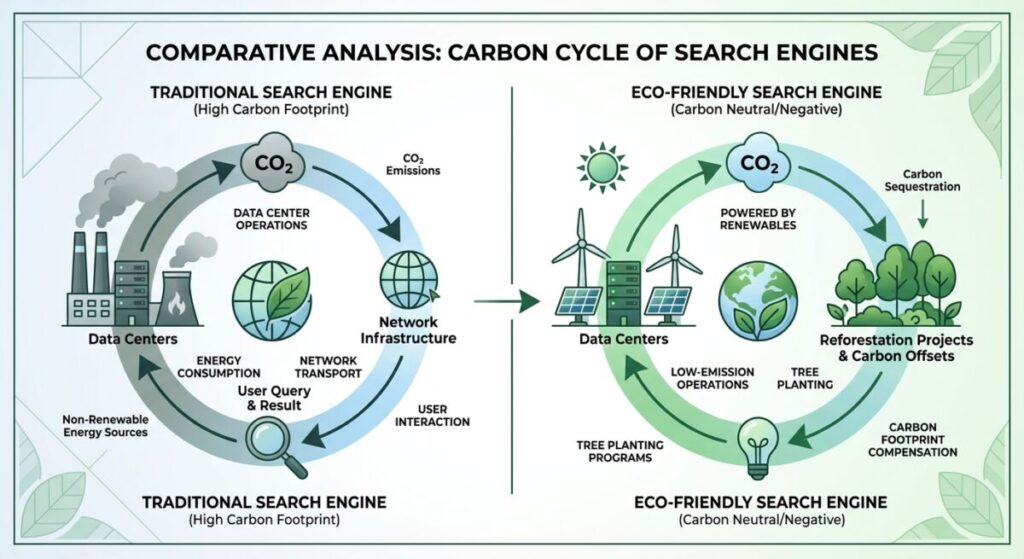
It sounds like a scam, right? Search the web, plant a tree? But the math is actually quite basic. When you click on a sponsored link (an ad) at the top of your search results, the advertiser pays the search engine. Most companies pocket that profit. Eco-friendly engines take a majority percentage of that profit and send it to planting partners like the Eden Reforestation Projects.
Even if you never click an ad, your search contributes to the platform's scale. More users mean more advertisers. More advertisers mean higher ad prices. Higher prices mean more trees. It is a virtuous cycle. But keep in mind, if you are looking for total privacy while doing this, you should compare these to the best private search engines for total anonymity in 2026, as green engines still need some data to serve relevant ads.
Comparing Search Quality: Will You Actually Find What You Need?
Let us be real. If the search results suck, you will switch back to Google in five minutes. We tested 100 common queries across these platforms in March 2026. Here is what we found. For local searches — like "coffee shop near me" — Ecosia and Search For Trees are nearly identical to the big players. They have mapped out local businesses effectively.
For technical or coding queries, there is still a slight lag. You might need to try a second search once in a while. But for 95% of what a general audience does? These green engines are more than capable. Why settle for a search engine that only takes your data when you can have one that gives back to the earth?
The Environmental Impact of Your Search
Did you know that a single Google search emits about 0.2 grams of CO2? That does not sound like much. But multiply that by billions of searches every day. It is a catastrophe. By using a green search engine in 2026, you are not just offsetting that 0.2 grams. You are neutralizing your entire digital existence. A mature tree can absorb about 22 kilograms of CO2 per year. One tree planted via your searches covers your browsing for a lifetime.
Choosing the Right One for Your Lifestyle
Are you a privacy nut? Go with Ecosia. They do not sell your data to advertisers. Are you a Google addict? Choose Search For Trees. Do you want the latest 2026 AI-assisted search features? TreeSprout is your best bet. There is no longer an excuse to use a "neutral" search engine when active positive alternatives exist right in front of you.
The choice is yours. But remember, every search is a vote for the kind of world you want to live in. Why not vote for a world with more forests? It is the easiest change you will ever make in your digital life.
Frequently Asked Questions
Which eco-friendly search engine plants the most trees? Ecosia is currently the leader in total trees planted, with over 210 million trees as of March 2026. Their long-standing infrastructure allows them to maintain a high planting volume across multiple continents.
Is Ecosia better than Google for privacy? Yes, Ecosia is significantly better for privacy because they do not create permanent personal profiles of users or sell your data to third-party advertisers. They also anonymize all searches within one week to protect your identity.
How many searches does it take to plant one tree? On average, it takes about 45 to 50 searches to generate enough ad revenue to plant one tree. This number can vary based on whether you click on sponsored links or use an ad blocker.
Do these search engines cost money to use? No, all eco-friendly search engines mentioned are completely free for the user. They generate their revenue through traditional search advertising, just like Google or Bing.
Can I use these search engines on my phone? Absolutely, most green search engines like Ecosia and OceanHero have dedicated apps for iOS and Android. You can also set them as your default search engine in Chrome or Safari settings.
Are the search results as good as Google? Search For Trees uses Google’s own index, so the results are identical. Ecosia uses Bing’s index, which is highly accurate for general queries but may differ slightly on very technical topics.
Is OceanHero different from Ecosia? Yes, OceanHero focuses on recovering plastic from the ocean rather than planting trees. For every five searches you perform, they recover the equivalent of one plastic bottle from the sea.
What is the newest green search engine in 2026? TreeSprout is the most notable new entry in 2026, offering a unique multi-index search and an integrated eco-shopping assistant. It aims to broaden the scope of digital environmentalism beyond just reforestation.
Start Your Green Search Journey Today
Making the switch is the simplest way to contribute to global reforestation efforts. You do not have to change your habits. You do not have to spend money. You just have to change a single setting in your browser. At Infineural Technologies, we believe that small digital changes lead to massive physical results. If you are ready to optimize your entire digital presence for the modern era, contact us today to see how we can help your brand grow sustainably in 2026.