
Stop Looking for Rare Videos on YouTube
You probably think YouTube has everything. It doesn't. In fact, as we move through 2026, YouTube's algorithm has become even more focused on mainstream, brand-safe content. If you are looking for an obscure documentary from 1998, a deleted news clip, or a niche technical tutorial, you are looking in the wrong place. The bottom line? To find rare content today, you must use specialized crawlers that index the deep web and decentralized servers. Platforms like Petey Vid, the Internet Archive, and PeerTube are the real heavy hitters for finding what Google hides.

At Infineural Technologies, we've seen how difficult it can be to source unique visual assets for high-level digital marketing campaigns. Most people give up after the second page of Google Videos. But the pros? They know that the "hidden" video web is actually ten times larger than what you see on your mobile feed. And if you want to stay ahead of the curve, you need to master these alternative tools. If you want to see how these fit into the broader search market, check out our Top Search Engines List: 12 Best Platforms for Traffic (2026).
The Problem with Mainstream Video Algorithms in 2026
Why is it so hard to find the good stuff? It comes down to money. Big platforms prioritize high-retention, high-ad-value content. That rare 10-minute clip of a 1970s architecture lecture doesn't make them money. So, they bury it. But it's not just about profit. Copyright bots in 2026 have become aggressive. They often flag and remove historical or educational content that technically falls under fair use. This creates a massive gap in the market for users who need specific, hard-to-find footage.
Have you ever searched for a video you know existed only to find a "Video Unavailable" message? It's frustrating. But those videos often live on elsewhere. They are mirrored on private servers or indexed by engines that don't care about Google's censorship rules. This is where private search engines come into play, offering a way to find content without the filter bubble.
1. Petey Vid: The King of Video Diversity
If I had to pick one tool for 2026, it would be Petey Vid. Why? Because it doesn't just crawl YouTube. It indexes over 60 different video hosting platforms. This includes niche sites like Bitchute, Rumble, and even older archives that most people forgot about. It is built on the principle of information diversity. When you search here, you aren't getting what an algorithm thinks you like. You are getting what actually exists across the web.
In our tests at Infineural Technologies, Petey Vid consistently surfaced content that was completely missing from Google's video tab. For example, search for "early 2000s flash animation archives" on Google and you get modern tributes. Search on Petey Vid and you get the original files. It's a night and day difference. But remember, because it is so broad, you need to use specific keywords. Don't be vague. Tell the engine exactly what you want.
2. The Internet Archive (Wayback Machine for Video)
The Internet Archive is the closest thing we have to a digital Library of Alexandria. By March 2026, its video collection has grown to over 15 million items. This isn't just "web video." We are talking about digitized 16mm films, old television broadcasts, and entire collections of government footage. If it is old and it was recorded, it is probably here. And the best part? It is almost all free to use for research.
But there is a trick to using it. The internal search can be clunky. You shouldn't just type a word and hope for the best. Use the "Advanced Search" feature. Filter by year, creator, or original format. This is how you find the rare gems. For instance, we recently helped a client find 1980s Japanese tech commercials for a retro-themed campaign. We didn't find them on YouTube. We found them in the "Community Video" section of the Internet Archive. It is a goldmine if you have the patience to dig.
3. PeerTube and Decentralized Discovery
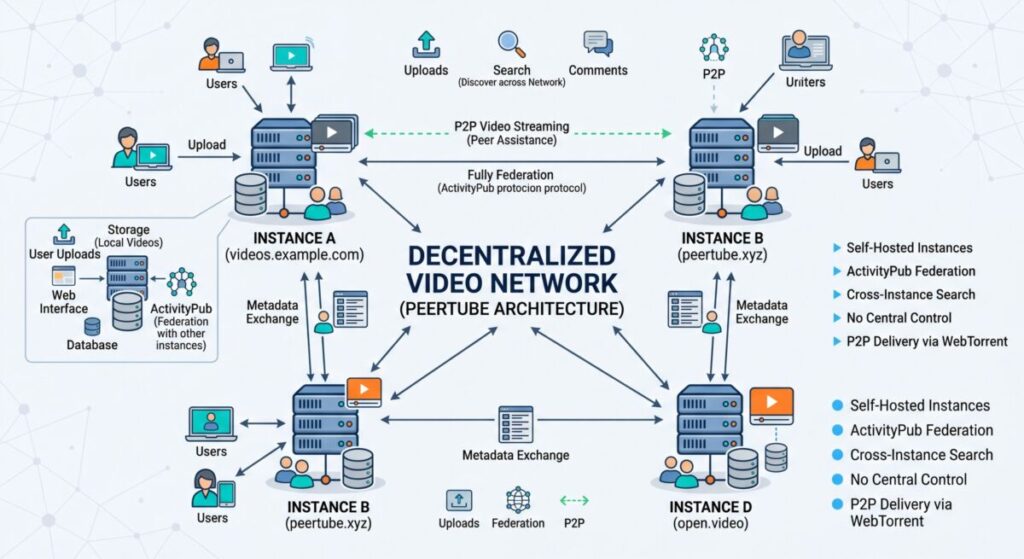
We can't talk about 2026 without mentioning Web3 and decentralized hosting. PeerTube is a federated platform. This means it isn't one big site; it's thousands of small servers (instances) that talk to each other. This makes it incredibly hard to censor. Rare content thrives here because nobody can "delete" a video from the entire network at once. If you are interested in how this works, you should read our guide on how to use decentralized search engines for Web3 browsing.
The challenge is searching across all those instances. You need a global PeerTube indexer. These tools allow you to search the entire "Fediverse" for video content. It is the best place to find independent journalism, niche hobbyist videos, and technical deep-dives that have been de-platformed elsewhere. But be warned: the interface isn't as polished as what you're used to. It's raw. But isn't that where the best content usually lives?
4. Baidu and Yandex: The International Perspective
Sometimes "rare" just means "not in English." If you are only searching in English, you are missing 70% of the internet. In 2026, AI translation has made it easy to watch videos from anywhere. So, why not search where the rest of the world uploads? Yandex is particularly powerful for finding video content that has been removed from Western platforms due to DMCA requests. Their crawlers are much more permissive.
And don't ignore Baidu for technical or manufacturing videos. Many of the world's most detailed "how-to" videos for hardware are hosted on Chinese platforms like Bilibili, which Baidu indexes perfectly. You might find a rare repair guide for a piece of 2024 tech that simply doesn't exist on the English-speaking web. Use a translation tool to type your query and see what happens. The results will surprise you.
5. AI-Powered Semantic Video Search
By March 2026, a new category of search engine has emerged. These don't just look at titles and tags. They use AI to "watch" the video and index the actual frames. This is a massive leap forward for finding rare content. Imagine searching for "blue car driving through a desert at sunset" and finding a three-second clip buried inside a two-hour unlabelled vlog. That is now possible.
Tools like Twelve Labs or specialized AI video crawlers are becoming the standard for professional researchers. They allow for semantic search. You don't need the right keywords; you just need to describe the scene. This technology is still maturing, but it is already the most effective way to find specific visual data that was never properly captioned. It is a total shift in how we discover media.
How to Verify Rare Video Sources
Finding the video is only half the battle. You also have to make sure it's authentic. In the age of AI-generated content (even in 2026), deepfakes are everywhere. When you find a "rare" clip on an obscure engine, check the metadata. Look for the original upload date. Use reverse image search on specific frames to see if the video has appeared elsewhere under a different context. Trust, but verify.
At Infineural Technologies, we recommend using a multi-engine approach. Don't rely on just one. Cross-reference your findings across Petey Vid and the Internet Archive. If the same clip appears in multiple independent archives, the odds of it being authentic are much higher. This is the same level of due diligence we apply when looking for hidden keyword opportunities. It's all about finding the data others are too lazy to look for.
Frequently Asked Questions
What is the best search engine for deleted YouTube videos?
The Internet Archive's Wayback Machine is your best bet, as it often saves snapshots of video pages. Additionally, Petey Vid may still have the video indexed if it was mirrored on an alternative platform before deletion.
Are alternative video search engines safe to use?
Most are safe, but engines like Yandex or obscure PeerTube instances may have fewer filters for malicious ads. Always use a secure browser and an updated antivirus when exploring less mainstream sites.
How can I search for videos by their content rather than titles?
Use AI-powered semantic search tools like Twelve Labs which index the actual visual frames of a video. In 2026, these tools allow you to describe a scene in natural language to find matching footage.
Why don't rare videos show up on Google?
Google prioritizes high-authority sites and content that meets strict community guidelines and copyright standards. Obscure, old, or controversial videos often lack the SEO signals or "safety" scores Google requires for high ranking.
Is it legal to download rare videos from these engines?
It depends on the license of the specific video; many on the Internet Archive are in the public domain. Always check the Creative Commons status or copyright notice before downloading or reusing any content.
Can I find rare videos on social media search?
Yes, platforms like X (formerly Twitter) and TikTok have massive amounts of raw, unindexed video. However, their internal search is often limited to recent posts, making them poor for historical research.
What is a federated video platform?
A federated platform like PeerTube consists of many independent servers that share data and search results. This decentralized structure prevents any single entity from controlling or deleting all the content on the network.
How do I find high-quality versions of old, rare videos?
Look for specialized archives like the Library of Congress or film-specific repositories that offer high-bitrate digitizations. Many AI upscaling tools in 2026 can also help improve the quality of a low-resolution find.
The Bottom Line for Your Content Strategy
Finding rare content isn't just about being a good "googler." It is about knowing the map of the digital world. In 2026, the best information is fragmented. It is hidden in decentralized nodes and international databases. If you are a marketer, a researcher, or just someone who hates being told what to watch, these tools are your secret weapon. Don't settle for what the algorithm feeds you. Go out and find the truth yourself.
Do you need help navigating the complex world of search and digital discovery? At Infineural Technologies, we specialize in advanced search strategies that go beyond the basics. Whether you are looking for rare data or trying to rank for the most competitive keywords, we have the expertise to get you there. Reach out to us today and let's build something that stands out.